




Section 2: Outcomes and planned performance
2.1 Outcomes and performance information
The Government requires agencies to measure their intended and actual performance by outcomes. Government outcomes are the results, impacts or consequences of actions by the Government on the Australian community.
Each of the Treasury's outcomes is described by output groups, with performance indicators and targets used to assess and monitor the Treasury's performance in achieving government outcomes.
2.1.1 Outcome 1: Sound macroeconomic environment
A sound macroeconomic environment is an essential foundation for strong sustainable economic growth and the improved wellbeing of Australians. It is characterised by stable prices, low interest rates, healthy employment growth and a sustainable external position.
As many influences on macroeconomic outcomes are beyond the Government's control, policy aims to improve prospects for the Australian economy rather than target specific outcomes or major economic indicators. Success is more about improving Australia's medium to long‑term performance compared to its past and compared to other countries than the results of any one year.
Outcome 1 strategy
The Treasury contributes to a sound macroeconomic environment by providing high quality macroeconomic policy advice to the Treasurer, based on careful monitoring and analysis of economic conditions in Australia and overseas.
The Treasury also provides advice to the Government on a range of international policy challenges, including strengthening multilateral regimes underpinning open trade and capital flows, supporting developing countries development aspirations, and shaping the evolution of regional economic architecture.
In 2008‑09, the Treasury will provide advice on:
- domestic and international developments affecting the Australian economy and forecasts of the direction of the Australian and international economies;
- the setting of sound macroeconomic policies;
- housing affordability, as part of the Treasury and Department of the Prime Minister and Cabinet's leadership role in delivering the COAG Reform Agenda;
- policies likely to improve Australia's economic growth potential and wellbeing, including improved understanding of the impact of changes in workforce participation and productivity on future growth and fiscal pressures;
- work with others to reform, strengthen and modernise key international forums (including the World Bank, International Monetary Fund (IMF), Organisation for Economic Cooperation and Development (OECD), and Asian Development Bank (ADB));
- the Treasury's key role in shaping the Group of Twenty (G‑20), the Asia Pacific Economic Cooperation (APEC) forum , and the East Asia Summit process;
- deeper economic engagement strategies with China and India, reflecting the importance of these countries in the international economy, and building on already close links with policy makers in other key East Asian countries, including Japan and Indonesia;
- the work with Indonesian Government counterparts in support of their reform efforts under the $50 million Government Partnerships Fund, a key component of the $1 billion Australia‑Indonesia Partnership for Reconstruction and Development;
- the lead role the Treasury can play in government initiatives to develop well functioning economic ministries in the Pacific, particularly in Papua New Guinea, Solomon Islands and Nauru, and advising Treasury ministers in various Pacific Ministerial Forums; and
- high quality, strategic policy support to selected countries in the Asia‑Pacific region.
Outcome 1 resource statement
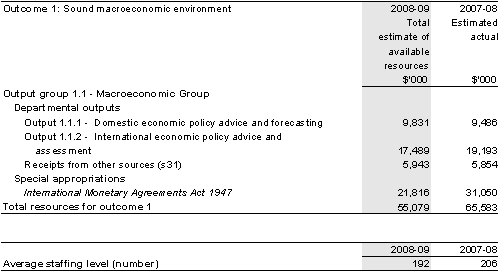
Table 2.1.1 details budget appropriations and the total resourcing for outcome 1.
Table 2.1.1: Total resources for outcome 1
Note: Departmental splits, by output, are indicative estimates and may change in the course of the budget
year as government priorities change.
Contributions to outcome 1
| Output group 1.1 — Macroeconomic Group | |
|---|---|
Components of output group 1.1 are: Special appropriation — International Monetary Agreements Act 1947.
Administered item — subscriptions to international financial institutions.
Output 1.1.1 — Domestic economic policy advice and forecasting; and Output 1.1.2 — International economic policy advice and assessment. |
|
| Key performance indicators | 2008‑09 target |
Advice meets the Government's needs in administering its responsibilities and making and implementing government decisions that contribute to a sound macroeconomic environment and relate to international economic and financial issues. The degree of client satisfaction with the quality and timeliness of the advice provided will be assessed through formal and informal feedback mechanisms. |
Policy advice is timely and high quality, and based on a deep understanding of issues and a whole-of-government and whole‑of‑economy perspective. It is influential in the Government's decision making and longer term strategies on macroeconomic policy and international economic issues. |
Effective presentation of budget documents and other publications adequately informs public debate. |
Budget and Mid‑Year Economic and Fiscal Outlook documentation and the quarterly publication of the Economic Roundup are timely and high quality. |
Progress made on the COAG Reform Agenda meets the expectations of the Commonwealth and States agreed at the December 2007, March 2008 and subsequent meetings. |
Leadership and policy expertise meets the targets established by COAG at its quarterly meetings for the COAG Working Group on housing. |
Effective participation in international forums and bilateral dialogue supports the achievement of government objectives. |
Representation by Treasury officials at the IMF, World Bank, OECD, ADB, G‑20 and APEC meetings is influential. |
Advice to Ministers is effective in improving economic governance and policies and building capacity in Papua New Guinea, Solomon Islands and Nauru. |
Advice to Treasury Ministers on Pacific issues is timely and influential. |
Support is effective for Pacific programs — the Strongim Gavman Program in Papua New Guinea, Regional Assistance Mission to Solomon Islands and Economic Advice and Governance Assistance Program in Nauru. |
Assessment that relevant components meet/exceed satisfactory ratings as assessed under performance evaluation systems (for example, Australian Agency for International Development (AusAID) implementation quality system). |
Payment of subscriptions to international financial institutions, including the IMF is timely and accurate. |
Financial transactions with the international financial institutions, including the IMF, are timely and accurate and made with due regard to minimising cost and risk for Australia. |
2.1.2 Outcome 2: Effective government spending arrangements
Effective government spending arrangements contribute to the overall fiscal outcome, influence strong sustainable economic growth and improve the wellbeing of Australians.
Effective spending measures should meet their stated objectives, minimise behavioural distortions and deliver significant economic and other benefits compared with costs.
The Treasury provides policy advice to portfolio ministers to promote government decisions that further these objectives.
Outcome 2 strategy
The Treasury takes a whole‑of‑government and whole‑of‑economy perspective in developing its advice on the fiscal strategy and spending arrangements across and within portfolios.
In 2008‑09, the Treasury will provide advice on:
- the fiscal strategy, including for the medium‑term, and on budget priorities, debt and balance sheet management consistent with the fiscal strategy. This includes advising on the operation of the Future Fund, implementing the new Funds announced in the Budget, and contributing to the Review of Government Spending;
- the Commonwealth Budget and related financial papers;
- leadership and policy expertise to deliver the COAG Reform Agenda agreed in December 2007. For outcome 2, this will be undertaken more particularly with respect to the agendas for the Working Groups on health and ageing, productivity, climate change and water, and Indigenous reform;
- leadership and policy expertise to enable Commonwealth and State Treasurers to finalise a new Intergovernmental Agreement on Commonwealth‑State financial arrangements on the basis agreed by COAG on 26 March 2008; and
- market mechanisms and frameworks to achieve environmental outcomes, including modelling climate change, and contributing to the design of an Emissions Trading System, for implementation by 2010 and a system of Mandatory Renewable Energy Targets by 2020.
Outcome 2 resource statement
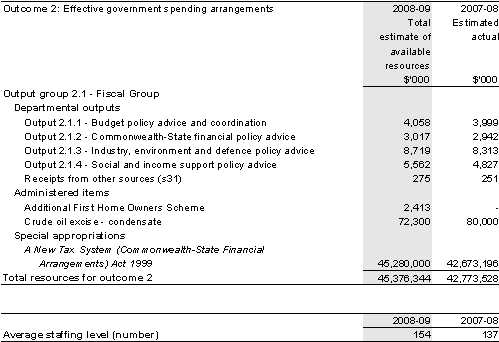
Table 2.1.2 details budget appropriations and the total resourcing for outcome 2.
Table 2.1.2: Total resources for outcome 2
Note: Departmental splits, by output, are indicative estimates and may change in the course of the budget year as government priorities change.
Contributions to outcome 2
Output group 2.1 — Fiscal Group | |
|---|---|
Components of output group 2.1 are: Administered item — Additional First Home Owners Scheme.
Administered item — crude oil excise — condensate.
Special appropriation — A New Tax System (Commonwealth-State Financial Arrangements) Act 1999.
Output 2.1.1 — Budget policy advice and coordination; Output 2.1.2 — Commonwealth-State financial policy advice; Output 2.1.3 — Industry, environment and defence policy advice; and Output 2.1.4 — Social and income support policy advice. |
|
| Key performance indicators | 2008‑09 target |
Advice meets the Government's needs in administering its responsibilities and making and implementing government decisions on fiscal and budget strategy and spending arrangements, including its longer term strategies. The degree of client satisfaction with the quality and timeliness of the advice provided will be assessed through formal and informal feedback mechanisms. |
Policy advice is timely and high quality, and based on a deep understanding of issues and a whole-of-government and whole‑of‑economy perspective. It is influential in the Government's decision making and longer term strategies on fiscal and budget strategy, and spending arrangements. |
Timely, high quality, accurate and transparent Budget reports, Mid-Year Economic and Fiscal Outlook and Final Budget Outcome documents meet the Government's expectations. The budget preparation and coordination process is subject to an annual evaluation. |
Budget, Mid-Year Economic and Fiscal Outlook and Final Budget Outcome documentation is timely and high quality. |
Progress made on the COAG Reform Agenda meets the expectations of the Commonwealth and States agreed at the December 2007, March 2008 and subsequent meetings. |
Leadership and policy expertise meets the targets established by COAG at its quarterly meetings for COAG Working Groups on health and ageing, productivity, climate change and water, and Indigenous reform. Leadership and policy expertise enables COAG to finalise the architecture of Commonwealth-State financial relations. |
Advice meets the Government's needs in making and implementing government decisions on environmental issues. The degree of client satisfaction with the quality and timeliness of the advice provided will be assessed through formal and informal feedback mechanisms. |
Contribution to the Garnaut Climate Change Review, including through provision of climate change modelling, to be finalised in September 2008. Work influentially with other Commonwealth and State agencies on the design and implementation of an Emissions Trading System and a system of Mandatory Renewable Energy Targets. |
For the administered and special appropriation items, accurate calculation of payments to State and Territory Governments are made according to the agreed formulae. |
Payments to State and Territory Governments are made according to agreed schedules. |
2.1.3 Outcome 3: Effective taxation and retirement income arrangements
Effective taxation and retirement income arrangements contribute to the overall fiscal outcome and influence strong sustainable economic growth and the improved wellbeing of Australians.
Tax measures should meet revenue objectives (or other public policy objectives) and have regard to the principles of economic efficiency, horizontal and vertical equity and transparency whilst minimising compliance and administrative costs. By meeting these objectives, tax measures contribute to wellbeing, either directly or by providing the revenue base to finance government services.
The Treasury provides policy advice to government to promote government decisions that further these objectives.
Outcome 3 strategy
The Treasury takes a whole‑of‑government and whole‑of‑economy perspective in developing its tax and retirement income policies.
In 2008‑09, the Treasury will provide advice on:
- implementation of government election commitments, including introducing an education tax refund and first home saver accounts, and establishing an optional superannuation clearing house facility;
- the Government's comprehensive review of Australia's tax system;
- progress of the National Reform Agenda agreed to by COAG, in particular with respect to the housing, water, business regulation and competition working groups;
- development of quantitative modelling to identify the labour force participation effects of government policy proposals, including tax changes;
- obligations under the Charter of Budget Honesty Act 1998;
- review and renegotiation of tax treaties with key investment partners, tax information exchange agreements with offshore financial centres, Australia's contribution to the tax policy work of the OECD and the program of reform of Australia's international tax arrangements; and
- processes and outputs in developing advice on tax and retirement income policies (including implementing the outcomes of the review by the Tax Design Review Panel into ways to streamline and enhance tax law changes).
Outcome 3 resource statement
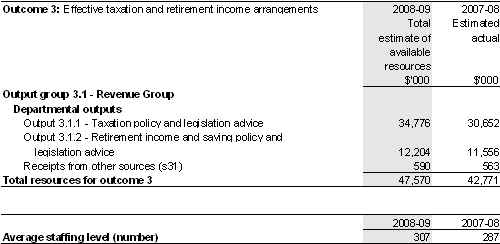
Table 2.1.3 details budget appropriations and the total resourcing for outcome 3.
Table 2.1.3: Total resources for outcome 3
Note: Departmental splits, by output, are indicative estimates and may change in the course of the budget year as government priorities change.
Contributions to outcome 3
Output group 3.1 — Revenue Group | |
|---|---|
Components of output group 3.1 are: Output 3.1.1 — Taxation policy and legislation advice; and Output 3.1.2 — Retirement income and saving policy and legislation advice. | |
| Key performance indicators | 2008‑09 target |
Advice meets the Government's needs in administering its responsibilities, and making and implementing decisions on tax policy and legislation and on retirement income and savings policy and legislation. The degree of client satisfaction with the quality and timeliness of the advice provided will be assessed through formal and informal feedback mechanisms. |
Policy advice is timely, and high quality to enable the Government to make informed decisions on tax policy and legislation and on retirement income and savings policy and legislation. Advice includes business, personal, international and indirect taxation and involves extensive consultation. It is influential in the Government's decision making and longer term strategies. |
Effective presentation of relevant information, including budget documentation and other publications, adequately informs public debate. |
Documentation is timely and high quality. Budget publications are available free on the Internet. Widespread access to documents helps keep the public informed. |
Tax, retirement income and savings policy law is developed in accordance with the principles of good law design. |
An increasing number of tax and superannuation measures will be designed using a principles-based approach. On a majority of measures, stakeholders will be consulted. At least one post-implementation review will be undertaken annually to ascertain, among other things, how to improve the law development process. |
Legislation is delivered according to government priorities. |
Budget and other announcements on tax, retirement income and savings policy are implemented. The majority of prospective tax and retirement income legislation will be ready to introduce into Parliament within twelve months of the Government announcing it. The majority of retrospective legislation will be ready to introduce into Parliament within six months of the Government announcing it. Revenue Group will put in place arrangements to ensure legislation is delivered according to government priorities. |
2.1.4 Outcome 4: Well functioning markets
Well functioning markets contribute to improving national productivity and promoting stronger economic growth, which enhances the living standards of all Australians.
Well functioning markets enable the most efficient use of resources and maximises consumer confidence in markets, thereby enhancing community benefits from economic activity.
Outcome 4 strategy
The Treasury provides advice on policies that promote competitive, efficient markets and that work to enhance consumer wellbeing, a secure financial system and sound corporate practices, and foreign investment consistent with Australia's national interest.
In 2008‑09, the Treasury will provide advice on:
- measures to promote competition in the financial system including strategies to enhance consumers' ability to switch between banking providers, and to enhance disclosure of penalty fees;
- major projects on financial services reform, including simplifying product disclosure and transferring responsibility from the States and Territories to the Commonwealth for the regulation of mortgages, margin loans and trustee corporations;
- a facility to rationalise financial products and progress policy projects on director liability, corporate responsibility and corporate reporting;
- reforms to strengthen financial system stability, expansion of Australia's export of financial services, promotion of competition in banking, superannuation and insurance, improved payment systems and ongoing access and affordability issues in insurance;
- international cooperation in financial system regulation, corporate governance, financial reporting, auditing and corporate insolvency including developing further regulatory recognition and cooperation with, in particular, the United States and New Zealand;
- the reform agenda for competition policy, including implementing criminal offences for serious cartel conduct;
- implementation of the COAG reform agenda (particularly competition and regulatory reform) and microeconomic reforms in key infrastructure markets such as energy, transport and communications;
- the Government's response to the Productivity Commission's review of the Australian consumer policy framework and reforms delivering a nationally harmonised consumer product safety system;
- Australia's foreign investment policy, including advice on reforms to the existing framework, as well as international investment and trade policy issues. In providing advice on the design and administration of Australia's foreign investment framework, the Treasury will improve the efficiency and effectiveness of existing regulation by providing advice on the appropriateness of existing legislative and policy provisions, as well as on operational processes for the handling of individual foreign investment applications;
- work with the Foreign Investment Review Board and other stakeholders to ensure foreign investment analysis and advice to the Government is appropriately coordinated, particularly in relation to major foreign investment proposals that have potential significance for Australia's national interest; and
- representation of Australia's interests on investment issues in negotiating free trade agreements and in multilateral forums such as the OECD and APEC. This includes promoting the OECD Guidelines for Multinational Enterprises to businesses operating in and out of Australia. The Treasury will participate in specific work aimed at improving investment climates in the Asia‑Pacific region.
The Treasury will also:
- continue to provide services to support a range of portfolio bodies. This work includes providing secretariat services and, in some cases, maintaining day‑to‑day operations;
- serve as the lead agency for Standard Business Reporting which will simplify and reduce the burden of business‑to‑government financial reporting; and
- support the operations of the Australian Government Actuary.
Outcome 4 resource statement
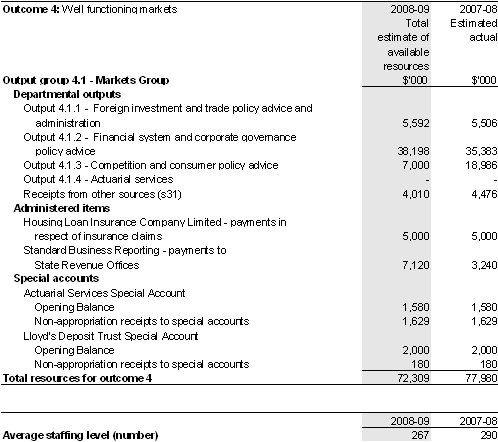
Table 2.1.4 details Budget appropriations and the total resourcing for outcome 4.
Table 2.1.4: Total resources for outcome 4
Note: Departmental splits, by output, are indicative estimates and may change in the course of the budget year as government priorities change.
Contributions to outcome 4
Output group 4.1 — Markets Group | |
|---|---|
Components of output group 4.1 are: Administered item — Housing Loans Insurance Company Limited — payments in respect of insurance claims.
Administered item — Standard Business Reporting — payments to State Revenue Offices.
Administered item — HIH Claims Support Scheme — payment of assistance.
Output 4.1.1 — Foreign investment and trade policy advice and administration; Output 4.1.2 — Financial system and corporate governance policy advice; Output 4.1.3 — Competition and consumer policy advice; and Output 4.1.4 — Actuarial services. | |
| Key performance indicators | 2008‑09 target |
Advice meets the Government's needs in administering its responsibilities, and making and implementing decisions on policy that supports well functioning markets. The degree of client satisfaction with the quality and timeliness of the advice provided will be assessed through formal and informal feedback mechanisms. |
Policy advice is timely and high quality, and based on a deep understanding of issues and a whole-of-government and whole‑of‑economy perspective to enable the Government to make informed decisions that support well functioning markets. It is influential in the Government's decision making and longer term strategies. |
Effective presentation of relevant information, including publications, adequately informs public debate. |
Documentation is timely and high quality. Markets Group's publications are available free on the Internet. Widespread access to documents helps stakeholders to keep informed on issues relating to well functioning markets. |
Progress made on the COAG Reform Agenda meets the expectations of the Commonwealth and States agreed at the December 2007, March 2008 and subsequent meetings. |
Leadership and policy expertise meets the targets established by COAG at its quarterly meetings for each COAG Working Group. |
Statutory and other procedural, administrative and reporting requirements are met. |
All statutory, procedural and administrative requirements are met on time and in full. |
Secretariat and executive services provided to advisory and external bodies are effective. |
Services provided meet the reasonable expectations of the advisory and external bodies. |
Representation and/or liaison by Treasury officers with other agencies, private sector organisations and international bodies is effective. |
Agencies, organisations and bodies have a better understanding of the requirements for a well functioning financial system, sound corporate practices and financial reporting and effective regulation for corporations and financial services. |
Government policy is appropriately represented and Australia's negotiating position is pursued effectively in international forums. |
The community understands and complies with Australia's foreign investment policy framework, as evidenced by the maintenance of a low level of Interim and Final Orders or prosecution actions. |
Treasury implements Australia's foreign investment policy framework efficiently and effectively. |
Most foreign investment proposals are decided within 30 days of lodgement. |
Efficient provision of high quality actuarial services with income from consultancy fees relative to total costs meeting specified quantitative criteria. |
The financial position of the Australian Government Actuary special account at 30 June 2009 is sound. |
If www.budget.gov.au responds slowly or you are having trouble downloading a document, try one of the Budget Website Mirrors
Note: Where possible, Budget documents are available in HTML and for downloading in Portable Document Format(PDF). If you require further information on any of the tables or charts on this website, please contact Treasury.