




Statement 1: Budget Overview
Fiscal outlook
As a result of the deteriorating global economic conditions, the Budget deficit is expected to be substantially larger than forecast in the February 2009 Updated Fiscal and Economic Outlook (UEFO).
Table 2: Budget aggregates

- Excludes expected Future Fund earnings.
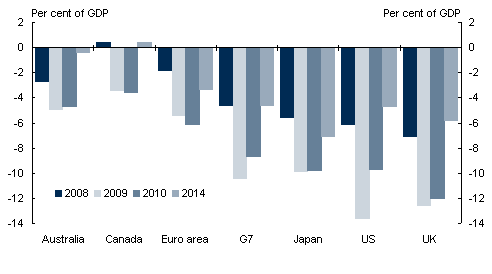
An underlying cash deficit of $57.6 billion or 4.9 per cent of GDP is expected in 2009‑10, compared with an estimated deficit of $35.5 billion or 2.9 per cent of GDP at the UEFO. In accrual terms, a fiscal deficit of $53.1 billion or 4.5 per cent of GDP is estimated for 2009‑10 compared with $33.3 billion or 2.8 per cent of GDP at the UEFO. This is significantly lower than the 8.8 per cent of GDP collective budget deficit for advanced economies as a whole, and less than half that of the major advanced economies at 10.4 per cent (Chart 2).
Chart 2: Budget balance positions for selected countries
Source: IMF World Economic Outlook April 2009, Chapter 2 supplemental tables.
The budget deficit is a direct consequence of the global recession, which has had a substantial impact on tax revenues. Combined with payment variations, these downgrades represent around two‑thirds of the total decrease in the underlying cash balance over four years since the 2008‑09 Budget, and more than three‑quarters of the decrease in 2010‑11 and 2011‑12.
Since the 2008‑09 Budget, taxation receipt estimates have been revised downwards by $23 billion in 2008‑09, $49 billion in 2009‑10, $55 billion in 2010‑11, and $47 billion in 2011‑12 (a total of $173 billion). The 2008‑09 estimate represents the biggest one‑year downward revenue revision to taxation receipts in Australia since 1930‑31 at the height of the Great Depression.
This Budget reports taxation receipt estimates for 2012‑13 for the first time. These estimates are considerably less than they would have been a year ago. Adding potential downward revisions to the 2012‑13 estimates, the total downward revisions to taxation receipts across the forward estimates would be around $210 billion.
Cumulatively, the revisions are equal to almost wiping out the revenue windfalls from the terms of trade boom since the 2005‑06 Budget.
Initially, the effects of the global financial crisis were seen most strongly in lower equity and commodity prices, reducing business profits and investment income, which flowed through to lower company and capital gains tax receipts. As the crisis has progressed, wage, employment and consumption growth has slowed, reducing receipts from individuals' income tax, GST and other consumption taxes significantly.
During these tough economic times, it is critically important that the Government's fiscal stance supports the economy and jobs. The net measures in the Budget raise the level of GDP by ¾ of a per cent in 2009‑10. This support is temporary in nature, phasing out as the economy recovers.
As the global recession impacts on revenues and spending, it becomes necessary to borrow funds that can be repaid when conditions improve. A temporary deficit, along with temporary borrowing, is the only responsible course of action. The alternative would require significant spending cuts or tax increases, which would inevitably precipitate a deeper and more protracted downturn, and much higher unemployment.
The Government is committed to taking action to return the budget to surplus as the economy recovers, and has outlined a clear strategy to achieve this.
- Tax receipts will recover naturally as the economy strengthens.
- The Government will hold real growth in spending to 2 per cent per annum to expedite the return to surplus once economic growth returns to above‑trend levels.
The Government has engaged strict spending discipline by finding structural budget savings. This strategy is expected to see the deficit more than halve by the end of the forward estimates, and return the budget to surplus by 2015‑16.
The Government has engaged strict spending discipline with structural savings to offset the cost of key reforms. The Government will fully offset the impact of the pension increase delivered in this Budget by 2021‑22.
If www.budget.gov.au responds slowly or you are having trouble downloading a document, try one of the Budget Website Mirrors
Note: Where possible, Budget documents are available in HTML and for downloading in Portable Document Format(PDF). If you require further information on any of the tables or charts on this website, please contact The Treasury.