




Statement 1: Budget Overview
Secure and sustainable pension reform
In the 2008‑09 Budget, the Government committed to reform the pension system. Since that time, the scale of the global recession has highlighted the importance of the pension as a safety net for those most vulnerable in society. The Government has found room under difficult circumstances to deliver on its commitment, with substantial increases in pension payments, reform of the payments structure for pensioners, and more assistance for carers, at a cost of $16.0 billion over five years.
Sustainability of the pension is in everyone's interest. So to ensure we can afford a strong safety net now and into the future, particularly given the challenges of an ageing population, the Government has announced reforms across a range of areas including within the pension and broader retirement income system.
Strengthening the financial security of seniors, carers and people with disability
In May 2008, the Government commissioned an investigation into measures to strengthen the financial security of seniors, carers and people with disability. The findings of the Harmer Pension Review have been central in framing the reform of the pension system.
In reforming the pension system, the Government will deliver a new system with increased payments, incentives for workforce participation, and new pension income eligibility arrangements to ensure affordability.
The key finding of the Harmer review was that the rate of payment to single pensioners is too low. In response, the Government will increase the total value of the pension for singles by up to $1,689 per annum — an increase of $32.49 per week. From 20 September 2009, full‑rate single pensioners will receive an extra $30 per week in their base pension and an extra $2.49 per week in a new fortnightly supplement.
Under the new arrangements, the total value of the package of payments (pension plus supplements) for single pensioners will increase to two‑thirds of the couple combined package, and achieve a new pension benchmark for singles of 27.7 per cent of Male Total Average Weekly Earnings ― an increase of over 10 per cent from the current 25 per cent. This new benchmark will be protected by legislation.
The Government will increase the total value of the pension package for full‑rate couples by $527 per annum — an increase of $10.14 per couple per week ― payable fortnightly through a new Pension Supplement.
The Government will ensure that all pensioners benefit immediately from pension reform by providing a minimum increase in payments of $10.14 for single pensioners and couples combined. This, again, provides a focus on the needs of singles.
These measures will benefit recipients of the Age Pension, Disability Support Pension, Carer Payment, Veterans' Service Pension, Income Support Supplement and War Widow/ers Pension, Bereavement Allowance, and Wife and Widow B Pension, at a cost of $14.2 billion over four years.
To provide additional, ongoing assistance to carers, the Government will introduce a Carer Supplement of $600 per annum for Carer Payment recipients and an additional $600 per annum for Carer Allowance recipients for each eligible person in their care, at a cost of $1.8 billion over five years. These annual payments will provide ongoing financial certainty for carers which previous 'one‑off' lump‑sum payments did not. The Government will bring forward the 2009‑10 payments for both supplements to 2008‑09.
Simplifying the pension system
On top of the fortnightly base pension, pensioners currently receive a GST Supplement and Pharmaceutical Allowance (each paid fortnightly) as well as Telephone Allowance and Utilities Allowance (each paid quarterly). This structure is difficult to understand and leaves many pensioners unsure of their entitlements.
To simplify the system, the Government will combine these multiple payments into a single Pension Supplement which will be paid fortnightly. It will be increased by $2.49 per week for singles and $10.14 per week for couples combined. Simplifying the current system will greatly improve pensioners' ability to budget for their living expenses with confidence.
The Government will also significantly improve the flexibility of the payment options open to pensioners. Under the new arrangements, from 1 July 2010, pensioners will be able to choose to receive around half the value of the new Pension Supplement as either a quarterly or fortnightly payment, providing pensioners with the opportunity to structure their payments to better suit their needs.
The Government will also improve arrangements for pensioners to access advance payments through an increase in the maximum allowable advance and an increase in the number of times they can access advance payments in a year.
The Government will extend the new Pension Supplement to recipients of Partner Allowance, Widow Allowance and other income support recipients over Age Pension age.
The Government will also simplify the payment of allowances to self‑funded retirees by combining the existing Seniors Concession Allowance and Telephone Allowance into a new Seniors Supplement.
Single Commonwealth Seniors Health Card and Veteran's Gold Card holders will also receive an increase in their Seniors Supplement of $129 per year (the equivalent of $2.49 per week) to better reflect the costs of living alone.
Long‑term sustainability of the pension system
Australia, like most developed countries, is facing the challenge of an ageing population. When the Age Pension was introduced in 1909, around half the male population reached retirement age. Today, over 85 per cent of the male population reach retirement age and can expect to spend more than 7 years longer in retirement.
At the same time, the number of working‑age people to support every person aged 65 years and over is expected to more than halve over the next 40 years. This presents a major challenge to the long‑term sustainability of the pension system.
A key feature of the Government's pension reform package is the introduction of measures to improve the long‑term sustainability of the system. Central to this has been a review of the qualifying age for the Age Pension. To reflect improvements in life expectancy and to help counter the long‑term costs of demographic change, the Government will progressively increase the qualifying age for the Age Pension to 67 years, consistent with international developments and the findings of the Harmer Review. The Age Pension age will increase at a rate of six months every two years, beginning in 2017 and reaching 67 years in 2023.
The Government will also improve the long‑term sustainability of the system by reprioritising spending within the pension system.
From 20 September 2009, the Government will increase the rate at which the pension is withdrawn from 40 cents for each additional dollar of private income to 50 cents in the dollar. Reforms to the pension income test will save $1.2 billion over four years.
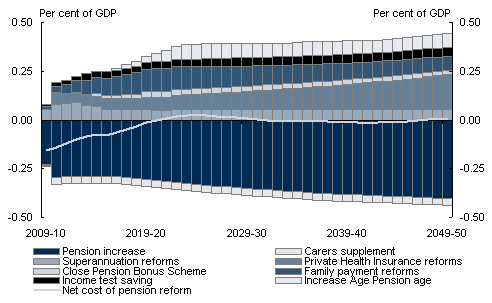
These and other changes mean that, despite the ageing of the population and the significant increase in assistance provided under the reform package, the Government will offset the cost of pension reform by 2021‑22.
Chart 3: Sustainability of pension reform
Supporting workforce participation — a new Work Bonus
The Harmer Review also found that direct incentives for paid work were better targeted to pensioners with limited resources and were more effective than the existing Pension Bonus Scheme. Accordingly, the Government will close the Pension Bonus Scheme to new entrants from 20 September 2009. Existing members of the scheme will continue to accrue entitlements under existing rules. This measure will save $58 million over five years, with substantial savings realised outside the forward estimates.
To improve incentives to undertake paid employment, the Government will introduce a Work Bonus that will discount 50 per cent of the first $500 of fortnightly employment income in determining pension entitlements — halving the rate at which pension is withdrawn. Pensioners can get a maximum benefit of $125 per fortnight from the Work Bonus.
A smooth transition to a new system
Around 70 per cent of existing pensioners — including all full‑rate pensioners — will be better off immediately under the new arrangements with its more generous MTAWE benchmark, and will move directly to the new system.
Other existing part‑rate pensioners will transition to the new arrangements when they provide a better outcome for them, having regard to the higher pension rates, new income test arrangements and benefits of the Work Bonus.
Importantly, these pensioners will continue to receive their existing entitlements, plus an additional $10.14 increase per week (singles and couples combined), all maintained in real terms, until the new system provides the better outcome.
Reforming the retirement income system
Australia's retirement income system comprises the Age Pension, compulsory superannuation and voluntary savings (including voluntary superannuation). The Government's retirement income reforms will deliver greater equity, and provide more support to those on the lowest incomes. To ensure Australia's retirement income system remains sustainable into the future, the Government will reduce the generosity of some superannuation concessions to those with greater private resources.
Under current arrangements, concessional superannuation contributions are taxed at the concessional rate of 15 per cent up to the concessional contributions cap. The concessional contributions cap is currently $50,000 per annum and the transitional cap (which applies until 30 June 2012 for those aged 50 or over) is $100,000 per annum.
From 1 July 2009, the Government will reduce the cap on concessional superannuation contributions from $50,000 to $25,000 (indexed), and the transitional cap from $100,000 to $50,000. From 2012‑13 those aged 50 years and over will be subject to the lower $25,000 (indexed) cap.
This measure is expected to affect approximately 170,000 individuals, 55 per cent of whom would be aged 50 or over. This represents only 4 per cent of those in the 50 plus age group who are making concessional contributions and only 1.6 per cent of the total population in this age group.
It is expected that 77,000 individuals aged less than 50 will be affected by the measure. This represents 1.1 per cent of those in the less than 50 age group who are making concessional contributions and only 0.8 per cent of the total population in this age group. This measure will result in savings of $2.8 billion over four years.
The Government will also temporarily reduce the matching rate of the superannuation co‑contribution (and maximum amount payable) that is paid on eligible personal superannuation contributions.
The co‑contribution matching rate will be reduced from 150 per cent to 100 per cent for contributions made between 1 July 2009 and 30 June 2012, and to 125 per cent for contributions made between 1 July 2012 and 30 June 2014. The co‑contribution matching rate will return to 150 per cent for contributions made from 1 July 2014. This temporary measure will result in savings of $1.4 billion over four years, while still providing significant incentives for low‑income earners to make personal superannuation contributions.
Fairer and more sustainable private health insurance incentives
Spending on the Private Health Insurance (PHI) rebate is growing rapidly, and without reform is expected to more than double to $9.3 billion per annum by 2019‑20. Expenditure on the rebate disproportionately favours those on higher incomes. By 2010‑11, it is expected that approximately 14 per cent of single tax filers with incomes above $75,000 will receive about 28 per cent of the total PHI rebate paid to singles. Similarly approximately 12 per cent of couple tax filers who have incomes above $150,000 will receive around 21 per cent of the total PHI rebate paid to couples.
Accordingly, the Government is rebalancing its suite of policies supporting private health insurance so that people with a greater capacity to provide for their own private health insurance do so. Higher income earners will face a more significant penalties for not holding private health insurance and will receive a lower (or no) rebate. The Government will continue to support low‑ and middle‑income earners who elect to take out private health insurance through the existing 30, 35 and 40 per cent private health insurance rebates.
Effective 1 July 2010, the Government will introduce three new 'Private Health Insurance Incentive Tiers' to better balance the mix of incentives for people to take out private health insurance. Existing arrangements will remain unchanged for singles with income of less than $75,000 per annum and families with incomes of less than $150,000 per annum. Income in this context refers to income for Medicare levy surcharge purposes.
- Tier 1 will apply to singles with income between $75,001 and $90,000 ($150,001 and $180,000 for families) based on current projections. The private health insurance rebate will be 20 per cent, increasing to 25 per cent at 65 years of age, and to 30 per cent at 70 years. The surcharge for not taking out complying private health insurance will remain at 1 per cent.
- Tier 2 will apply to singles with income between $90,001 and $120,000 ($180,001 and $240,000 for families). The private health insurance rebate will be 10 per cent, increasing to 15 per cent at 65 years of age, and to 20 per cent at 70 years. The surcharge for not taking out complying private health insurance will be increased to 1.25 per cent.
- Tier 3 will apply to singles with income of more than $120,000 (more than $240,000 for families). No private health insurance rebate will be provided. The surcharge for not taking out complying private health insurance will be increased to 1.5 per cent.
Overall, this measure is expected to deliver savings of $1.9 billion over five years and private health insurance coverage is expected to remain at more than 99 per cent of current levels. While out‑of‑pocket costs for private health insurance will increase for people who receive a lower rebate, the increase in the Medicare levy surcharge rate means that higher income earners will retain an incentive to take out private health insurance. When combined with income tax cuts commencing in July 2009 and July 2010, these changes to private health insurance are expected to leave all taxpayers better off (based on average premiums).
Table 4: Private health insurance arrangements
| Current surcharge thresdholds (projected 2010-11) |
Tier 1 | Tier 2 | Tier 3 | |
|---|---|---|---|---|
| Singles | $0 - $75,000 | $75,001 - $90,000 | $90,001 - $120,000 | $120,001+ |
| Families | $0 - $150,000 | $150,001 - $180,000 | $180,001 - $240,000 | $240,001+ |
| Medicare levy surcharge | nil | 1.00% | 1.25% | 1.50% |
| Private health insurance | ||||
| rebate | ||||
| Less than 65 years | 30% | 20% | 10% | nil |
| 65 to 69 years | 35% | 25% | 15% | nil |
| 70 years or over | 40% | 30% | 20% | nil |
Family payment reforms
Australia's spending on family payments is generous by international standards. The most recent OECD comparisons show Australia's cash spending on family benefits, at 2.2 per cent of GDP, is equal third highest in the OECD and well above the OECD average of 1.3 per cent.
Spending on cash benefits to families has been growing at about 9 per cent per annum on average over the last decade, and faster than spending on pensions which has grown at slightly below 7 per cent per annum on average.
Family Tax Benefit accounts for the majority of spending on families (around $17 billion) and is the third‑largest spending program after grants to the States and Territories and the Age Pension.
To permanently improve targeting and limit growth in payments made to families higher up the income scale for now and in the future, the following income thresholds will be maintained at their current levels for a further three years, with Consumer Price Index (CPI) indexation resuming on 1 July 2012:
- the $150,000 primary income earner eligibility threshold for receiving Family Tax Benefit Part B;
- the $150,000 income threshold for receiving dependant tax offsets (including spouse, housekeeper, child housekeeper, parent/parent‑in‑law and invalid relative offsets);
- the Baby Bonus eligibility threshold of $75,000 family income in the six months following birth of the child (equivalent to $150,000 a year); and
- the income threshold for receiving the base rate of Family Tax Benefit Part A (FTB‑A) as well as the additional per child amount that is added to this threshold for families with more than one child. This means the income limit at which FTB‑A cuts out for a family with two children under 13 will remain around $112,000 until 2012. Each family's FTB‑A income cut out depends on the age and number of dependant children.
This measure is expected to result in savings of $1.4 billion over four years.
In addition, to ensure the family payment system remains sustainable, FTB‑A rates will, in future, be indexed by the CPI only. The maximum FTB‑A rate for children aged under 16 will no longer be linked to the couple pension rate. This change will maintain payment rates in real terms, although future payments will not grow by as much as they otherwise would.
This measure is expected to result in reduced outlays of $1.0 billion over four years compared to current indexation arrangements.
Families affected by both measures will benefit from other initiatives introduced by this Government, including the 50 per cent Education Tax Refund, the Teen Dental Health Plan, the increase in the Child Care Tax Rebate and the introduction of Paid Parental Leave from 1 January 2011. Even after taking into account the changes to family payments, these other initiatives will deliver over $4 billion worth of additional assistance to low and middle income families over the next four years.
In addition, the doubling of the Low Income Tax Offset from $750 to $1,500 by 1 July 2010 will deliver around $17 billion worth of assistance to low‑income earners over the next four years.
Tax reform
The Government is introducing a number of measures to improve fairness and integrity in the tax system by reducing opportunities for taxpayers to exploit parts of the tax system to minimise or avoid tax. The Government has also carefully examined a number of benefits that are delivered through the taxation system with a view to ensuring that tax expenditures are cost effective. The resulting tax reforms ensure everyone pays their fair share of tax, refocuses tax concessions on the areas of highest priority and allows the Government to redirect the savings in support of its other budget priorities.
These tax reforms, which will raise additional revenue of around $4.6 billion over the forward estimates, include:
- tightening the rules applying to the use of non‑commercial business losses to prevent high‑income individuals (those who earn $250,000 or more) from deducting losses against their salary, wage and other income from activities that are unlikely to make a profit, and which are often more like hobbies or lifestyle choices;
- limiting the scope of the tax exemption for the foreign employment income of Australians who work overseas for periods of 91 days or more so that this exemption only applies to aid workers (both government and non‑government organisations), charitable workers, certain government employees (such as defence and police force personnel deployed overseas) and those employed on overseas projects approved by the Minister for Trade as being in the national interest;
- better targeting the concessions for employee share schemes by abolishing the option to defer the tax on share discounts and means testing the availability of the $1,000 'up front' exemption for discounts, limiting this concession to individuals with an adjusted taxable income of $60,000 or less;
- reducing the generous concessional contributions cap for tax‑deductible contributions to superannuation;
- extending the tax file number withholding arrangements to include distributions by closely held trusts; and
- preventing company owners from getting tax‑free benefits through use of private companies.
Paid Parental Leave
To boost participation in the long‑term, and as part of its rebalancing of the family payment system, the Government is investing $731 million over five years to deliver a Paid Parental Leave (PPL) scheme based primarily on the recommendations of the Productivity Commission's Inquiry Report, Paid Parental Leave: Support for Parents with Newborn Children. The Government is taking a decisive and historic move as part of reforms to position Australia for the economic recovery.
This significant step forward lays the foundation for increased future participation that is critical to addressing an ageing population. PPL will make a significant contribution to the development of flexible work arrangements that help parents balance their work and family commitments. The scheme will commence operation from 1 January 2011.
From 1 January 2011, the statutory PPL scheme will be available to parents for births and adoptions that occur on or after 1 January 2011. In most cases the PPL scheme will be delivered through employers. To avoid cash flow pressures, the Government will pre‑pay statutory PPL amounts to employers, who will then make payments to their eligible employees.
This scheme lays the foundation to underpin higher workforce participation by helping parents to combine work and family commitments. As part of a system promoting flexible work arrangements that support parents to manage their work‑family commitments, the Government's PPL scheme provides a strong signal that having a child and taking time out from work for family reasons is part of the normal course of work and life for Australian families.
The PPL scheme is designed to enable parents to maintain attachment to their workplace by allowing them to retain personal links with their employer, maintain skills and expertise, and receive an income whilst nurturing their child. This will encourage greater long‑run female workforce participation by helping to address lifetime economic impacts of mothers' childbearing and caring roles.
The availability of a statutory PPL scheme will increase the leave able to be taken by women after childbirth to care for their child in the first months of life. Coupled with other leave arrangements, it is estimated that almost all parents will be able to stay with their infants for the first six months. This will lead to improved child development outcomes by providing more opportunity for parent and child to bond. The extra time at home will also create health benefits for both the mother and child, through the promotion of breastfeeding and giving most mothers the opportunity to take more time to recover from childbirth.
To be eligible for PPL, parents will need to meet a work test during the 13 months prior to the expected birth. The eligible primary carer will receive payments at the weekly rate of the prevailing Federal Minimum Wage — currently $543.78 — for a continuous period of up to 18 weeks. These payments will be treated as taxable income and will affect entitlement to family assistance payments, but will not be treated as income for income support payments such as Parenting Payment (partnered and single), Disability Support Payment and Newstart Allowance. The Government will limit eligibility for PPL where the primary carer has an adjusted taxable income of $150,000 a year or less.
Women in part‑time and lower paid employment will especially benefit from the PPL scheme. These workers will receive the full weekly rate of payment, not a proportion related to their income prior to child birth. For some workers this will result in a higher level of payment. Low income earners are also likely to receive the most net‑benefit due to the tax treatment of the payment, meaning they will pay little, if any, tax on PPL.
To assist with meeting the cost of the scheme, parents choosing to receive their PPL entitlements will be ineligible for the $5,000 Baby Bonus, except in cases of multiple births, where parents will not receive the Baby Bonus for the first child only. Parents will also not be eligible for Family Tax Benefit Part B, dependent spouse, child‑housekeeper and housekeeper tax offsets during the period in which PPL payments are received.
To help ensure that the scheme is operating effectively, a comprehensive review will commence two years after implementation. This review will consider among other things the introduction of the paternity leave component recommended by the Productivity Commission, and consideration of compulsory superannuation contributions, both of which have been deferred to contain the overall costs of the scheme.
The Australian Taxation Office has advised the Government that it considers that salary paid while on parental leave and other ancillary leave payments are ordinary time earnings for superannuation guarantee purposes. The Government will clarify that superannuation guarantee contributions will not apply to voluntary paid parental leave payments. The Government will review this position when it reviews the treatment of superannuation under the paid parental leave scheme. The Government will also defer the application of superannuation guarantee contributions for ancillary leave payments until the review is completed.
If www.budget.gov.au responds slowly or you are having trouble downloading a document, try one of the Budget Website Mirrors
Note: Where possible, Budget documents are available in HTML and for downloading in Portable Document Format(PDF). If you require further information on any of the tables or charts on this website, please contact The Treasury.