




Part 3: Australia's Federal Relations
This part provides information on payments for specific purposes and general revenue assistance, including GST payments, provided to the States and Territories (the States).
The current framework for federal financial relations under the Intergovernmental Agreement on Federal Financial Relations (Intergovernmental Agreement), introduced on 1 January 2009, provides a strong foundation for COAG to pursue economic and social reforms to underpin growth, prosperity and wellbeing into the future.
Significant progress has been made in implementing the framework, with the institutional arrangements well established, payment arrangements bedded down and performance reporting well underway.
Over 2009-10, fiscal stimulus payments to the States made under the framework, including for the Nation Building and Jobs Plan and the First Home Owners Boost, have supported the recovery of the economy from the global recession.
More detailed information on the Intergovernmental Agreement is provided in Budget Paper No. 3, Australia's Federal Relations 2010-11.
Overview of payments to the States
The States receive significant financial support from the Commonwealth. In 2009-10, the Commonwealth provided the States with payments for specific purposes of $52.5 billion and general revenue assistance, including GST payments, of $44.7 billion, totalling $97.2 billion, as shown in Table 24. This represents a 15.7 per cent increase compared with 2008-09.
Table 24: Commonwealth payments to the States, 2009-10

Payments for specific purposes
The Commonwealth provides payments to and through the States for specific purposes in order to pursue policy objectives in areas that may be administered by the States and local governments. Payments to the States for specific purposes constituted a significant proportion of Commonwealth expenditure — 15.5 per cent of total Commonwealth expenditure in 2009-10.
These payments cover most functional areas of state and local government activity — including health, education, community services, housing, infrastructure and environment.
National Specific Purpose Payments and National Partnership payments
Under the Intergovernmental Agreement, many payments for specific purposes were rationalised into one of the five National SPPs. These National SPPs are the primary way that the Commonwealth supports the States' efforts in delivering services in the major sectors of health, schools, skills and workforce development, disability services and affordable housing.
The National SPPs are distributed among the States according to population shares based on the Australian Statistician's determination of States' population shares as at 31 December of each financial year. In recognition that distributing National SPPs according to population shares would result in a shift in payment shares, this method of distribution is being phased in over five years from 2009-10.
- In the case of the government schools component of the National Schools SPP, the relevant population is each State's share of full-time equivalent student enrolments in government schools.
In addition to National SPPs, the Commonwealth provides National Partnership payments to the States to support the delivery of specific projects (project payments), to facilitate reforms (facilitation payments), or to reward those jurisdictions that deliver on nationally significant reforms (reward payments). Previous payments for specific purposes that were not rolled into the National SPPs have become National Partnership project payments where they support national objectives and provide a financial contribution to the States to deliver specific projects.
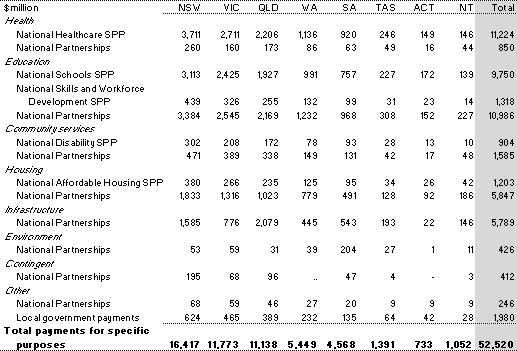
In 2009-10, the States received $52.5 billion in payments for specific purposes, an increase of 26.1 per cent compared with the $41.7 billion the States received in 2008-09. Total payments for specific purposes, including National SPPs and National Partnership payments are shown in Table 25.
Table 25: Payments for specific purposes to the States, 2009-10
Financial assistance grants to local governments
The Commonwealth provided $1.95 billion in financial assistance grants to local governments in 2009-10. Table 26 provides details of these grants, which are provided to the States to be distributed to local governments in each State. An analogous payment is made to the Australian Capital Territory.
Financial assistance grants are increased annually on the basis of an escalation factor determined each year by the Treasurer.
In the 2009-10 Budget, the Commonwealth decided to make the first quarter financial assistance grants payment for 2009-10 in the 2008-09 financial year, with a corresponding reduction in 2009-10. A similar decision was taken in the 2010-11 Budget, with an additional payment of $511.6 million in 2009-10 and a corresponding reduction in 2010-11. This accelerated provision of funding gave local governments immediate use of these funds to take full advantage of the global economic recovery and prepare them for future challenges.
To account for the bringing forward of these payments, the Treasurer determined an adjusted final escalation factor for 2009-10 of 0.8504. The 2009-10 grants were based on an estimated escalation factor of 0.6318 and incorporated a recovery of an overpayment of $10.6 million in respect of 2008-09. Over the two years of 2009-10 and 2010-11, local governments will still receive their full financial assistance grants entitlement. For this reason, an adjusted escalation factor for 2010-11 is estimated at 0.7765.
Table 26: Financial assistance grants to local government (cash basis),
2009-10
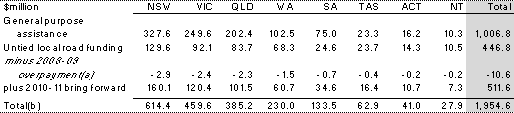
- There was an overpayment in 2008-09 because the estimated escalation was higher than the final factor. A balancing adjustment of $10.6 million was made in 2009-10.
- Total financial assistance grants are the actual cash payment that each State receives on behalf of local government. They are equal to the estimated entitlement for a given year, adjusted for an overpayment or underpayment from the previous year. The difference between the estimated entitlement and the final entitlement for the current year will be adjusted in the following year.
General revenue assistance
General revenue assistance is a broad category of payments, including GST payments, which are provided to the States without conditions, to spend according to their own budget priorities.
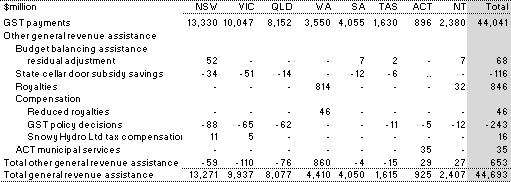
In 2009-10, the States received $44.7 billion in general revenue assistance from the Commonwealth, as shown in Table 27, comprising $44.0 billion in GST payments and $0.7 billion of other general revenue assistance. This is a 5.5 per cent increase in general revenue assistance, compared with the $42.4 billion the States received in 2008-09. In 2009-10, total general revenue assistance to the States represented 13.2 per cent of total Commonwealth expenditure.
Table 27: General revenue assistance, 2009-10
GST payments
Reconciling GST revenue and GST payments to the States
The Commonwealth makes GST payments to the States based on the revenue received from the GST. In 2009-10, GST revenue was $46.6 billion — an increase of $3.9 billion (9.2 per cent) from 2008-09.
However, GST revenue for a financial year varies from the amount of GST payments to the States for that year for several reasons including:
- GST revenues which are recognised on a Commonwealth whole of government basis, but are not recognised because the revenues will not be remitted to the Australian Taxation Office until the following financial year; and
- penalties, other than general interest charge penalties, which are not included in the definition in the Intergovernmental Agreement of GST to be paid to the States.
A reconciliation of GST revenue and GST payable to the States is provided in Table 28.
Table 28: GST revenue and GST payable to the States, 2009-10
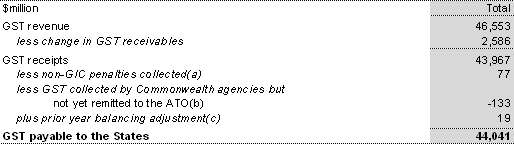
- General interest charge (GIC) penalties are defined in the Intergovernmental Agreement as being a part of the Commonwealth's GST revenue that is paid to the States. However, while other GST related penalties are also recognised in the Commonwealth's GST revenue, non GIC penalties are not defined in the Intergovernmental Agreement as being a part of the GST revenue that is paid to the States.
- This is the GST component of sales by Commonwealth agencies which has been collected by those agencies but which, as at 30 June in each year, will not have been remitted to the Australian Taxation Office, because it is not due to be paid until the next Business Activity Statement is lodged (typically on 21 July in the following financial year).
- The Commissioner's determination for 2008-09 was $18.5 million lower than the final outcome. This underpayment was paid in 2009-10.
Note: The outcome illustrated is estimated pending confirmation by the Australian National Audit Office.
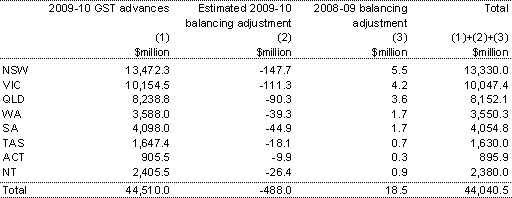
Advances of GST payments have been provided to the States throughout the 2009-10 financial year based on the Commonwealth's estimate of GST receipts at the 2010-11 Budget. Commonwealth advances of GST payments in 2009-10 are estimated to be $488 million higher than GST payable to the States shown in Table 28. This difference has been recorded as a receivable for the 2009-10 financial year resulting in the accrual GST expense being less than the GST cash advanced to the States.
To ensure that States receive their correct entitlement of GST for 2009-10 a balancing adjustment will be made in the 2010-11 financial year upon confirmation by the Australian National Audit Office of the final outcome GST receipts. Table 29 provides a reconciliation of GST payable and GST payments to the States.
Table 29: GST payable and GST payments to the States, 2009-10

Note: The outcome illustrated is estimated pending confirmation by the Australian National Audit Office.
Distribution of GST payments among the States
As agreed by COAG in the Intergovernmental Agreement, the Commonwealth distributes GST payments among the States in accordance with the principle of horizontal fiscal equalisation and having regard to the recommendations of the Commonwealth Grants Commission (the Commission).
Table 30 provides a summary of all GST payments to the States in 2009-10, further detail on the components of Table 30 are discussed below.
Table 30: Summary of the distribution of GST payments among the States
GST relativities
The Commonwealth Grants Commission recommends GST relativities to be used in calculating each State's share of GST payments. The relativities determine how much GST revenue each State receives compared with an equal per capita share and are determined such that, if each State made the same effort to raise revenue from its own sources and operated at the same level of efficiency, each State would have the capacity to provide services at the same standard.
The GST relativities for 2009-10 were discussed with the Ministerial Council for Federal Financial Relations in March 2009. The relativities for 2009-10 are shown in Table 31.
Table 31: GST relativities, 2009-10

Applying the GST relativities to the GST pool
The GST relativities were applied to estimated state populations throughout 2009-10 in order to determine an adjusted population for each State. Each State received its adjusted population share of the GST pool. The GST advances to the States have been distributed on the Treasury estimated population of each jurisdiction. In accordance with the Federal Financial Relations Act 2009, States are entitled to a share of the GST revenue grants based on the population contained in the determination made by the Australian Statistician.
Upon confirmation of the final outcome of GST receipts by the Australian National Audit Office, the balancing adjustment to be made in 2010-11 will be allocated using the population as at 31 December 2009 as determined by the Australian Statistician. The calculations for the distribution of advance payments of GST in 2009-10 and estimated balancing adjustment as shown in Table 32 are allocated based on the estimated population shares at Budget 2010‑11.
Table 32: Distribution of the 2009-10 estimated GST revenue and
balancing adjustment
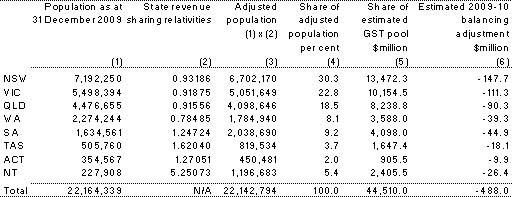
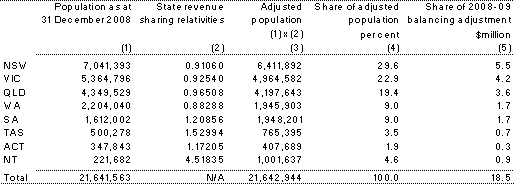
Table 33 shows the distribution of the 2008-09 GST balancing adjustment to account for the variation between the determination made by the Commissioner for Taxation in June 2009 and the final outcome. This residual adjustment is made on the basis of the state populations and recommended relativities prevailing in the 2008-09 payment year.
Table 33: Distribution of the 2008-09 GST balancing adjustment amount
GST administration costs
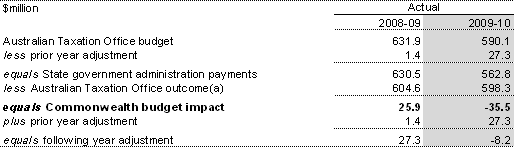
The Commissioner of Taxation administers the GST law and the States compensate the Commonwealth for the agreed costs incurred by the Australian Taxation Office in administering the GST, including costs incurred by the Australian Customs Service, as shown in Table 34.
Table 34: GST administration, 2009-10
- Estimated outcome for 2009-10 pending confirmation by the Australian National Audit Office.
In March 2009, the Ministerial Council for Federal Financial Relations agreed to a GST administration budget of $624.3 million for 2009-10. This was subsequently revised down to $590.1 million at the 2010-11 Budget owing to a revised estimate of the costs.
The estimated outcome for the 2009-10 GST administration expenses of $598.3 million differs from the amount paid by the States and the prior year adjustment by $-8.2 million. Once the outcome for GST administration costs in 2009-10 is audited, any adjustment required will be incorporated into the States' administration costs for 2010-11.
Other general revenue assistance
Budget balancing assistance residual adjustment
In the Intergovernmental Agreement on the Reform of Commonwealth State Financial Relations of 1999, the Commonwealth guaranteed that the budget position of each State would be no worse than it would have been had tax reform associated with the introduction of the GST not been implemented. The guaranteed minimum amount is an estimate of the revenue that each State would have received under the previous system of Commonwealth grants, and if the state taxes had not been abolished as part of the reforms.
During the transitional period, which expired on 30 June 2009, the Commonwealth paid budget balancing assistance to the States if a State's share of GST payments in a financial year was less than its guaranteed minimum amount for that year. No budget balancing assistance was payable when GST revenue exceeded the guaranteed minimum amount.
As the 2008-09 financial year was the final transitional year, the Treasurer is not required to determine a guaranteed minimum amount in 2009-10 or future years. Following the finalisation of state data for the 2008-09 financial year, the Commonwealth paid a residual adjustment amount of $67.8 million in 2009-10 in respect of budget balancing assistance owed to the States in 2008-09. This is in addition to the $275.2 million paid in 2008-09.
Table 35: Guaranteed minimum amount, GST payments, budget balancing
assistance and residual adjustment

State cellar door subsidy savings
States previously agreed to return to the Commonwealth savings arising to them from the Commonwealths introduction of the wine equalisation tax producer rebate. Rather than the States returning these savings annually, the Commonwealth recovered the present value of the future stream of annual payments to extinguish all current and future State commitments in respect of this measure. The total value of the savings is $184.6 million, of which $68.7 million was recovered in 2008-09.
GST compensation for small business concession
In 2009-10 the Government recovered the net overpayment to the States for compensations paid in respect of deferred GST revenue through allowing small business and non-profit organisations that voluntarily registered for the GST to pay and report GST on an annual rather than a monthly or quarterly basis. The total amount recovered represents the present value of the overpayment less the present value of the stream of future annual payments, and extinguishes all current and future Commonwealth and State commitments in respect of this compensation. Western Australia and South Australia elected to repay their overpayment in 2008-09.
Payments to the States
This attachment provides Commonwealth payments to the States and local governments on an accruals basis. This includes Commonwealth advances (loans) to the States, including new advances, interest on advances and repayments of advances. Most of these advances were funded from borrowings made on behalf of the States under previous Australian Loan Council arrangements.
The following tables present payments to the States for 2009-10:
Table 36 — health;
Table 37 — education;
Table 38 — community services;
Table 39 — housing;
Table 40 — infrastructure;
Table 41 — environment;
Table 42 — contingent liabilities;
Table 43 — other purposes;
Table 44 — general revenue assistance;
Table 45 — advances, repayment of advances and interest payments; and
Table 46 — payments presented on the Australian Bureau of Statistics Government Finance Statistics (GFS) functional basis.
Table 36: Payments for specific purposes to support state health services, 2009-10
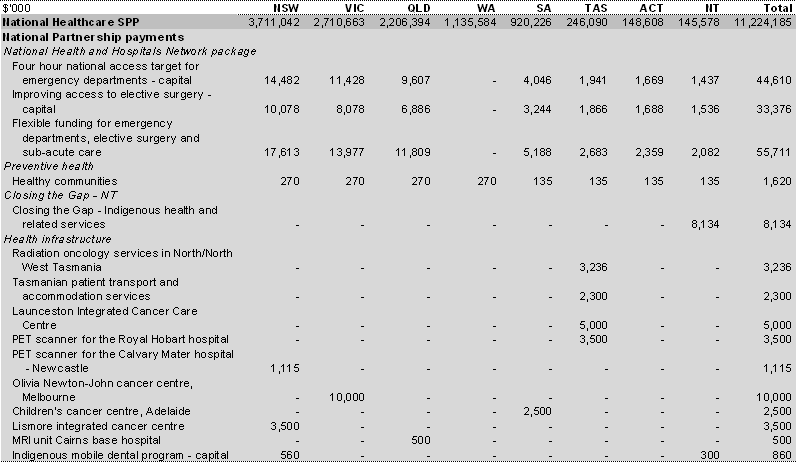
Table 36: Payments for specific purposes to support state health services, 2009-10 (continued)
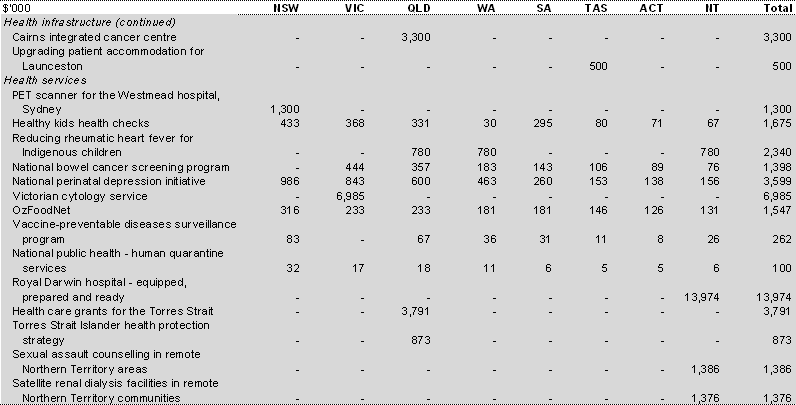
Table 36: Payments for specific purposes to support state health services, 2009-10 (continued)
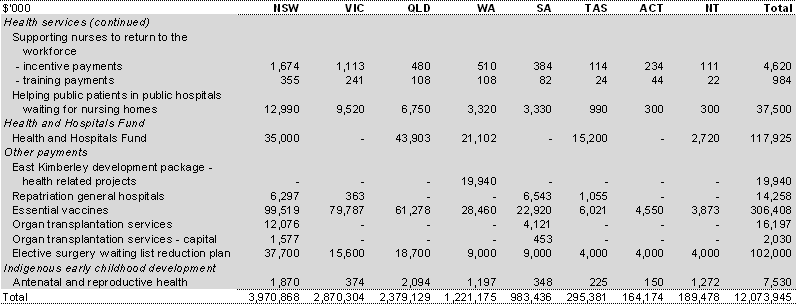
Table 37: Payments for specific purposes to support state education services, 2009-10
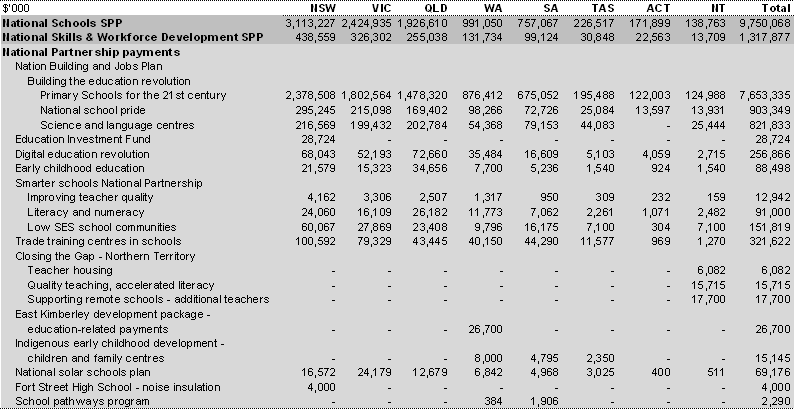
Table 37: Payments for specific purposes to support state education services, 2009-10 (continued)
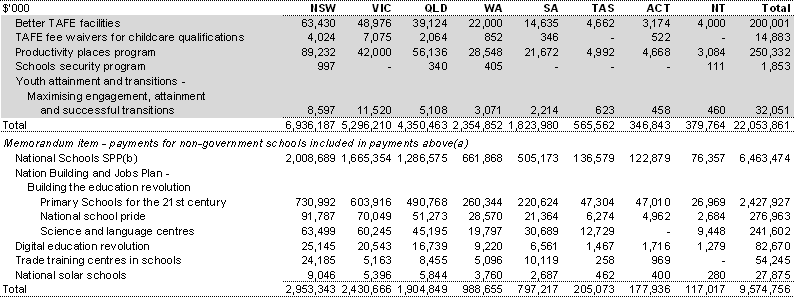
- Non-government schools payments are net of GST.
- This payment includes payments paid under the Schools Assistance (Learning Together — Achievement through Choice and Opportunity) Act 2004.
Table 38: Payments for specific purposes to support community services, 2009-10
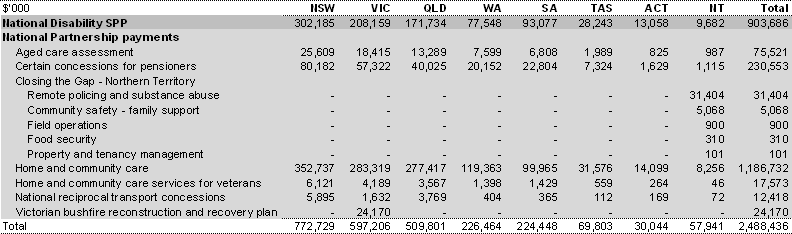
Table 39: Payments for specific purposes to support housing services, 2009-10
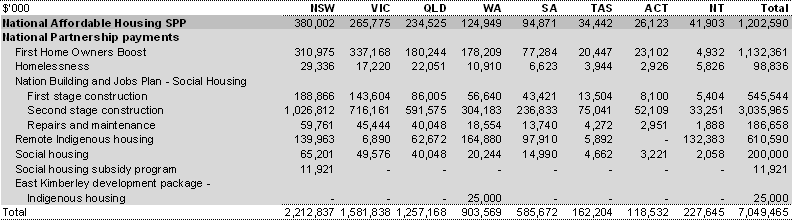
Table 40: Payments for specific purposes to support state infrastructure services, 2009-10
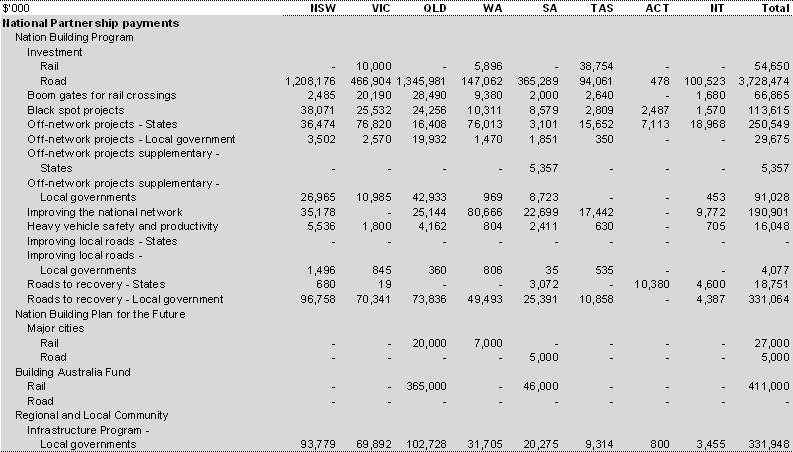
Table 40: Payments for specific purposes to support state infrastructure services, 2009-10 (continued)
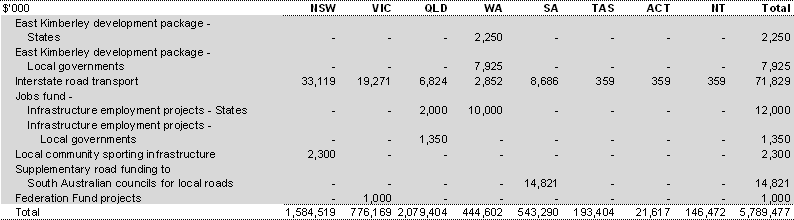
Table 41: Payments for specific purposes to support state environmental services, 2009-10
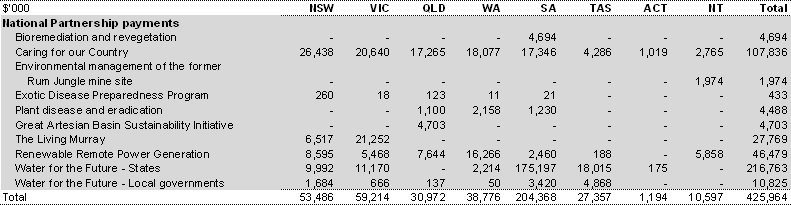
Table 42: Contingent payments to the States, 2009-10

Table 43: Payments to support other state services, 2009-10
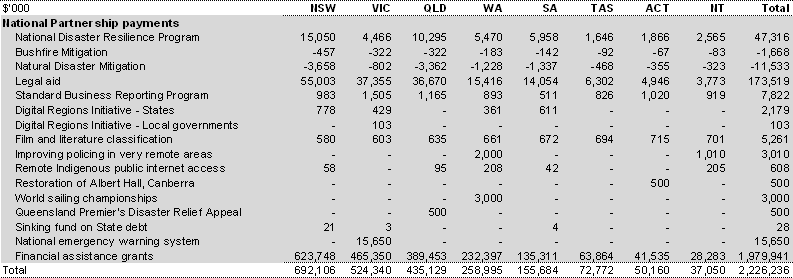
Table 44: General revenue assistance payments to the States and Territories, 2009-10
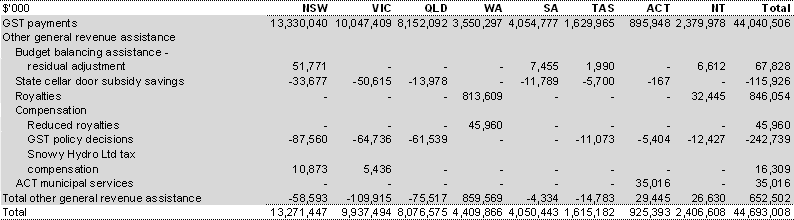
Table 45: Other financial flows — estimated advances, repayment of advances and interest payments,
2009-10
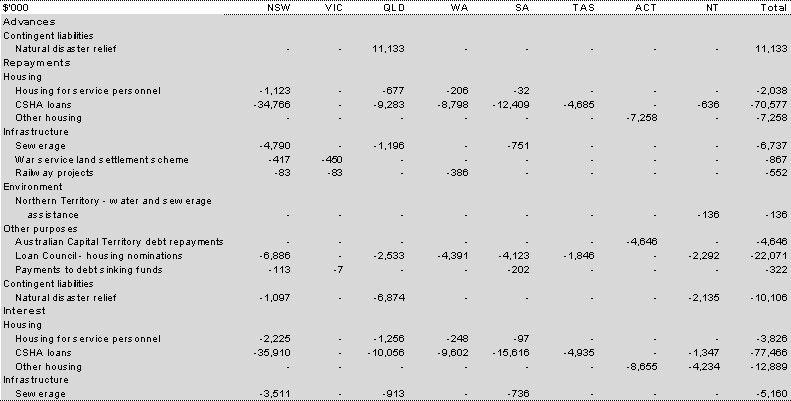
Table 45: Other financial flows — estimated advances, repayment of advances and interest payments,
2009-10 (continued)
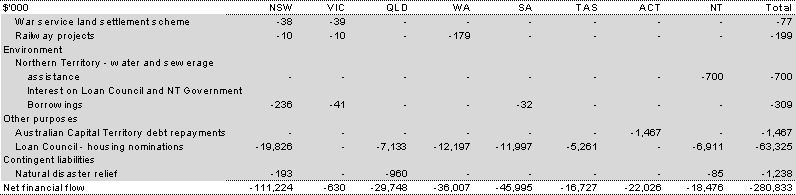
Table 46: Total payments to the States by GFS function, 2009-10
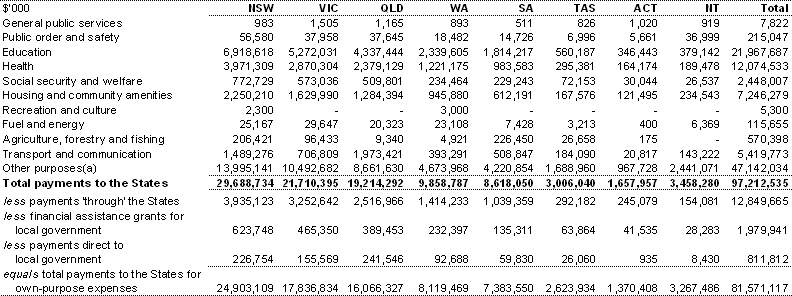
- Payments for 'Other purposes' includes general revenue assistance to the States.
If www.budget.gov.au responds slowly or you are having trouble downloading a document, try one of the Budget Website Mirrors
Note: Where possible, Budget documents are available in HTML and for downloading in Portable Document Format(PDF). If you require further information on any of the tables or charts on this website, please contact The Treasury.