


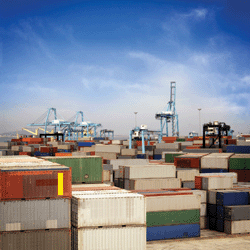
Port and freight infrastructure
The Hunter Valley coal chain
The Hunter Valley coal chain is the world's largest coal export supply system. Hunter Valley coal production is forecast to increase from under $100 million tonnes per annum (mtpa) to over 200 mtpa by 2014 and possibly up to 300 mtpa. The Government‑owned Australian Rail Track Corporation (ARTC) is investing over $1 billion to improve coal carrying capacity in the region to realise its Hunter Valley Investment Strategy.
In the December 2008 Nation Building Package, the Government provided a $1.2 billion equity injection to the ARTC to finance its Hunter Valley rail expansion and to upgrade other key sections of the national rail network.
This is in addition to the $2 billion committed to rail infrastructure by the Government from the Nation Building Program for a range of rail projects across the nation including at Port Botany in New South Wales, Geelong Port in Victoria, and Bell Bay in Tasmania.
The Government is acting now to position Australia for future economic growth.
Modern seaport facilities
It is critical that Australia's national gateways — our seaports and airports — are modern, efficient and able to cope with growing demand as the global economy recovers. Our export infrastructure, including ports and airports, is a gateway for Australian business.
Before the economic downturn, capacity constraints and infrastructure bottlenecks were evident in some of Australia's key export gateways. Addressing these bottlenecks will mean that Australia is well‑positioned, as the global economy recovers, to take advantage of the many opportunities and benefits that will emerge.
From farm gate to international markets
Australia's trade gateways must be internationally competitive to prosper in an increasingly connected and competitive global economy. The land‑side supply chains and infrastructure networks must also be efficient and flexible. This will facilitate Australian commodities getting to market and at a lower cost.
The Government will set aside $339 million for a multi‑user and multi‑functional Oakajee Port common user facilities in Western Australia and $50 million towards the Darwin Port expansion, subject to the outcome of further work currently underway.
This builds on the Government's commitments, through the Nation Building Program, to expand capacity and relieve bottlenecks around New South Wales export infrastructure by investing:
- $150 million to improve landside access to Port Botany
- $300 million to develop an inter‑modal terminal at Moorebank in south‑west Sydney.
Smarter regulation, governance, planning and pricing can also make our ports more efficient. The Government is leveraging its direct investment in Australia's international gateways by adopting a strategic, nationally coordinated approach to the future development and planning of Australia's port and freight infrastructure in consultation with the Council of Australian Governments and Infrastructure Australia.
New frameworks for aviation
The Government is also committed to improving the competitiveness and efficiency of Australia's airports and aviation industry and is currently developing the nation's first aviation White Paper. This will provide the aviation industry and infrastructure owners with the certainty needed to make long‑term planning and investment decisions.