The Government's bank guarantees have helped maintain confidence in domestic financial markets, and enabled lending to continue to provide further support to economic activity. The Government's economic stimulus strategy has cushioned Australia from the worst effects of the global recession. Without these initiatives, the contraction in the Australian economy in 2009‑10 would have been four times larger.
As well as supporting jobs and economic activity, the Government's fiscal stimulus measures are assisting first home buyers and building physical and social infrastructure. The Government has also supported jobs through its employment assistance measures.



and to have a short‑lived impact on the budget balance. The measures were targeted at those areas most in need of support — household consumption and dwelling investment.
To date, the FHOB has helped stimulate housing activity by assisting over 59,000 first home buyers to enter the housing market.
Retail sales are 4.5 per cent above their pre‑stimulus levels of November 2008; growth of 3.8 per cent in December 2008 was the strongest in eight years.
Nation Building and Jobs Plan
Two‑thirds of the Nation Building and Jobs Plan (NBJP) is a
direct investment of $29.9 billion in schools, housing, energy efficiency, community infrastructure and roads, and support to small businesses. The NBJP will drive the largest annual increase in public investment on record.
The centrepiece of the NBJP is the Building the Education Revolution program. Every school in Australia will benefit from a share of $14.7 billion of investment in school infrastructure and maintenance.
The NBJP also provides $12.2 billion in immediate stimulus by delivering valuable assistance to individuals and families through one‑off bonuses.
Supporting investment and skills
To support growth and prosperity as we emerge from the global recession, the Government has taken early action to help people get back into work and learn the skills needed for future jobs.
The Government is investing $1.5 billion through its Jobs and Training Compact, which aims to provide support to those affected by the downturn. This includes $299 million to provide retrenched workers with intensive employment assistance and $155 million in support for apprentices and their employers.
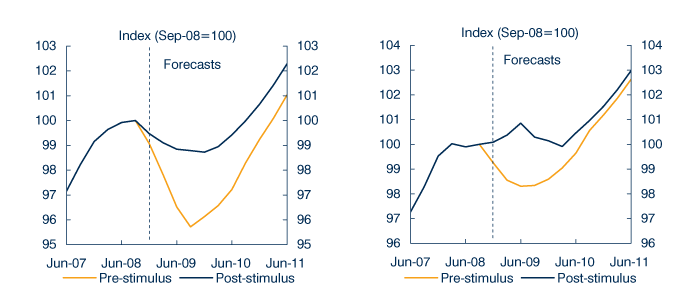
Stimulus effect on real GDP
Stimulus effect on household consumption