A clearer picture
This Budget has been framed against the backdrop of the most challenging global environment in generations. This has called for changes in the approach to the preparation of the Budget forward estimates — an extension of the economic forecasting period and the adoption of economic projection assumptions that take account of the economic cycle.



Reasons for the change
The recent approach to preparing economic parameters for the Budget has been to include economic forecasts for the current year and the Budget year, and project for a further three years based on long‑term trends. This approach dates from the mid‑1990s and has been used over a period when the economy has grown reasonably close to its trend rate.
With the economy expected to contract in 2009‑10 and then stage a subsequent recovery, this approach would provide a misleading picture of the Budget position over the forward estimates period.
Additional forecast year
Treasury has forecast an additional forecast year for the 2009‑10 Budget. A forecast for 2010‑11 has been prepared on the basis that the usual assumption of trend growth after the Budget year would overstate the fiscal position. GDP growth in 2010‑11 is forecast to be 2¼ per cent, below the long‑run trend of 3 per cent.
Projections based on the economic cycle
It is usual to assume further out — in the projection years — that the economy grows at trend rates. This is an unrealistic assumption when the economy is expected to recover from a period of substantial weakness.
Based on past experience, the economy is expected to grow at 4½ per cent in 2011‑12 and 2012‑13 as the economy recovers and unemployment falls. The unemployment rate is expected to fall by 1 percentage point in each of the projection years.
The approach is also in line with that taken in budgets in the early 1990s when above‑trend rates of growth were assumed as the economy recovered from recession.
Other countries are also assuming above trend growth in their forward estimates as their economies are expected to recover. The US, UK, New Zealand and Sweden are all adopting such an approach.
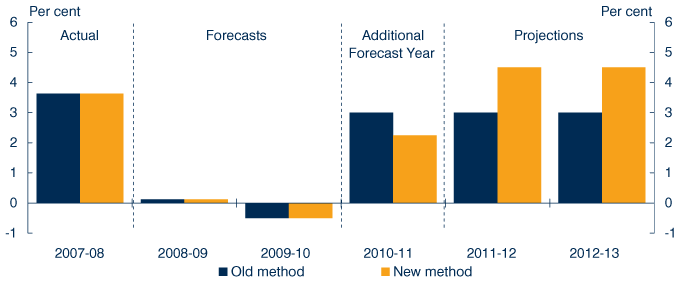
Real GDP growth under old and new methodologies