




Statement 1:
Budget Overview
(Continued)
Saving for the future
This Budget takes important steps to increase national savings. The Government is introducing a tax discount for interest income, increasing the Superannuation Guarantee and introducing complementary reforms to deliver a saving and superannuation system that is fairer for low income earners and provides more flexibility for those needing to save as they approach retirement.
Discount for interest income
In this Budget, the Government will provide $950.0 million over the forward estimates to improve the taxation treatment of savings by reducing the discrepancy in the treatment of interest income relative to non‑interest earning investments.
Under the current system for taxing savings, interest income is taxed in full at the individual's marginal rate, while capital gains can receive a 50 per cent discount. The Government recognises that this can act as a disincentive for small savers who are more likely to put extra non‑superannuation savings into deposits. The Australia's Future Tax System review recommended a 40 per cent discount apply to interest income.
From 1 July 2011, the Government will provide individuals with a 50 per cent tax discount on up to $1,000 of interest earned by individuals, including interest earned on deposits held in authorised deposit‑taking institutions, bonds, debentures and annuity products. Assuming the benefit gained from the discount is reinvested each year, a middle‑income taxpayer with $17,000 invested at 6 per cent per annum will, after five years, have a balance almost $1,000 higher than if they had not received the discount.
The discount will be available for interest income earned directly by an individual as well as indirectly, such as via a trust or managed investment scheme, and is expected to benefit around 5.7 million depositors in 2011‑12.
The Government expects that this measure will also assist in securing a greater supply of stable deposit funding for banks, building societies and credit unions, which would reduce their requirement to borrow in international capital markets from overseas investors.
Since deposits typically represent a high proportion of funding for smaller lenders, this reform should help to put downward pressure on their funding costs, allowing them to lend at more competitive interest rates to Australian households and small businesses. This is consistent with the Government's objective to support competition in the banking sector following the global financial crisis.
Supporting retirement incomes
The recent Australia to 2050 Report highlighted the challenges Australia faces from an ageing population, particularly the need to ensure adequate retirement incomes.
The Government is taking action to address these challenges and assist Australians improve their retirement incomes through a number of superannuation reforms.
From 1 July 2013, the Government will gradually increase the Superannuation Guarantee from its current rate of 9 per cent to 12 per cent by 1 July 2019.
In addition, the Government will increase the maximum age for Superannuation Guarantee contributions from 70 to 75 with effect from 1 July 2013 to improve superannuation coverage for older workers.
These changes are an important step in meeting the challenges faced by an ageing population and improving the wellbeing of Australians.
Government superannuation contributions tax rebate for low income earners
Low income earners currently receive little or no concessions on their concessional superannuation contributions, which are taxed at 15 per cent. Some low income earners pay more tax on their superannuation contributions than they do on their labour income.
To increase equity, the Government will introduce a superannuation contributions tax rebate for low income earners. In 2012‑13, this rebate will, in effect, refund the contributions tax for people with adjusted taxable incomes of up to $37,000 a year up to a maximum rebate of $500 a year. Eligible non‑concessional superannuation contributions will continue to receive the superannuation co‑contribution.
Flexibility for people approaching retirement
The Government will provide greater superannuation flexibility for people nearing retirement by continuing a higher concessional contributions cap for certain individuals after 30 June 2012.
The higher cap will be for concessional superannuation contributions up to $50,000 (indexed) for people aged 50 or over who have total superannuation balances of less than $500,000.
This measure will allow people aged 50 or over to catch up on their superannuation contributions when they are most able. It will particularly benefit those people who have had periods outside the workforce.
These reforms will help Australians to enjoy a better lifestyle in retirement. These measures will mean an extra $108,000 on average in the retirement superannuation balance for a 30 year old worker on full‑time average weekly earnings.
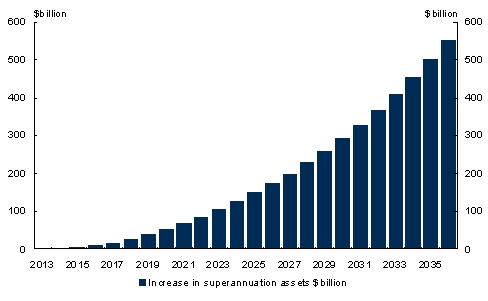
The Government's superannuation reforms will increase Australia's pool of superannuation savings by $85 billion over 10 years and $500 billion by 2035 (Chart 3).
Chart 3: Additional superannuation savings
If www.budget.gov.au responds slowly or you are having trouble downloading a document, try one of the Budget Website Mirrors
Note: Where possible, Budget documents are available in HTML and for downloading in Portable Document Format(PDF). If you require further information on any of the tables or charts on this website, please contact The Treasury.