




Statement 2:
Economic Outlook
(Continued)
The outlook for the international economy
After contracting in 2009 for the first time in the post‑war era, the global economy is in the early stages of recovery. While global growth is improving more rapidly than expected, recovery is patchy, with a sluggish recovery in advanced economies and a more robust one in emerging markets — a divergence that is expected to persist over the forecast horizon.
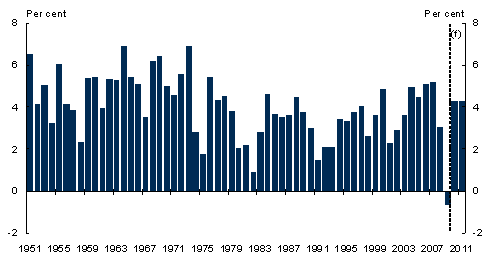
While there are significant stresses in some sovereign debt markets, most notably in Greece, financial market conditions more broadly have improved and bank lending constraints have eased. The healing in overall financial conditions together with the recovery in confidence, ongoing stimulus measures, and encouraging signs that the economic recovery has broadened, should see the world economy grow by 4¼ per cent in both 2010 and 2011 (Chart 1).
Chart 1: World GDP growth
Source: International Monetary Fund (IMF) and Treasury.
The outlook is strongest for our Asian neighbours, with the Chinese economy forecast to grow by 10 per cent this year. Excess capacity in these Asian emerging economies has quickly been eroded and the performance of labour markets relative to the major advanced economies has been striking. With limited resource slack and an acceleration of capital inflows, inflationary pressures are building in some economies.
The outlook for our advanced major trading partners, while positive, is more subdued. Although these advanced economies endured a deep downturn, the subsequent rebound is expected to be modest by the standards of past recessions. The process of repairing bank balance sheets is still playing out, particularly in the United States (US) and Europe, and there is a pressing need to consolidate fiscal positions over the next few years, which must go well beyond unwinding the fiscal stimulus measures that have supported recent growth outcomes. Unemployment has risen sharply as a result of the crisis and is projected to fall only gradually. A large margin of spare capacity has opened up, and will act as a major restraining force on inflation for some time to come.
The vast majority of the advanced world, including the economies of North America, the euro area, the United Kingdom (UK) and Japan are in liquidity traps — with policy interest rates close to zero and limited scope to further stimulate these economies through conventional monetary policy. Most of these economies are, however, expected to emerge from these traps over the forecast horizon.
From peak to trough, real GDP fell by almost 4 per cent in the US, just over 6 per cent in the UK, nearly 7 per cent in Germany and more than 8 per cent in Japan. Based on the latest growth forecasts, GDP in these economies is not expected to return to pre‑recession levels until later this year at the earliest.
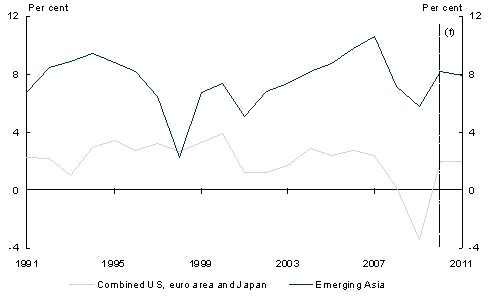
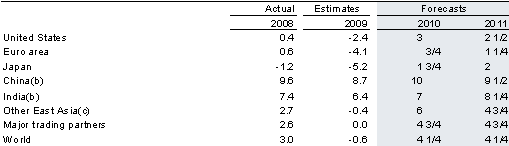
The ongoing disparity in growth forecasts between the advanced and developing world is apparent in Chart 2. As a group, the US, euro area and Japan are expected to grow by 1.9 per cent this year — around a quarter of the aggregate pace forecast for emerging Asia. Among our developing major trading partners, China and India continue to lead, and among our advanced major trading partner economies, the US is leading the recovery despite being at the epicentre of the global financial crisis (Table 2).
Chart 2: GDP growth — combined US, euro area and Japan, and
emerging Asia
Note: GDP growth rates are calculated using GDP weights based on purchasing power parity (PPP). Emerging Asia comprises China, India, Newly Industrialised Economies (NIEs: Hong Kong, South Korea, Singapore and Taiwan) and ASEAN‑5 (Indonesia, Malaysia, the Philippines, Thailand and Vietnam).
Source: National statistical publications, IMF and Treasury.
Table 2: International GDP growth forecasts(a)
- World and euro area growth rates are calculated using GDP weights based on purchasing power parity (PPP), while growth rates for major trading partners and Other East Asia are calculated using export trade weights.
- Production‑based measures of GDP.
- Other East Asia comprises the NIEs of Hong Kong, South Korea, Singapore and Taiwan and the Association of Southeast Asian Nations group of five (ASEAN‑5), which comprises Indonesia, Malaysia, the Philippines, Thailand and Vietnam.
Source: National statistical publications, IMF and Treasury.
The outlook for the United States has improved. By the end of 2009, the US economy was growing at its strongest rate in over six years, albeit from a low base. While a decline in the pace of inventory destocking was responsible for around two‑thirds of growth, there were also positive signs from both consumer spending and business investment. These positive signs have continued into the new year, which was evident in the 2010 March quarter advance GDP report, and the US economy is on track to record growth of 3 per cent this year.
There are ongoing strains on US households from a weak labour market, restricted credit flows, and the fall in asset prices. However, US households have been more resilient than expected. They have made some progress in rebuilding their savings following an extended period of decline in the household saving rate. Capacity utilisation remains well below its historical average, although the corporate sector is recovering, with corporate profits near historical highs. The outlook for business investment hinges not only on the ability of US companies to fund capital expenditures but on their willingness to do so. This will depend to a large extent on their confidence about the outlook for demand.
Financial market conditions in the US have improved markedly over the past few months, and in response the Federal Reserve has terminated almost all of its extraordinary measures implemented during the recent crisis. Credit constraints continue to ease, although they remain tight relative to pre‑crisis levels, particularly for small businesses. Small businesses, which are responsible for a large part of employment growth, remain quite pessimistic and this will restrain the recovery in the US economy in the short term.
In contrast to brighter signs for the US, the economic outlook for the euro area remains downbeat. Spurred by the Greek sovereign debt crisis, a broader group of economies on the euro area periphery, including Spain, Ireland, and Portugal, are having to implement rapid fiscal consolidations with the associated impacts on economic activity being magnified by the lack of monetary and exchange rate flexibility flowing from euro area membership. Despite exiting recession at the same time as the US economy, the recovery in the euro area has proceeded at a far slower pace. GDP is forecast to rise by only ¾ of a per cent this year and future prospects will be contingent on the extent to which the core euro area countries can expand domestic demand to provide some boost to offset the contractionary forces at play in the periphery. While the outlook for the core euro area economies is more promising, growth will be constrained by the weak prognosis for those on the periphery.
The outlook for the Japanese economy is not as downbeat as for the euro area, although it remains rather lacklustre especially when cast against the backdrop of a 5¼ per cent decline in GDP last year — the worst contraction of any major advanced economy. Exports have been the main driver of the recovery, helped by the resilience of emerging economies, although the positive spillover effect to domestic demand has been fairly limited. The Japanese economy is projected to grow by 1¾ per cent this year although deflation continues and remains a key concern.
The Chinese economy continues to grow strongly, with GDP having grown by 8.7 per cent in 2009, driven by domestic demand. Investment contributed 8.2 percentage points to this growth, propelled by the Government's fiscal stimulus program and monetary loosening.
China's economy is forecast to grow by 10 per cent this year, before easing to around its trend rate of 9½ per cent in 2011. Government policy continues to be supportive of growth, while domestic activity is being reinforced by the improvement in external demand. Consumption is expected to play a larger role than in the past, as China seeks to redirect growth away from investment.
China's strong economic recovery has raised concerns about the sustainability of growth. Domestic demand continues to be heavily supported by Government stimulus and continued strong growth in 2011 will rely on a sustained recovery in both private sector and global demand. Robust loan growth since the start of the stimulus in November 2008 has increased the risks of high inflation and asset price bubbles. Chinese policymakers have already implemented a number of tightening measures to prevent overheating and further market‑based and administrative measures are likely. An additional concern is a rise in non‑performing loans associated with the run‑up in local government debt used to fund stimulus projects.
India's economy has proved resilient despite the headwinds of the global financial crisis and the worst drought since 1972. The outlook is for growth of 7 per cent in 2010 on the back of improved business and urban consumer confidence, improved weather conditions, and renewed foreign capital inflows. Like China, the momentum in the domestic economic recovery has shifted concerns to inflationary pressures, and India's central bank has already responded with monetary policy tightening.
The strength of domestic demand in China and India is having beneficial effects on Other East Asian economies. After suffering deep declines at the end of 2008, the region bounced back impressively, with four economies managing to record positive growth in 2009. Indonesia was the only economy within this region to avoid recording any quarters of negative growth during the recent crisis — in stark contrast to the experience of the 1997‑98 Asian Financial Crisis.
While the global outlook has improved, it remains subject to uncertainty and there are important emerging risks.
A significant downside risk is the sustainability of sovereign debt, as the recent events in Greece acutely demonstrate (Box 1). A loss of market confidence in the sustainability of fiscal positions in any of the major advanced economies would create serious renewed tensions in international financial markets and bring forward calls for more rapid fiscal consolidation at a time when large parts of the global economy are still transitioning to self‑sustaining expansion.
Fiscal consolidation plans will eventually need to be enacted across many advanced economies. Recovery in the private sector should offset the negative effects on growth of shrinking public sector demand. Nevertheless, high levels of public debt will be a major factor contributing to a more subdued outlook for many advanced economies and will remain a source of risk and volatility. Added to this, many advanced economies are burdened with high rates of unemployment and financial systems still in the process of repair.
The challenges of reversing extraordinary support measures and sustaining economic recovery are being addressed by the G‑20 through implementation of its Framework for Strong, Sustainable and Balanced Growth. Fiscal consolidation will be a key issue under the Framework's mutual assessment process given the high levels of public debt in many advanced economies.
There are also upside risks to the outlook. Just as many observers have underestimated the strength of the rebound to date, there may be the potential for further upward surprises in the near term as forecast levels of activity in the major economies remain well below potential. This scenario may arise through a stronger‑than‑expected feedback loop between improvements in activity and confidence.
Box 1: Sustainability of sovereign debt in other advanced economies
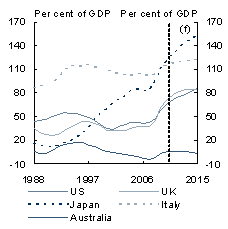
The global financial crisis inflicted a heavy toll on government finances, particularly among the major advanced economies (Chart A).
Chart A: Net public debt
Australian data are for the Australian Government general government sector and refer to financial years beginning 1988-89. Data for all other economies are total Government and refer to calendar years.
Source: IMF and Treasury.
Australia's fiscal consolidation plans are well ahead of the pack, with the budget balance projected to return to surplus by 2012‑13 ahead of any major advanced economy. Net Australian Government debt will remain lower than in the major advanced economies, peaking at 6.1 per cent in 2011‑12. This is substantially below the peaks in the major advanced economies, which range from 33 to 154 per cent of GDP.
Although debts and deficits are now near historical highs in several countries, the fiscal stimulus put in place during the crisis has been widely credited as a pivotal factor in preventing a second Great Depression.
Now that the global economy is recovering, the challenge for governments has shifted to ensuring the sustainability of sovereign debt. Relative to past sovereign debt crises in emerging economies, one key factor working in favour of advanced economies is that sovereign debts are overwhelmingly denominated in local currencies.
However, recent developments in Greece vividly demonstrate how quickly markets can lose confidence in the sustainability of a sovereign's debt dynamics. Due to the loss of market confidence, the Greek Government has had to call on a three‑year EU‑IMF support package. As a condition of this package, the Greek Government has agreed to severe austerity measures at a time when the Greek economy is contracting sharply. The associated impacts on aggregate demand will exacerbate the fiscal challenge.
Without significant action on the part of governments, debt levels are projected to rise continuously over the medium term in several countries. In addition, the impact of health and age spending, which the IMF estimates will rise by about 4 to 5 percentage points of GDP over the next 20 years in advanced economies, will add to fiscal pressures.
To ameliorate this risk, credible medium‑term fiscal consolidation plans, with specific targets and actions, like those enacted in Australia, are necessary. Ongoing engagement by the G‑20 can play a significant role by ensuring a broad cross‑country commitment and helping build consensus on necessary policy actions.
If www.budget.gov.au responds slowly or you are having trouble downloading a document, try one of the Budget Website Mirrors
Note: Where possible, Budget documents are available in HTML and for downloading in Portable Document Format(PDF). If you require further information on any of the tables or charts on this website, please contact The Treasury.