




Statement 6:
Expenses and Net Capital Investment
(Continued)
General government net capital investment
Net capital investment is broadly defined as acquisitions of non‑financial assets less depreciation expenses. It provides a measure of the overall growth in capital assets (including buildings and infrastructure, specialist military equipment, and computer software) after taking into account depreciation and amortisation as previously acquired assets age.
Australian Government general government net capital investment is expected to increase by $928 million in 2010‑11. This is predominantly due to projected growth in the defence, general public services and transport and communication functions. Net capital investment decreases in 2011‑12 and 2012‑13 due to a number of items in the Contingency Reserve for both these years. Details of movements are explained below.
Table 18: Estimates of total net capital investment
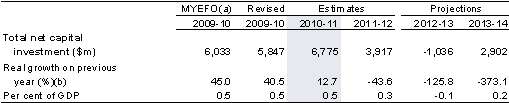
- GDP forecasts for the 2009‑10 Budget were prepared according to the System of National Accounts 1993, while forecasts for MYEFO and the 2010‑11 Budget were prepared according to the System of National Accounts 2008.
- Real growth is calculated using the Consumer Price Index. Real net capital investment is rising in 2013‑14. The negative real growth rate shown in that year is a function of the negative net investment in 2012‑13.
Reconciliation of net capital investment since the 2009‑10 Budget
A reconciliation of the net capital investment estimates, showing the effect of policy decisions and economic parameter and other variations since the estimates were published in the 2009‑10 Budget, is provided in Table 19.
Table 19: Reconciliation of net capital investment
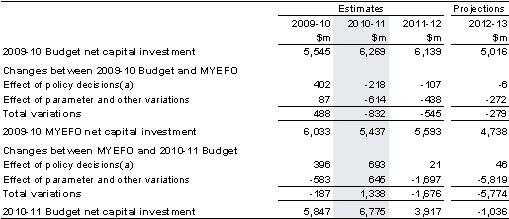
- Excludes secondary impacts on public debt interest of policy decisions.
Forecast net capital investment for 2010‑11 has increased by $1.3 billion since 2009‑10 MYEFO. This increase is driven by the effect of new policy decisions of $693 million and by parameter and other variations of $645 million. The major policy decisions include investment to enhance the force protection measures for Australian troops deployed to Afghanistan, investment for capacity enhancement of immigration detention facilities, investment in information and communication technology infrastructure to commence activity based funding as part of the National Health and Hospitals Network package, and replenishment of the national medical stockpile.
Net capital investment in 2010‑11 is estimated to be $6.8 billion. This is higher than forecast in the 2009‑10 Budget, primarily due to the accelerated investment in water entitlements under the Water for the Future package brought forward into 2009‑10 and 2010‑11, and the movement of funds from 2009‑10 to 2010‑11 as part of the National Broadband Network and Regional Blackspots program.
Discussion of changes between 2009‑10 MYEFO and the 2010‑11 Budget, shown in the table above, can be found in Statement 3 (in the section titled 'Variations in net capital investment estimates'). Further information on the capital measures since MYEFO can be found in Budget Paper No. 2, Budget Measures 2010‑11.
The significant reductions in net capital investment in 2011‑12 and 2012‑13 are due to a number of items in the contingency reserve (these are reflected in the other purposes function in Table 20). Other items which impact on these years include the accelerated investment in water entitlements and the decrease in defence's net capital investment.
Net capital investment estimates by function
Estimates for Australian Government general government net capital investment by function for the period 2009‑10 to 2013‑14 are provided in Table 20.
Table 20: Estimates of net capital investment by function
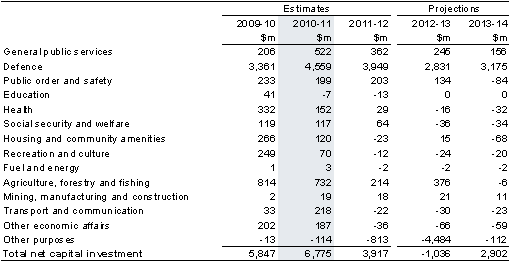
As in previous years, the most significant component of net capital investment in 2010‑11 occurs in the defence function. These investments reflect the acquisition of military equipment and the construction of support facilities. Such investments can experience uneven expenditure throughout their development and life cycle extending over long periods of time, and can contribute to fluctuations in levels of net capital investment from year to year.
The recent strength of the Australian dollar has contributed to Defence requiring lower capital investment in order to purchase the same level of capability, leading to a revision of previously published Defence net capital investment levels for 2010‑11 and the forward estimates.
Major factors contributing to net capital investment, expected to occur in the following functions, include:
- general public services — investment in major projects managed by the Department of Finance and Deregulation (new accommodation for the Australian Security Intelligence Organisation), refurbishment and relocation of various overseas missions by the Department of Foreign Affairs and Trade, purchase of a new research vessel for CSIRO financed through the EIF, and investment by several agencies in information technology including the ATO, the Department of Finance and Deregulation, and Centrelink;
- public order and safety — construction projects, including the fit out of the accommodation for the Australian Security Intelligence Organisation, fit out of the Edmund Barton Building for the Australian Federal Police, the commencement in 2010‑11 of the fit out of the Robert Garran Offices, and the Australian Customs and Border Protection Service fit out of Customs House in Brisbane;
- defence — facility and base infrastructure upgrades are being undertaken by the Department of Defence at HMAS Creswell (Australian Capital Territory), Lavarack Barracks (Queensland), Robertson Barracks (Northern Territory), and Royal Australian Air Force bases at Amberley (Queensland), Edinburgh (South Australia), Pearce (Western Australia), and Darwin and Tindal (Northern Territory);
- Defence also continues to deliver a major equipment acquisition program under the Defence Capability Plan agreed by Government as part of the 2009 Defence White Paper. This commitment maintains capital equipment expenditure at a high level over the forward estimates, including the purchase of the remaining Super Hornet and airborne early warning and control aircraft, armed reconnaissance and multi‑role helicopters, and Bushmaster protected mobility vehicles, in addition to initial deliveries of air‑to‑air refuelling aircraft, a large new class of Landing Helicopter Dock amphibious ships; anti‑ship missile defence upgrades to Anzac class frigates; and enhanced command and control battle management and communication systems for land forces.
- There are also a number of construction projects currently being undertaken, including Enhanced Land Force Facilities Stage 1 and Stage 2, Australian Super Hornet Facilities, Hardened and Networked Army Facilities and Airborne Early Warning and Control Facilities. Construction will occur at various Defence sites and locations across Australia.
- health — investment in the National Medical Stockpile, maintained by the Government to safeguard against pandemics and biosecurity incidents, including the purchase of additional vaccines in response to Pandemic (H1N1) 2009 in 2009‑10;
- Increased net capital investment in 2009‑10 is also attributed to the build and fit out of new accommodation for the Department of Health and Ageing in Woden, Australian Capital Territory.
- The Government's NHHN package will provide substantial capital funding, particularly in 2010‑11, primarily to invest in infrastructure and applications necessary to allow payments to be made to 150 Local Hospital Networks through activity based funding arrangements.
- social security and welfare — property acquisitions and business investments by the Indigenous Land Corporation, the most significant being the continued development of the Mossman Gorge Gateway Centre, the commencement of the construction of hostels for secondary students from 2010‑11, and ongoing capital investment in the construction of classrooms and accommodation in remote areas. The Department of Families, Housing, Community Services and Indigenous Affairs is also implementing significant upgrades to Centrelink's IT systems in 2009‑10, 2010‑11 and 2011‑12;
- housing and community amenities — investment by DHA of $246 million to construct 829 houses across Australia in 2009‑10 and 2010‑11 as part of the Government's Nation Building and Jobs Plan, with the remaining balance of $44 million allocated in 2010‑11. This construction activity is in addition to DHA's ongoing capital program, which involves the construction and acquisition of new houses, and the acquisition of vacant land;
- recreation and culture — progressive restoration of buildings and land around Sydney Harbour by the Sydney Harbour Federation Trust, refurbishment and enhancement of the National Gallery of Australia, major upgrade of Canberra's Kings Avenue by‑pass, and higher capital investment by the Australian Broadcasting Corporation (ABC) for information technology and broadcasting equipment in 2009‑10. Additional capital investment will be undertaken by the ABC in 2010‑11 to sustain its levels of capital stock;
- agriculture, forestry and fishing — accelerated investment in water entitlements under the Water for the Future package using funding brought forward from the forward estimates into 2009‑10 and 2010‑11. Investment in water entitlements is expected to decline from 2011‑12 as water over‑allocation in the Murray‑Darling Basin is progressively addressed;
- other economic affairs — from 2011‑12, net capital investment declines primarily reflecting the Government's lower investment in developing and enhancing immigration detention facilities and the completion in 2011 of the expansion of the Australian Business Number Registration system; and
- transport and communication — construction and purchase of assets as part of the National Broadband Network and Regional Backbone Blackspots program in 2010‑11. An amount of $216 million, originally allocated in 2009‑10, has been deferred until 2010‑11 to reflect actual contractor payments. From 2011‑12, net capital investment declines, primarily reflecting increased depreciation and amortisation expenses due to significantly increased levels of assets in 2010‑11.
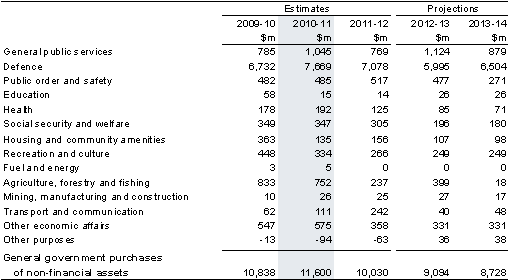
Table 21 reports the acquisition of non‑financial assets by function before taking into account depreciation or amortisation.
Table 21: Australian Government general government purchases of
non‑financial assets by function
Trends in Australian Government staffing
Trends in the estimated annual average staffing level (ASL)2 for all agencies in the Australian Government general government sector are reported in Table 22 below. These data provide a summary of people employed by the Australian Government, including all Defence Force personnel and those employed by Statutory Authorities.
ASL data was first collected and published in the Budget papers for 2001‑02. Since 2001‑02, there has been significant growth in the number of ASL (approximately 45,900 or 22 per cent).
Table 22: Estimates of Average Staff Levels (ASL)

The current estimate is 258,321 ASL for 2009‑10. The 2010‑11 Budget is expected to result in a modest net increase of 383 ASL (0.1 per cent) in 2010‑11 across the General Government Sector. The Government's Career Transition and Support Centre in the Australian Public Sector Commission will assist staff and agencies affected by downsizing.
Appendix C5 provides details of ASL at the portfolio and agency level.
2 ASL figures reflect the average number of employees receiving salary or wages over the financial year, with adjustments for casual and part-time staff, to show the average full-time equivalent (FTE). ASL figures also include non-uniformed staff and overseas personnel.
If www.budget.gov.au responds slowly or you are having trouble downloading a document, try one of the Budget Website Mirrors
Note: Where possible, Budget documents are available in HTML and for downloading in Portable Document Format(PDF). If you require further information on any of the tables or charts on this website, please contact The Treasury.