




Part 2: Payments for Specific Purposes (Continued)
Health
National Healthcare Agreement
The National Healthcare Agreement agreed by COAG in November 2008 affirms the commitment of the Commonwealth and the States to:
- ensuring that there is a focus on health policy and prevention of disease and injury and the maintenance of health, not simply the treatment of illness;
- meeting the primary health care needs of all Australians efficiently through timely and quality care;
- ensuring that people with complex care needs can access comprehensive, integrated and coordinated services;
- providing timely and appropriate high‑quality hospital and hospital‑related care to all Australians;
- meeting the needs of older Australians through high‑quality, affordable health and aged care services that are appropriate to their needs, as well as enabling choice and seamless, timely transition within and across the different sectors;
- ensuring all Australians experience best‑practice care that is suited to their needs and circumstances;
- achieving health outcomes for Indigenous Australians that are comparable to the broader population and those living in rural and remote areas; and
- a sustainable health system that can respond and adapt to future needs.
National Health and Hospitals Network Agreement
On 20 April 2010, COAG, with the exception of Western Australia, agreed significant reforms to the health and hospital system — the establishment of a National Health and Hospitals Network.
The National Health and Hospitals Network Agreement provides for the establishment of the National Health and Hospitals Network as a nationally unified and locally controlled health system that will ensure future generations of Australians enjoy world class, universally accessible health care, by:
- establishing the Commonwealth as:
- the majority funder of public hospital services;
- responsible for full funding and policy responsibility for GP and primary health care; and
- responsible for full funding, policy, management and delivery responsibility for a national aged care system;
- establishing Local Hospital Networks to run hospitals and private healthcare organisations to run/co‑ordinate primary care; and
- establishing the States as:
- responsible for system‑wide public hospital service planning and performance (in conjunction with Local Hospital Networks) and capital planning; and
- key partners supporting the Commonwealth's responsibility for system‑wide GP and primary health care policy and service planning coordination.
Payment to support health services
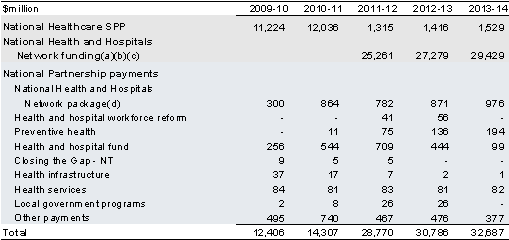
In 2010‑11, the Commonwealth will provide funding of $14.3 billion to support state health care services.
This includes funding in the 2010‑11 Budget of $3.8 billion, over five years commencing in 2009‑10, for National Health and Hospitals Network reform. These measures aim to improve the quality of health and hospital services by helping patients receive more seamless care across sectors of the health system, improving the quality of care patients receive through high performance standards and improved engagement of local clinicians, and providing a secure funding base for health and hospitals into the future.
These measures include:
- recurrent funding for around 22,000 additional elective surgery procedures in 2013‑14;
- implementing access targets for elective surgery so that by December 2015, 95 per cent of patients will be treated within clinically recommended times;
- additional funding for emergency department services to implement a new four‑hour national access target to ensure patients are admitted, referred or discharged within four hours of presentation to an emergency department; and
- 1,300 new sub‑acute care beds by 2013‑14.
From 2011‑12, the Commonwealth will provide National Health and Hospitals Network funding sourced from the existing National Healthcare SPP and an amount of GST dedicated to health and hospital services. This funding will be paid into a new National Health and Hospitals Network fund to fund public hospitals, primary care services, and — other than in Victoria — aged care.
Table 2.2 provides information on payments to support state health services, including additional investments and reforms under the National Health and Hospitals Network Agreement.
Table 2.2: Payments to the States to support health services
- Sourced from the National Healthcare SPP and GST dedicated to health and hospital services, other than for Western Australia.
- Estimates of GST dedicated to health and hospital services are calculated on the basis of Treasury projections using data from the Australian Institute of Health and Welfare. These estimates are indicative only, with final amounts of GST dedicated to health and hospital services to be determined annually, in consultation with the States, on the basis of actual expenditure.
- National Health and Hospitals Network funding for hospital services will be paid through the National Health and Hospitals Network fund to Local Hospital Networks via state‑based joint Intergovernmental funding authorities.
- Funding for this measure includes the full amount of funding allocated to Western Australia. This funding is dependent on the Western Australian Government becoming a signatory to the National Health and Hospitals Network Agreement.
National Healthcare SPP and National Health and Hospitals Network funding
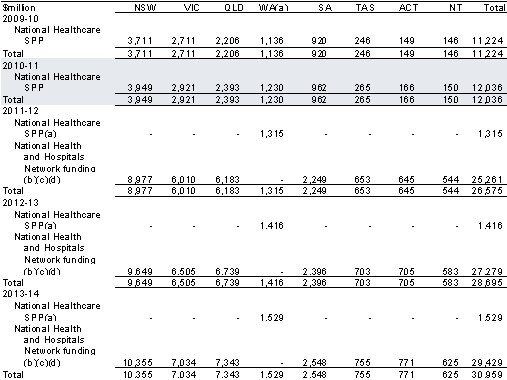
In 2010‑11, the Commonwealth will provide $12.0 billion to support state healthcare services through the National Healthcare SPP.
With the commencement of the National Health and Hospitals Network in 2011‑12, funding will increase from $12.0 billion to $26.6 billion reflecting the Commonwealth's increased funding responsibilities.
Table 2.2.1: National Healthcare SPP and National Health and Hospitals
Network funding
- Western Australia will continue to receive the National Healthcare SPP until it becomes a signatory to the National Health and Hospitals Network Agreement.
- Sourced from the National Healthcare SPP and GST dedicated to health and hospital services, other than for Western Australia.
- National Health and Hospitals Network funding for hospital services will be paid through the National Health and Hospitals Network fund to Local Hospital Networks via state‑based joint Intergovernmental funding authorities.
- Estimates of GST dedicated to health and hospital services are calculated on the basis of Treasury projections using data from the Australian Institute of Health and Welfare. These estimates are indicative only, with final amounts of GST dedicated to health and hospital services to be determined annually, in consultation with the States, on the basis of actual expenditure.
The National Healthcare SPP, which will expire in its current form in 2011‑12, will be indexed by the following factors:
- a health‑specific cost index (the Australian Institute of Health and Welfare health price index);
- the growth in population estimates weighted for hospital utilisation; and
- a technology factor (the Productivity Commission derived index of technology growth).
The growth factor for the National Healthcare SPP is currently estimated to be 7.24 per cent in 2010‑11.
National Health and Hospitals Network funding sourced from the National Healthcare SPP will continue to be indexed on 1 July each year. From 2011‑12, there will be an adjustment to funding sourced from the current National Healthcare SPP to ensure the agreed changes to the roles and responsibilities for the Home and Community Care program and related programs in the National Health and Hospitals Network Agreement are budget neutral to both the States and the Commonwealth. This includes all States with the exception of Victoria, which is not a party to this part of the agreement. The adjustment for Western Australia is dependent on it becoming a signatory to the National Health and Hospitals Network Agreement.
National Partnership payments for Health
National Health and Hospitals Network — hospitals and mental health
Hospitals — four hour national access target for emergency departments — facilitation and reward funding
The Commonwealth will provide $500 million over four years to introduce a four hour national access target to reduce the time taken to treat patients in public hospital emergency departments.
The funding will comprise:
- $250 million in facilitation payments to facilitate improved emergency department performance, and help States move towards a new four hour national target; and
- $250 million in reward payments from 2011‑12 for those States that meet this target.
The four hour national access target for emergency departments will require hospitals to admit, refer for follow‑up treatment, or discharge at least 95 per cent of patients within four hours of presenting at a hospital emergency department, where it is clinically appropriate to do so. The implementation of the four hour target will be staggered over time, so that it will first apply — in 2011 — to those cases in the most urgent category of clinical need, and will be progressively applied to the less urgent clinical triage categories in subsequent years.
This measure forms part of the Commonwealth's National Health and Hospitals Network package.
Table 2.2.2: Estimated payments to the States for hospitals — four hour
national access target for emergency departments — facilitation and reward
funding

- Funding for this measure includes the full amount of funding allocated to Western Australia from 2011‑12. This funding is dependent on the Western Australian Government becoming a signatory to the National Health and Hospitals Network Agreement.
Hospitals — four hour national access target for emergency departments — capital funding
The Commonwealth will provide $250 million over four years to expand capacity within the hospital system for emergency department treatment.
The expansion of emergency departments and associated facilities will help achieve the Commonwealth's new four hour national access target. This target will require emergency departments to admit, refer or discharge patients within four hours of presenting at a hospital emergency department. This funding will allow for the upgrade of public hospital emergency departments in order to meet these new targets and will be distributed based on population and need.
This measure forms part of the Commonwealth's National Health and Hospitals Network package.
Table 2.2.3: Estimated payments to the States for hospitals — four hour
national access target for emergency departments — capital funding

- Funding for this measure includes the full amount of funding allocated to Western Australia. This funding is dependent on the Western Australian Government becoming a signatory to the National Health and Hospitals Network Agreement.
Hospitals — improving access to elective surgery — facilitation and reward funding
This reform component seeks to implement access targets for elective surgery so that:
- by December 2014, 95 per cent of patients in urgency categories 1 and 2 will be treated within clinically recommended times; and
- by December 2015, 95 per cent of patients in category 3 will be treated within clinically recommended times.
To support the achievement of these targets, the Commonwealth will make $650 million available to the States over four years. These funds are to facilitate and reward the staged achievement of national access guarantees and elective surgery targets for public elective surgery patients.
In 2010‑11, funding includes $300 million for an intensified focus on patients who have been waiting longer than clinically recommended times. Reward payments of $350 million over three years will be provided from 2011‑12 to 2013‑14, to reward the achievement of performance targets. These funds are expected to support an additional 22,000 elective surgery procedures each year by 2013‑14.
The Commonwealth will meet 60 per cent of the recurrent cost of services provided from 2014‑15 onwards.
This measure forms part of the Commonwealth's National Health and Hospitals Network package.
Table 2.2.4: Estimated payments to the States for hospitals — improving
access to elective surgery — facilitation and reward funding

- Funding for this measure includes the full amount of funding allocated to Western Australia. This funding is dependent on the Western Australian Government becoming a signatory to the National Health and Hospitals Network Agreement.
Hospitals — improving access to elective surgery — capital funding
The Commonwealth will provide $150 million over three years to boost elective surgery capacity in public hospitals.
Expanding the capacity to perform additional elective surgery will help to achieve the Commonwealth's new national target for elective surgery and the National Access Guarantee for Elective Surgery. This target seeks to ensure that 95 per cent of elective surgery patients in all urgency categories are treated within the clinically recommended time by the end of 2015.
This measure, in conjunction with National Health and Hospitals Network — Improving access to elective surgery — facilitation and reward funding will help the hospital system to provide an additional 22,000 elective surgery procedures each year by 2013‑14.
This measure forms part of the Commonwealth's National Health and Hospitals Network package.
Table 2.2.5: Estimated payments to the States for hospitals — improving
access to elective surgery — capital funding

- Funding for this measure includes the full amount of funding allocated to Western Australia. This funding is dependent on the Western Australian Government becoming a signatory to the National Health and Hospitals Network Agreement.
Hospitals — new sub‑acute hospital beds
The Commonwealth will provide $1.6 billion over four years to provide funding for at least 1,300 additional beds for sub‑acute services.
Under this measure, States will need to commit to — and establish — an agreed number of new sub‑acute beds each year to receive a payment from the Commonwealth. These beds could be provided in public hospitals, as well as in private hospitals or in community settings. This funding will provide beds for palliative, rehabilitative and geriatric care, as well as sub‑acute mental health treatment.
This measure forms part of the Commonwealth's National Health and Hospitals Network package.
Table 2.2.6: Estimated payments to the States for hospitals — new
sub‑acute hospital beds

- Funding for this measure includes the full amount of funding allocated to Western Australia. This funding is dependent on the Western Australian Government becoming a signatory to the National Health and Hospitals Network Agreement.
Hospitals — flexible funding for emergency departments, elective surgery and sub‑acute care
The Commonwealth will provide $200 million over four years to increase hospital capacity and improve services to patients through a funding pool. The funding pool will give the States capacity to rapidly respond to capital and recurrent cost needs in the hospital system in relation to emergency departments, elective surgery and sub‑acute care. This funding will also allow for minor repairs and improvements to public hospitals to be rapidly completed.
This measure forms part of the Commonwealth's National Health and Hospitals Network package.
Table 2.2.7: Estimated payments to the States for hospitals — flexibility
funding for emergency departments, elective surgery and sub‑acute care

- Funding for this measure includes the full amount of funding allocated to Western Australia. This funding is dependent on the Western Australian Government becoming a signatory to the National Health and Hospitals Network Agreement.
Mental health — expanding the Early Psychosis Prevention and Intervention Centre model
The Commonwealth will provide $23.5 million over four years to establish a new Early Psychosis Prevention and Intervention Centres (EPPIC) model with interested States. This measure builds on the EPPIC model currently operating in Victoria. EPPIC provides an integrated and comprehensive mental health service to help address the needs of people aged 15‑24 with emerging psychosis. Services provided include early intervention, education, career support, and clinical treatment.
This measure forms part of the Commonwealth's National Health and Hospitals Network package.
Table 2.2.8: Estimated payments to the States for mental health —
expanding the Early Psychosis Prevention and Intervention Centre model

- Funding for this measure includes the full amount of funding allocated to Western Australia. This funding is dependent on the Western Australian Government becoming a signatory to the National Health and Hospitals Network Agreement.
Aged care — supporting long stay older patients
The Commonwealth will redirect funding of $276.4 million over three years from 2011‑12 from high care residential aged care places to State governments to provide similar levels of care for Long Stay Older Patients (LSOP) in public hospitals.
As the numbers of LSOP are expected to decline over time as a result of other reforms announced as part of the National Health and Hospitals Network package, this measure funds up to 2,000 places in 2011‑12, up to 1,700 places in 2012‑13 and up to 1,400 places in 2013‑14. The cost of these places will be met from within existing funding in the forward estimates for aged care places.
This measure also provides for the continuation of the existing LSOP initiative for a further two years to 2011‑12. This initiative supports hospitals and multi‑purpose services to deliver more flexible care to older people. Through this initiative the Commonwealth is providing $37.5 million per year to States, allocated on the basis of the population of aged persons in each State. See also Helping public patients in public hospitals waiting for nursing homes in the National Partnership on Health Services section of this document.
This measure forms part of the Commonwealth's National Health and Hospitals Network package.
Table 2.2.9: Estimated payments to the States for aged care — supporting
long stay older patients

- Funding for this measure includes the full amount of funding allocated to Western Australia. This funding is dependent on the Western Australian Government becoming a signatory to the National Health and Hospitals Network Agreement.
Aged care — expand access to multi‑purpose services
The Commonwealth will provide $120 million over three years to establish new, and increase the capacity of existing, multi‑purpose service facilities. Up to 286 additional beds are expected to be available by 2012‑13. Multi‑purpose services provide a combination of services including acute‑care, residential aged care, community health, home and community care, and other health‑related services. These services ensure that small communities supporting a range of independently run services have access to more coordinated and cost‑effective services.
This measure forms part of the Commonwealth's National Health and Hospitals Network package.
Table 2.2.10: Estimated payments to the States for aged care — expanding
multi‑purpose services

- Funding for this measure includes the full amount of funding allocated to Western Australia. This funding is dependent on the Western Australian Government becoming a signatory to the National Health and Hospitals Network Agreement.
National Partnership on hospital and health workforce reform
The Commonwealth will provide $1.4 billion over five years ($96.9 million from 2009‑10 to 2012‑13) under the National Partnership on hospital and health workforce reform. Under the agreement, $1.1 billion will be paid as a Commonwealth Own Purpose Expense and $0.5 billion paid as a State contribution. This National Partnership aims to improve the efficiency of public hospital services, enhance health workforce capability and supply, increase the volume and quality of sub‑acute care services, and improve the operations of emergency departments. It will support an efficient and effective public hospital system that delivers high‑quality and safe services to patients.
The outputs of this National Partnership include:
- a nationally consistent approach to activity‑based funding of public hospital services;
- increased capacity and productivity for the health workforce;
- enhanced sub‑acute care services; and
- better outcomes for emergency department patients.
Funding for increased capacity and productivity for the health workforce is provided to the National Health Workforce Agency or relevant organisation, rather than directly to the States, and has thus been reflected in the National Partnership as a Commonwealth Own Purpose Expense.
Payments for enhanced sub‑acute care services and better outcomes for emergency department patients were made in 2008‑09.
Activity‑based funding
This reform component will move jurisdictions to a more nationally consistent approach to funding services provided in public hospitals, whilst adhering to the Community Service Obligations required for the maintenance of small and regional hospital services, for which an activity‑based funding approach would not be adequate.
Activity‑based funding is a management tool that has the potential to enhance public accountability and drive technical efficiency in the delivery of health services.
The Commonwealth will provide $133.4 million in funding for this reform component. $36.5 million was paid in 2008‑09, with the remaining amounts to be paid in 2011‑12 and 2012‑13.
Table 2.2.11: Estimated payments to the States for activity‑based funding

National Partnership on preventive health
The Commonwealth will provide $642.9 million over six years to 2015‑16 ($415.5 million from 2009‑10 to 2013‑14) for the National Partnership on preventive health. This National Partnership has been established to address the rising prevalence of lifestyle‑related chronic diseases. It will lay the foundations for healthy behaviours in the daily lives of Australians, including instituting programs to address risk factors related to smoking, nutrition, alcohol, and physical activity.
The National Partnership will contribute to increasing the proportion of children and adults at healthy body weight and meeting national guidelines for healthy eating and physical activity; reducing the proportion of adults smoking daily; and reducing harmful consumption of alcohol.
These outcomes will be achieved through the delivery of a range of programs related to healthy children, workers and communities, as well as partnerships with industry, enabling infrastructure and social marketing campaigns.
Healthy children
The Commonwealth will provide funding for the States to deliver a range of programs for children, covering physical activity, healthy eating and prevention in settings such as child care centres, pre‑schools and schools. The payments to the States for healthy children programs will be structured as 50 per cent facilitation payment and 50 per cent reward payment.
Table 2.2.12: Estimated payments to the States for healthy children

Healthy workers
In addition to developing a national healthy workplace charter with peak employer and employee groups, the Commonwealth will provide funding to the States to facilitate the delivery of healthy living programs in workplaces, covering topics such as physical activity, healthy eating, harmful consumption of alcohol and smoking cessation. The payments to the States will be structured as 50 per cent facilitation payment and 50 per cent reward payment.
Table 2.2.13: Estimated payments to the States for healthy workers

Social marketing
In addition to funding a social marketing campaign to extend and complement the Australian Better Health Initiative campaign, the Commonwealth will fund the States to provide reinforcing local activities. These payments will be provided as facilitation payments.
Table 2.2.14: Estimated payments to the States for social marketing

Enabling infrastructure
The Commonwealth will establish the Australian National Preventive Health Agency, as well as provide additional funding to create the Australian Health Survey, which will collect representative data on the prevalence of chronic diseases and lifestyle related risk factors amongst Indigenous and non‑Indigenous Australians, including nutrition, physical activity and biomedical measures.
The Commonwealth will also provide funding to the States for additional state‑based surveillance activities covering nutrition and physical activity measures consistent with national protocols.
The payments will be provided as facilitation payments.
Table 2.2.15: Estimated payments to the States for enabling infrastructure

National Partnership on Closing the Gap — Northern Territory
The Commonwealth will provide funding to the States of $18.7 million over three years from 2009‑10 to continue to strengthen the measures initiated under the Northern Territory Emergency Response (NTER). The funding will be provided to the Northern Territory to deliver initiatives across law and order, community safety, education, health, food security, and interpreters. The Commonwealth will work in partnership with the Northern Territory and Indigenous communities to move NTER into a long‑term development phase.
The education and community services section outlines further payments made under the National Partnership on Closing the Gap — Northern Territory.
Table 2.2.16: Estimated payments to the States for Closing the Gap —
Indigenous health and related services

National Partnership for health infrastructure
Several payments will be combined into a National Partnership for health infrastructure.
Tasmanian health package
The Commonwealth will provide funding to improve health services in Tasmania. The Tasmanian package includes expanded radiation oncology services in North/North West Tasmania, increased patient transport and accommodation services through the Tasmanian patient transport initiative and investment in the Launceston Integrated Cancer Care Centre.
Table 2.2.17: Estimated payments to the States for radiation oncology
services in North/North West Tasmania

Table 2.2.18: Estimated payments to the States for patient transport and
accommodation services

Table 2.2.19: Estimated payments to the States for the Launceston
Integrated Cancer Care Centre

PET scanner for the Royal Hobart hospital
The Commonwealth provided funding in 2009‑10 for the purchase of a positron emission tomography (PET) scanner at Royal Hobart hospital.
Table 2.2.20: Estimated payments to the States for the PET scanner for the
Royal Hobart hospital

PET scanner for Calvary Mater hospital, Newcastle
The Commonwealth provided funding in 2009‑10 for the purchase of a PET scanner at Calvary Mater Newcastle hospital. This complements the Hunter‑New England region's major centre for oncology services.
Table 2.2.21: Estimated payments to the States for a PET scanner for the
Calvary Mater hospital

PET scanner for the Westmead hospital, Sydney
The Commonwealth will provide funding to New South Wales for the provision of PET scanner services and research at Westmead hospital.
Table 2.2.22: Estimated payments to the States for a PET scanner for the
Westmead hospital

Olivia Newton‑John cancer centre, Melbourne
The Commonwealth provided funding in 2009‑10 towards the establishment of the Olivia Newton‑John cancer centre at the Austin hospital, Melbourne. The centre is a purpose‑built facility that combines cancer treatment services with clinical research programs currently run by Austin Health and the International Ludwig Institute for Cancer Research.
Table 2.2.23: Estimated payments to the States for the Olivia Newton‑John
cancer centre

Children's cancer centre, Adelaide
The Commonwealth will provide funding to South Australia for the construction of a purpose‑built children's cancer centre at the Women's and Children's Hospital in Adelaide. The new centre will establish a fully integrated, dedicated children's cancer facility that will provide state of the art care and treatment facilities.
Table 2.2.24: Estimated payments to the States for the children's cancer
centre, Adelaide

Lismore integrated cancer centre
The Commonwealth provided funding in 2009‑10 to bring forward the completion of the integrated cancer centre at the Lismore base hospital to May 2010. The integrated cancer centre is a purpose‑built facility offering a range of cancer treatments including a radiation oncology service.
Table 2.2.25: Estimated payments to the States for the Lismore integrated
cancer centre

Cairns base hospital chemotherapy cancer initiative
The Commonwealth provided funding in 2009‑10 towards the Cairns base hospital chemotherapy initiative.
Table 2.2.26: Estimated payments to the States for the Cairns base hospital
chemotherapy cancer initiative

Cairns integrated cancer centre
The Commonwealth will provide funding towards the establishment of an integrated cancer centre at the Cairns base hospital. The integrated cancer centre will be a purpose‑built facility offering a range of cancer treatments including a radiation oncology service.
Table 2.2.27: Estimated payments to the States for the Cairns integrated
cancer centre

Health infrastructure projects in Tasmania
The Commonwealth will provide funding to Tasmania to upgrade chemotherapy and cancer facilities in North West Tasmania, with a focus on the North West Regional hospital at Burnie. Funding will also be provided to upgrade a portion of the additional patient accommodation proposed for Launceston.
Table 2.2.28: Estimated payments to the States for upgrading
chemotherapy and cancer facilities in North West Tasmania

Table 2.2.29: Estimated payments to the States for upgrading patient
accommodation for Launceston

National Partnership on health services
Several payments will be combined into a National Partnership on health services.
Healthy kids health checks
The Commonwealth will provide funding to the States to strengthen linkages between the Medicare Benefits Schedule healthy kids check and state‑funded child health assessment services, and to promote further the provision of health assessment services to children who are about to enter school.
The program will promote early detection of lifestyle risk factors, delayed development and illness, and introduce guidance for healthy lifestyles and early intervention strategies.
Table 2.2.30: Estimated payments to the States for healthy kids health
checks

Reducing rheumatic heart fever for Indigenous children
The Commonwealth will provide funding to support disease registers and control programs for acute rheumatic fever and rheumatic heart disease to reduce rheumatic heart fever for Indigenous children.
Table 2.2.31: Estimated payments to the States for reducing rheumatic
heart
fever for Indigenous children

National bowel cancer screening program
The Commonwealth will provide funding to the States to support follow‑up for national bowel cancer screening program participants who returned a positive test result. The second phase of the program commenced on 1 July 2008, and offers testing to people turning 50, 55 or 65 years of age between January 2008 and December 2010.
Table 2.2.32: Estimated payments to the States for the national bowel
cancer
screening program

National perinatal depression initiative
The Commonwealth will provide funding to the States for the national perinatal depression initiative. The initiative aims to improve prevention and early detection of antenatal and postnatal depression and provide better support and treatment for expectant and new mothers experiencing depression.
Table 2.2.33: Estimated payments to the States for the national perinatal
depression initiative

Victorian cytology service
The Commonwealth will provide funding for the Victorian cytology service. The service is a Commonwealth‑funded pathology laboratory, responsible for reporting cervical cytology tests.
Table 2.2.34: Estimated payments to the States for the Victorian cytology
service

OzFoodNet
The Commonwealth will provide funding for OzFoodNet. OzFoodNet is a collaborative initiative with state health authorities for enhanced food‑borne disease surveillance, to provide a better understanding of the causes and incidence of food‑borne disease in the community and to provide an evidence base for policy formulation.
OzFoodNet collaborates nationally to coordinate investigations into food‑borne disease outbreaks, particularly those that cross state and country borders.
Table 2.2.35: Estimated payments to the States for OzFoodNet

Pneumococcal disease surveillance
The Commonwealth will provide funding for the vaccine‑preventable pneumococcal disease surveillance program. The program will improve surveillance reporting of pneumococcal disease and allow national monitoring, analysis and timely reporting of data to provide an evidence base for policy formulation.
Table 2.2.36: Estimated payments to the States for pneumococcal disease
surveillance

Vaccine‑preventable diseases surveillance program
The Commonwealth will provide funding for the vaccine‑preventable diseases surveillance program. The program will improve surveillance reporting of nationally notifiable vaccine‑preventable diseases and allow national monitoring, analysis and timely reporting of data to provide an evidence base for policy formulation.
Table 2.2.37: Estimated payments to the States for vaccine‑preventable
diseases surveillance program

National public health — human quarantine services
The Commonwealth will provide funding for human quarantine services to support the implementation of health measures at our international borders. The aim of these health measures is to manage the risk of travellers bringing designated diseases into Australia.
Table 2.2.38: Estimated payments to the States for national public health —
human quarantine services

Royal Darwin hospital — equipped, prepared and ready
The Commonwealth will provide funding for the national critical care and trauma response centre at Royal Darwin hospital and to maintain it in a state of readiness to respond to a major incident in the region.
Table 2.2.39: Estimated payments to the States for Royal Darwin hospital —
equipped, prepared and ready

Health care grants for the Torres Strait
The Commonwealth will provide funding to Queensland towards the costs associated with the provision of health care to Papua New Guinea nationals by Queensland health services.
Table 2.2.40: Estimated payments to the States for health care grants for
the
Torres Strait

Torres Strait Islander health protection strategy
The Commonwealth will provide funding to Queensland to assist in mosquito detection and eradication in the region. Funding will also be provided to Queensland to support the Torres Strait communication officer position.
Table 2.2.41: Estimated payments to the States for the Torres Strait
Islander
health protection strategy

Sexual assault counselling in remote Northern Territory areas
The Commonwealth will provide funding to the Northern Territory to assist Indigenous communities affected by sexual assault‑related trauma. Small teams of professionally qualified counsellors and Indigenous sexual assault workers will provide culturally safe mobile outreach services to children, families and communities in remote areas of the Northern Territory from regionally‑based locations in Tennant Creek, Darwin, Katherine and Alice Springs. This service is known as the NT mobile outreach service.
Table 2.2.42: Estimated payments to the States for sexual assault
counselling
in remote Northern Territory areas

Satellite renal dialysis facilities in remote Northern Territory communities
The Commonwealth will provide funding to the Northern Territory to improve access to renal dialysis services for remote communities in the Northern Territory, to help reduce the pressure on existing renal services. In the Northern Territory, Aboriginal and Torres Strait Islander people have an incidence of end‑stage renal disease at least 28 times higher than that for non‑Indigenous Australians.
Table 2.2.43: Estimated payments to the States for satellite renal dialysis
facilities in remote Northern Territory communities

Supporting nurses to return to the workforce
The Commonwealth will redirect funding from the bringing the nurses back into the workforce program and will cease administration arrangements. This will involve negotiations with state Departments of Health and participating private hospitals, as well as consultations with the profession.
The Commonwealth will ensure that nurses who are currently enrolled in the program will continue to receive incentive payments, although no new nurses will be accepted into the program from 12 May 2010.
Table 2.2.44: Estimated payments to the States for supporting nurses to
return to the workforce — incentive payments

Table 2.2.45: Estimated payments to the States for supporting nurses
to return to the workforce — training payments

Helping public patients in public hospitals waiting for nursing homes
The Commonwealth will provide funding to improve care outcomes for older patients in public hospitals who no longer require acute care or rehabilitation and who are waiting for residential aged care. The funding enables the States to provide a range of services relevant to their own service systems, to enhance the care of older people in public hospitals and reduce the risk of hospitalisation.
Table 2.2.46: Estimated payments to the States for helping public patients
in public hospitals waiting for nursing homes

Health and Hospitals Fund
Health and Hospitals Fund — hospital infrastructure and other projects of national significance
The Commonwealth will provide $1.5 billion over seven years from the Health and Hospitals Fund to support the development of health infrastructure projects of national significance. The Commonwealth will collaborate with the States to expand and modernise key public hospitals across Australia to improve hospital care.
Table 2.2.47: Estimated payments to the States for Health and Hospitals
Fund — hospital infrastructure and other projects of national significance

Health and Hospitals Fund — national cancer system
The Commonwealth will provide $1.3 billion over six years from the Health and Hospitals Fund to support infrastructure to deliver a world‑class cancer care system in Australia. This funding will help modernise cancer services and improve detection, survival and treatment outcomes, particularly for patients in regional and rural Australia.
Table 2.2.48: Estimated payments to the States for Health and Hospitals
Fund — national cancer system(a)

- Annual estimates may change as a result of funding negotiations.
Health and Hospitals Fund — translational research and workforce training
The Commonwealth will provide $430.3 million over six years ($71.0 million from 2009‑10 to 2012‑13) from the Health and Hospitals Fund to support translational medical research infrastructure. This translational research investment will provide new medical research infrastructure in the areas of mental health and neurological disorders, child health, Indigenous health and medical bionics. The funding has been targeted at projects that will focus on translating research into clinical practice to deliver better health outcomes for all Australians.
Table 2.2.49: Estimated payments to the States for Health and Hospitals
Fund — translational research and workforce training

Local government programs
Healthy communities
The Commonwealth provides funding to support the national roll‑out of successful and effective community‑based physical activity and healthy eating programs.
Table 2.2.50: Estimated payments to local government for healthy
communities

Other National Partnership payments for health
National Partnership on the East Kimberley development package — health related projects
The Commonwealth will provide $43.5 million to Western Australia for health infrastructure projects from the East Kimberley development package. Investment priorities under the package include primary and preventive health care, drug and alcohol services, short‑term patient accommodation, housing for health service providers, improvements to remote clinics, aged care facilities and environmental health measures. Improving primary and preventative health care services in these areas will reduce the incidence of chronic and acute illness in the community as well as reduce the pressure on acute health services in Kununurra and Wyndham.
The East Kimberley development package as a whole is described in the infrastructure services section.
Table 2.2.51: Estimated payments to the States for the East Kimberley
development package — health related projects

Repatriation general hospitals
The Commonwealth met its future payment commitments to the States in respect of repatriation general hospitals by providing a single payment in 2009‑10 and ceasing future annual payments. The final payment represented the present value of the stream of future annual payments.
Table 2.2.52: Estimated payments to the States for repatriation general
hospitals

Essential vaccines
The Commonwealth has implemented the National Partnership agreement on essential vaccines to provide funding to States for essential vaccines included in the National Vaccine Schedule. The National Partnership agreement provides for transitional arrangements to allow time for the Commonwealth to enter into centralised purchasing arrangements for individual vaccines and transition to a Commonwealth Own Purpose Expense.
Table 2.2.53: Estimated payments to the States for essential vaccines

Organ transplantation services
The Commonwealth met its future payment commitments to the States in respect of organ transplantation by providing a single payment in 2009‑10. Future annual payments were ceased.
Under long‑standing arrangements, the Commonwealth has reimbursed New South Wales and South Australia for 40 per cent of the cost of certain organ and tissue transplantation‑related services that are conducted by the Australian Red Cross Blood Service.
Table 2.2.54: Estimated payments to the States for organ transplantation
services

Table 2.2.55: Estimated payments to the States for organ transplantation
services — capital component

Northern Territory medical school — funding contribution
The Commonwealth will provide funding towards recurrent costs for the Northern Territory medical school. This recurrent funding is in addition to the capital grant of $27.8 million over three years provided by the Commonwealth for the establishment of the school. The capital grant will be funded from the Health and Hospitals Fund established in 2009‑10.
Table 2.2.56: Estimated payments to the States for the Northern Territory
medical school

Elective surgery waiting list reduction plan
The Commonwealth will provide funding under the elective surgery waiting list reduction plan. Facilitation funding will be provided for systemic improvements such as the construction of additional operating theatres and the purchase of new surgical equipment to improve long term elective surgery performance. Reward funding will be provided as a reward for those States that reduce elective surgery waiting times and increase surgery throughput.
Table 2.2.57: Estimated payments to the States for elective surgery waiting
list reduction plan

Commonwealth Dental Health Program
The Commonwealth Dental Health Program will provide funding to reduce public dental waiting lists.
The Commonwealth has signalled its intention to close the previous Government's Medicare chronic disease dental scheme, in order to make funding available for the introduction of the Commonwealth Dental Health Program and the Medicare Teen Dental Plan. However, without the support of the Senate, the Commonwealth has been unable to put in place the necessary subordinate legislation to close the Medicare Chronic Disease Dental Scheme. The commencement of the program is therefore on hold.
Table 2.2.58: Estimated payments to the States for the Commonwealth
Dental Health Program

National Partnership on Indigenous early childhood development — antenatal and reproductive health
Under the National Partnership on Indigenous early childhood development the Commonwealth will provide $107 million for antenatal and reproductive health. The funding is to improve access to antenatal care by young Indigenous mothers, and support young Indigenous women to make informed decisions about their sexual and reproductive health.
The education section outlines further payments made under the National Partnership on Indigenous early childhood development.
Table 2.2.59: Estimated payments to the States for the Indigenous
early childhood development program — antenatal and reproductive health

If www.budget.gov.au responds slowly or you are having trouble downloading a document, try one of the Budget Website Mirrors
Note: Where possible, Budget documents are available in HTML and for downloading in Portable Document Format(PDF). If you require further information on any of the tables or charts on this website, please contact The Treasury.