




Part 2: Payments for Specific Purposes (Continued)
Skills and workforce development
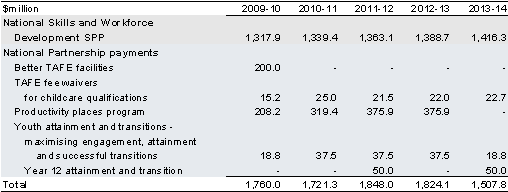
In 2010‑11, the States will receive $1.7 billion in payments from the Commonwealth to support state skills and workforce development‑related services.
Policy decisions in this Budget include the redirection of funding from the forward estimates for the National Partnership on the productivity places program in 2013‑14. This reflects the scheduled conclusion of the National Partnership and will provide savings of $375.9 million that will be redirected to provide more effective support for skills development under the Government's skills for sustainable growth package.
Table 2.4 provides information on all payments to the States to support state skills and workforce development‑related services.
Table 2.4: Payments to support state skills and workforce development
services
National Agreement for Skills and Workforce Development
The National Agreement for Skills and Workforce Development aims to provide Australians with the opportunity to develop the skills and qualifications needed to participate in, and contribute to, the labour market.
Central to achieving this objective is a shared commitment to a national training system that is responsive to local needs, and delivers high‑quality and nationally consistent training outcomes. This will help to ensure that the skills provided by the national training system are responsive to changing labour market demand.
The reforms needed to achieve the objectives and outcomes in the agreement include reforming training products and services to meet a more demand‑ and client‑driven system, and driving further competition in training arrangements.
National Skills and Workforce Development SPP
The National Skills and Workforce Development SPP is the funding associated with the National Skills and Workforce Development Agreement. The Government is providing $6.8 billion over five years from 2009‑10 to work towards increasing the skill levels of all Australians, including Indigenous Australians. The 2009‑10 base funding will be provided on an ongoing basis and indexed from 1 July 2010.
Table 2.4.1: Estimated payments to the States for the National Skills and
Workforce Development SPP

Growth factor
The Intergovernmental Agreement defines the growth factor for the National Skills and Workforce Development SPP as the product of:
0.85 x wage cost index one + 0.15 x wage cost index six
The growth factor is estimated to be 1.63 per cent in 2010‑11. This is lower than estimated in MYEFO 2009‑10 owing to a decrease in both wage cost indices.
National Partnerships payments for skills and workforce development
National Partnership on better TAFE facilities
The Commonwealth will provide $200 million to the States in 2009‑10 to improve infrastructure in TAFE facilities. These payments are part of the overall $500 million being invested under the Teaching and Learning Capital Fund for Vocational Education and Training announced as part of the Nation Building Package on 12 December 2008.
Table 2.4.2: Estimated payments to the States for the National Partnership
on better TAFE facilities

National Partnership on TAFE fee waivers for childcare qualifications
The National Partnership on TAFE fee waivers for childcare qualifications provides $106.4 million over five years (2009‑10 to 2013‑14) to remove fees for the diploma and advanced diploma of children's services courses delivered at TAFE institutions, or by other government vocational education and training providers.
This agreement will assist in meeting the objectives of the National Partnership on early childhood education.
Table 2.4.3: Estimated payments to the States for the National Partnership
on TAFE fee waivers for childcare qualifications

National Partnership on productivity places program
The productivity places program is part of the Government's skilling Australia for the future initiatives and aims to reduce skills shortages and increase the productivity of industry and enterprises.
The program aims to deliver up to 557,556 course enrolments and 402,881 qualification commencements.
Funding under the National Partnership for existing worker training requires 50/40/10 cost sharing across the Commonwealth, States and private sources.
Job seeker training is 100 per cent Commonwealth funded.
The national priority list will be used as a starting point for the priority occupations to be targeted. States may suggest that qualifications be added or removed if there is evidence that national priorities do not reflect regional needs.
In the 2010‑11 Budget, the Government announced the redirection of funding from the forward estimates for the National Partnership on the productivity places program in 2013‑14.
Table 2.4.4: Estimated payments to the States for the National Partnership
on the productivity places program

National Partnership on youth attainment and transitions
The Commonwealth is providing continued funding of $150.1 million over five years (2009‑10 to 2013‑14) for initiatives to improve young people's engagement with learning, levels of Year 12 or equivalent attainment, and transition to further education, training, or employment, under the National Partnership on youth attainment and transitions.
The National Partnership also provides $100 million in reward funding to the States for progress towards the COAG target of 90 per cent Year 12 or equivalent attainment for 20 to 24 year olds by 2015.
The National Partnership includes two payments to the States. They are for:
- the implementation of strategies to address the reform areas of multiple learning pathways, career development, and mentoring — maximising engagement, attainment and successful transitions; and
- improving participation rates in 2010 and Year 12 or equivalent attainment rates in 2012 — reward funding.
Table 2.4.5: Estimated payments to the States for the National Partnership
on youth attainment and transition — maximising engagement, attainment
and successful transitions(a)

- The amount of funding paid to Victoria includes $44 million to be used to implement the school business community partnership brokers program through their local learning and employment network.
Table 2.4.6: Estimated payments to the States for the National Partnership
on youth attainment and transition — year 12 attainment and transition

If www.budget.gov.au responds slowly or you are having trouble downloading a document, try one of the Budget Website Mirrors
Note: Where possible, Budget documents are available in HTML and for downloading in Portable Document Format(PDF). If you require further information on any of the tables or charts on this website, please contact The Treasury.