




The Government's medium-term fiscal strategy
The medium-term fiscal strategy has remained unchanged since the Government's first budget in 2008‑09. The key elements of the strategy are to:
- achieve budget surpluses, on average, over the medium term;
- keep taxation as a share of GDP below the level for 2007‑08, on average; and
- improve the Government's net financial worth over the medium term.
The strategy provides the necessary flexibility for the budget position to vary in line with economic conditions, as it did in response to the global financial crisis, while providing for long-term fiscal sustainability.
In order to return the budget to surplus as quickly as possible after the global financial crisis, the Government also committed to:
- allow the level of tax receipts to recover naturally as the economy improves, while maintaining the Government's commitment to keep taxation as a share of GDP below the 2007‑08 level on average; and
- hold real growth in spending to 2 per cent a year until the budget returns to surplus.
The focus remains on returning the budget to surplus, including by continuing to reprioritise existing expenditure consistent with 2 per cent real expenditure growth and by allowing the level of tax receipts to continue to recover naturally as the economy improves.
Once the budget returns to surplus, and while the economy is growing at or above trend, the Government will maintain expenditure restraint by retaining a 2 per cent annual cap on real spending growth, on average, until surpluses are at least 1 per cent of GDP.
Delivering on the fiscal strategy
The Government has continued to demonstrate strong fiscal discipline, as required by the fiscal strategy. This discipline ensures that strengthening economic growth feeds directly through to a strengthening budget position. This strategy is expected to produce the fastest fiscal consolidation in at least 40 years (see Box 3.1).
Real growth in spending will be held to below 2 per cent a year as the economy returns to above trend growth (see Table 3.1). Restraint in spending growth and the natural recovery of tax receipts will see a progressive tightening of the fiscal policy stance over the forward estimates.
Table 3.1: Delivering the 2 per cent commitment

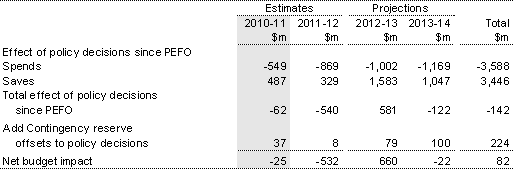
Since PEFO, the Government has offset all new spending decisions over the forward estimates, including those related to election commitments, by finding savings in other parts of the budget.
Table 3.2 shows the net effect of policy decisions taken since PEFO is a net saving of $82 million over the forward estimates. In assessing performance against the fiscal strategy, the total effect of policy decisions is adjusted to account for amounts that have previously been provided for in the Contingency Reserve. The Contingency Reserve offsets to policy decisions principally relate to official development assistance and provisioning for digital television switchover.
Table 3.2: Delivering fiscal reprioritisation
- On an underlying cash balance basis.
Box 3.1: Fastest fiscal consolidation since the 1960s
In order to return the budget to surplus as quickly as possible following the global financial crisis, the Government's fiscal strategy requires that the level of tax receipts be allowed to recover naturally as the economy improves and that real growth in spending be held to 2 per cent a year until the budget returns to surplus.
This strategy is projected to deliver a 4½ per cent of GDP fiscal consolidation in the three years to 2012‑13 (see Chart A). This is the fastest pace of fiscal consolidation in the forty years for which data on the underlying cash balance is available.
The strategy to return to surplus is deliberately designed to work on both the receipts and payments sides of the budget.
Chart A: Contribution of payments and receipts to fiscal consolidation
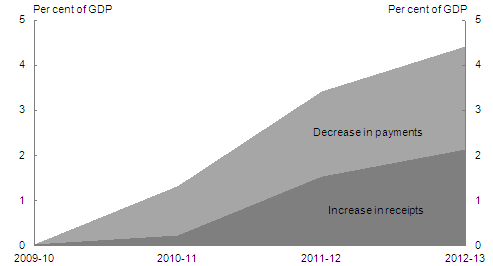
The commitment to allow the level of tax receipts to recover naturally ensures that stronger economic growth and lower unemployment are reflected in a stronger budget position. The commitment to spending restraint ensures that fiscal policy is tightened as the economic recovery proceeds.
This strategy, combined with a fiscal stimulus deliberately designed to be temporary, is delivering the large fiscal consolidation in the three years to 2012‑13. Around half of the fiscal consolidation comes from increasing receipts, while the other half is delivered through spending restraint.
A 1.3 per cent of GDP consolidation is projected for 2010‑11 alone. With only a modest recovery in receipts expected for 2010‑11, the majority of this consolidation comes from lower payments.
Chart B: Australian fiscal consolidations
Change in the underlying cash balance
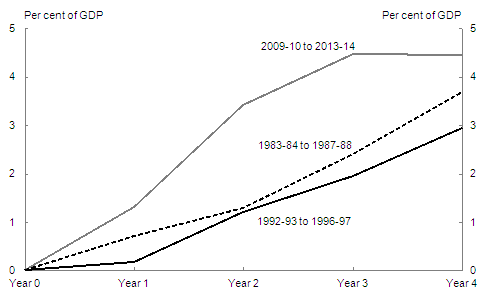
This consolidation is projected to be considerably faster than after previous economic downturns (see Chart B). The fiscal strategy is expected to result in a pace of consolidation over the first two years that is more than double the pace following the 1980s and 1990s recessions.
This substantial fiscal consolidation ensures the Government is reducing its contribution to aggregate demand as the private sector recovers, which will help temper inflationary pressures.
Medium term
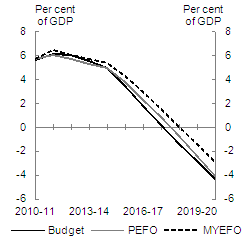
The budget position is projected to continue to strengthen over the medium term. The underlying cash balance is projected to reach a surplus of 1 per cent of GDP in 2016-17 (see Chart 3.1). Net debt is projected to return to zero in 2018-19, after peaking at 6.4 per cent of GDP in 2011‑12 (see Chart 3.2).
Chart 3.1: Underlying cash balances
projected to 2019‑20
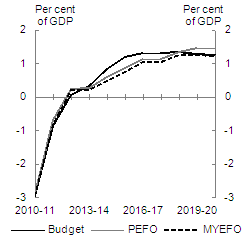
Chart 3.2: Government net debt
projected to 2019‑20
If www.budget.gov.au responds slowly or you are having trouble downloading a document, try one of the Budget Website Mirrors
Note: Where possible, Budget documents are available in HTML and for downloading in Portable Document Format(PDF). If you require further information on any of the tables or charts on this website, please contact The Treasury.