




Statement 2: Economic Outlook (Continued)
Overview
The recent natural disasters in Australia, Japan and New Zealand will reduce Australia's economic growth in early 2011. Combined, these natural disasters are expected to detract around ¾ of a percentage point from Australia's economic growth in 2010‑11, with real GDP likely to have contracted in the March quarter. While it will take many years for the affected communities to recover from these tragic events, the negative impacts on Australia's economic growth are expected to be temporary, with the resumption of activity and commencement of reconstruction expected to add to real GDP growth from 2011‑12.
More broadly, the Australian economy is in a strong position and the outlook is favourable, with above‑trend real GDP growth forecast over the next two years. Employment has grown strongly with over 300,000 jobs created over the past year and the unemployment rate has fallen to around 5 per cent. Underlying inflation has moderated and is currently at around decade lows. Beyond the short‑term impact of the natural disasters, Australia's real GDP growth is forecast to strengthen to 4 per cent in 2011‑12 and 3¾ per cent in 2012‑13, led by record levels of investment in the resources sector.
The favourable outlook for the Australian economy is supported by improving global conditions, although the international recovery remains uneven following the GFC and risks remain elevated. The world economy continues to recover and fears that growth would not be sustained have receded. Financial conditions have also improved, and global risk aversion and financial market volatility have moderated, notwithstanding ongoing concerns in some European countries. Looking ahead, the recovery in advanced economies is forecast to consolidate, while growth in the large emerging economies is expected to moderate to more sustainable rates. Accordingly, the global economy is expected to grow 4¼ per cent in 2011 and 4½ per cent in 2012, down from 5 per cent growth in 2010.
However, global economic conditions remain unbalanced. Output in the major advanced economies is still well below potential and, while economic growth has strengthened, it is not yet sufficient to make substantial inroads into high unemployment. This is at a time when governments in some major advanced economies are under pressure to make credible commitments towards medium‑term fiscal consolidation, leading to difficult policy trade‑offs. By contrast, after sustaining strong growth through the global recession, the large emerging market economies are now confronting significant capacity pressures.
While gaining traction, the global economic recovery also remains vulnerable. Uncertainty about the speed and strength of the Japanese recovery, compounded by the ongoing nuclear situation, and rising world oil prices are adding to existing fragilities. While financial conditions have improved in recent months, the potential for sovereign debt concerns in the euro area to affect the broader European financial sector and cause contagion effects beyond Europe remains a key risk. Failure to develop a credible medium‑term response to the unsustainable US fiscal position also poses a threat to the sustainability of the global recovery. Inflationary pressures continue to build in emerging market economies, driven by reduced spare capacity and compounded by rising food and oil prices. While oil prices have not returned to their July 2008 peaks, a further significant and sustained increase could pose broader risks to global growth in the context of a fragile global recovery.
Notwithstanding these risks, strong growth in China (now Australia's largest export market), India and in the other emerging economies of Asia is expected to underpin strong demand for Australian exports. Australia's major trading partners grew by a record 6.6 per cent in 2010, albeit from a low base, and are expected to grow by a robust 4½ per cent in 2011 and 5 per cent in 2012. This will continue to boost demand for Australia's non‑rural commodities and further support Australia's terms of trade.
Sustained high prices for Australia's key non‑rural commodity exports are driving record investment intentions in the mining sector and strong forecast growth in commodity exports. New engineering construction is expected to grow 56 per cent over the next two years, underpinned by large liquefied natural gas (LNG) projects, driving new business investment to 50‑year highs as a percentage of GDP. The surge in investment will expand the economy's capacity over time, with previous investment in mine and transport infrastructure underpinning a forecast increase in the volume of non‑rural commodity exports of over 20 per cent over the next two years.
Forecast growth in mining investment is well‑supported by projects that are already at an advanced stage and by the longer term outlook for global resources demand (Chart 1). While cyclical fluctuations in global growth will have implications for commodity prices, investment decisions are taken over longer time horizons and are underpinned by projections of the growing resource needs of the large emerging market economies over a period of decades. In value terms around two‑thirds of the large mining projects included in the economic forecasts have received final investment approval, with the majority of these already under construction.
Chart 1: Selected major resource projects
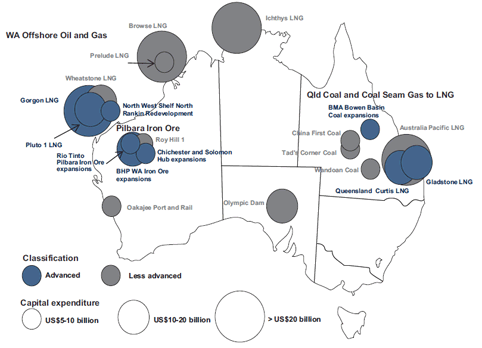
Note: ABARES defines advanced projects as either 'committed' or 'under construction' and less advanced projects as those undergoing a feasibility (in some cases, pre‑feasibility) study, or that have not yet been subject to a final investment decision since the completion of a feasibility study.
Source: Indicative estimates based on ABARES, company reports and other publicly available information.
The medium‑term outlook is for Australia's terms of trade to decline as the global supply of iron ore and coal increases. Still, the rapid pace of economic development in emerging Asia, and the prospect that strong resources‑intensive investment in China and India will continue for many years to come, underpin expectations that the decline in Australia's terms of trade will be gradual. One consequence of the increasing concentration of Australia's trade in non‑rural commodity exports to China and India is that Australia's economic outlook is now more sensitive to developments in those two countries.
Australia's high terms of trade are supporting strong national incomes and growth in the broader economy. However, conditions are expected to remain challenging in those sectors that are not benefitting — either directly or indirectly — from the resources boom. Australia's high terms of trade, strong growth relative to other advanced economies and tightened macroeconomic policy settings have seen the Australian dollar appreciate to post‑float highs. In real trade‑weighted terms, the exchange rate is currently around 40 per cent above its post‑float average, reducing the competitiveness of trade‑exposed sectors of the economy (Chart 2).
Chart 2: Real trade‑weighted exchange rate
(Post‑float average = 100)
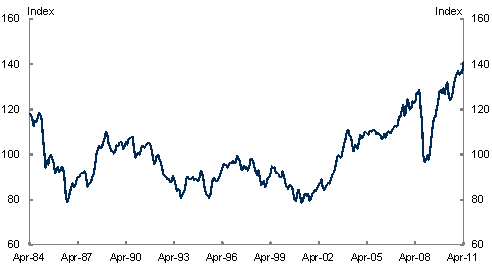
Source: RBA.
The high exchange rate and withdrawal of fiscal and monetary policy stimulus are helping to moderate inflationary pressures as the economy returns to full capacity. However, these same factors are also bearing down on activity and profits in some sectors. For many businesses, these challenges are compounded by more cautious household spending behaviour and greater difficulty accessing credit following the GFC. The mining investment boom is also increasing competition for labour and other inputs, raising cost pressures for some businesses. Therefore, while the Australian economy is expected to grow at an above‑trend rate over the next two years, conditions are likely to remain uneven across the economy.
Consistent with the strong outlook for real GDP growth, employment growth is expected to remain solid over the forecast period and the workforce participation rate is expected to remain at around record highs. The unemployment rate is forecast to fall gradually from around 5 per cent currently to 4½ per cent in the June quarter of 2013 as the economy approaches capacity. Underlying inflation is expected to remain contained but increase steadily, as the labour market tightens, to 3 per cent by the June quarter of 2013. Headline inflation will be higher in the short‑term due to the increase in world oil prices and the impact of the recent floods and Cyclone Yasi on fruit and vegetable prices.
While Australia's economic outlook is favourable, the significant risks to the global recovery noted earlier would, if they eventuated, have serious negative implications for economic growth. The adjustment in the economy as the mining sector expands, adding to capacity pressures and placing additional strains on other sectors, is a source of further uncertainty in the forecasts. Australia's high terms of trade also present risks. While the terms of trade are expected to remain at historically high levels, the prospect of heightened volatility and large adjustments become more significant the further prices for Australia's key non‑rural commodity exports are away from sustainable long‑run levels.
Notwithstanding Australia's positive medium‑term outlook, these risks, especially those to the global economy, heighten the importance of Australia continuing to pursue robust macroeconomic and structural policies. Fiscal consolidation will ensure that the Government is not compounding the pressures of a strengthening economy and that Australia is well prepared for any eventuality.
If www.budget.gov.au responds slowly or you are having trouble downloading a document, try one of the Budget Website Mirrors
Note: Where possible, Budget documents are available in HTML and for downloading in Portable Document Format(PDF). If you require further information on any of the tables or charts on this website, please contact The Treasury.