




Statement 2: Economic Outlook (Continued)
The outlook for the international economy
The global economic recovery is gaining momentum, but remains uneven and subject to significant downside risks. The recovery in the United States is consolidating, while robust growth in emerging market economies is continuing. Global financial conditions have also improved, notwithstanding the shocks from the earthquake in Japan and unrest in the Middle East and North Africa. However, output in the major advanced economies is still well below potential following the GFC, while the large emerging market economies are confronting significant capacity pressures. The strength and sustainability of the global recovery remains vulnerable due to ongoing stresses in European sovereign debt markets, enduring weaknesses in financial sector balance sheets, fiscal consolidation pressures in many of the major advanced economies, a build‑up of inflationary risks in emerging market economies and rising oil prices.
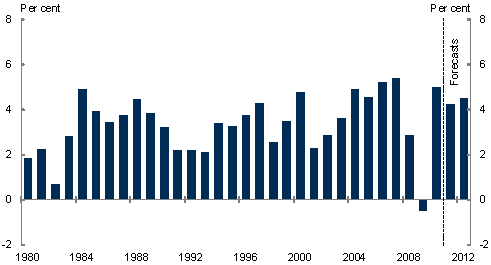
The global economy is expected to grow 4¼ per cent in 2011 and 4½ per cent in 2012, slightly lower than the stronger‑than‑expected 5 per cent growth recorded in 2010 (Chart 4).
Chart 4: World GDP growth
Source: IMF World Economic Outlook April 2011, Thomson Reuters and Treasury.
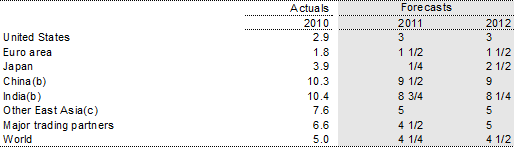
Australia's major trading partners (MTPs) are forecast to grow 4½ per cent in 2011, and 5 per cent in 2012 (Table 2) following 6.6 per cent growth in 2010, the strongest rate in more than 20 years. The easing in MTP growth in 2011 reflects, in part, the economic impact of the Japanese earthquake, and more generally an expected moderation in the rapid expansion in emerging Asia that occurred during the initial phase of the recovery. The Japanese earthquake is expected to detract around ¼ of a percentage point from MTP growth in 2011 and, through the reconstruction, add ¼ of a percentage point to MTP growth in 2012 (see Box 1).
Table 2: International GDP growth forecasts(a)
- World, euro area, and other East Asia growth rates are calculated using GDP weights based on purchasing power parity (PPP), while growth rates for major trading partners are calculated using export trade weights.
- Production‑based measure of GDP.
- Other East Asia comprises the newly industrialised economies (NIEs) of Hong Kong, South Korea, Singapore and Taiwan and the Association of Southeast Asian Nations group of five (ASEAN‑5), which comprises Indonesia, Malaysia, the Philippines, Thailand and Vietnam.
Source: National statistical agencies, IMF World Economic Outlook April 2011, Thomson Reuters and Treasury.
Developments in the United States and China, which are in different phases of their economic cycle, will largely determine the shape and durability of the global recovery. In the United States, macroeconomic policy remains highly accommodative, while in China the government is attempting to reduce inflationary pressures and overheating.
The outlook for the United States economy has solidified in recent months, with private consumption playing a larger role in the recovery. Extraordinary monetary policy accommodation continues to provide support to the economy. The fiscal package enacted in December 2010, based largely on tax cuts, will also play a role in supporting growth in 2011 by encouraging consumer spending. Following growth of 2.9 per cent in 2010, the United States economy is expected to continue to grow slightly above trend at 3 per cent in both 2011 and 2012, supporting a gradual fall in the unemployment rate.
A key uncertainty for the United States recovery is the potential for an extended period of high oil prices or continued lacklustre employment growth to dampen incomes growth and private consumption. Although the unemployment rate has fallen since November 2010 and employment growth has improved recently, there are still around 7 million fewer people employed than before the crisis. Unemployment is likely to remain significantly above pre‑crisis levels over the forecast period, weighing on recovery prospects. Further, although conditions in the United States housing market are stabilising and are unlikely to detract much more from growth, bloated inventories and weak house price growth will continue to restrain housing activity. Additionally, the wind‑down of stimulus and efforts to consolidate the fiscal position will be a drag on growth in 2012 and beyond.
The Chinese economy has continued to grow strongly, with GDP growth of 10.3 per cent in 2010. Despite a wind‑down of the Government's fiscal stimulus program and a tightening of monetary conditions, investment contributed over half (5.6 percentage points) of this growth and now makes up around half of GDP.
In 2011, the Chinese economy is forecast to grow 9½ per cent, before moderating slightly to 9 per cent in 2012. Domestic demand is expected to make a stronger contribution to growth, while net exports are expected to make a small positive contribution to growth in 2011 and 2012, as they did in 2010.
Consumption is expected to contribute more to growth than in the past, as China seeks to redirect growth away from investment by slowing credit expansion and moderating activity in the property sector. China's 12th Five Year Plan, which outlines key economic and social objectives for the next five years, is focused on restructuring China's economic model towards internal sources of growth.
Overall, Chinese Government policy continues to be supportive of growth. The key risks to the short‑term outlook are centred on controlling inflation and managing inflation expectations. Inflation is being driven by high food prices and excess liquidity. Despite recent increases in the reserve requirement ratio and interest rates, further tightening is likely, with the attendant risk of an overcorrection.
While the global outlook has improved, it is exposed to shocks and a number of key downside risks remain. Sovereign debt problems are most pressing in Europe. Greece and Ireland have already received European Union‑IMF rescue packages, and Portugal reached an agreement on a rescue package in early May with the EU and IMF. Each of these countries is undergoing large‑scale fiscal consolidation and implementing broad‑ranging structural reforms. However, market concern over the sustainability of the debt burden remains, as does the potential for contagion to the European banking sector.
The United States and Japan also face the challenge of addressing the longer‑term sustainability of their public finances. In the near term, considerable uncertainty shrouds the ultimate form of long‑term fiscal consolidation in the United States, while in Japan the near‑term focus will be on funding recovery and reconstruction from the earthquake. In both countries, credible long‑term consolidation plans have yet to be agreed.
Another significant risk to the global recovery is the inflationary pressure building in emerging economies. In fast‑growing emerging economies, spare capacity has been significantly reduced and inflationary pressures have been building for some time. Rapid capital inflows and rising food and oil prices are accentuating these pressures, adding impetus to the need for policy tightening. Measures are being taken, with monetary authorities in a number of these economies increasing interest rates since the start of 2011. However, as the pressure on authorities to further tighten policy increases, it will be crucial that inflationary pressures are reduced while avoiding a sharp slowing of growth. Given that emerging economies have driven the global recovery to date, a sharp slowing in these economies would not bode well for the global recovery.
Resurgent demand for oil, and improving confidence in the strength of the global recovery, underpinned rising oil prices during 2010. Disruptions to oil supply due to the unrest in the Middle East and North Africa in recent months have pushed oil prices to well over US$100 per barrel. In addition, the damage to Japan's nuclear power capacity from the recent earthquake may also result in an increase in oil and gas demand from Japan, the world's third‑largest consumer of oil, as well as from other economies reassessing their use of nuclear power.
A significant and sustained oil price rise would pose a significant risk to the global economic outlook. Recent work by the IMF estimates that a temporary rise in oil prices to an average of US$150 per barrel for 2011 could reduce the level of advanced economies' real GDP by ¾ of a per cent in 2012 from its current projections. In emerging economies, the effect is estimated to vary widely across regions, from GDP losses of close to ¾ of a per cent in Asia and ½ of a per cent in Latin America, to GDP gains in the Middle East and North Africa and in the Commonwealth of Independent States.
While the balance of risks is to the downside, there are also upside risks to the global recovery. There is potential for a rapid improvement in sentiment and a subsequent surge in investment and activity more broadly, financed from the substantial levels of liquidity sitting idle with banks and corporates, particularly in the United States but also in Japan. A continuation of the recovery in equity markets would also reduce some of the need for continued deleveraging.
Box 1: Japanese earthquake
The magnitude‑9.0 Tohoku earthquake in March 2011 was the most powerful in Japan's recorded history. On top of the tragic loss of human life, the earthquake and associated tsunami and nuclear emergency have had a significant impact on the Japanese economy.
Japanese GDP is expected to decline sharply in the first half of 2011, with industrial production in March falling 15.3 per cent. Reconstruction activity will add to GDP growth later this year and in 2012.
Japan's productive capacity was reduced significantly in the immediate area of the disasters, with structural damage estimated at ¥16‑25 trillion ($180‑300 billion) — far more than the 1995 Kobe quake. Damage extended to key ports and power plants, particularly the Fukushima Daiichi nuclear power plant. Other parts of Japan have also been affected by power shortages, disruptions to supply chains and falls in consumer confidence particularly associated with concerns about radiation leaking from the damaged nuclear power plant.
Short‑term global economic impacts are expected to be material, given that Japan accounts for around 6 per cent of world GDP. Japan is a key producer of high‑end intermediate goods, such as electronics parts, which are crucial to closely‑integrated global supply chains.
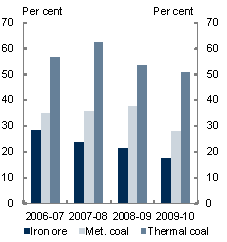
The disruption to Japanese production and damage to port infrastructure are expected to reduce Japan's short‑term demand for Australia's (non‑rural) commodity exports (Chart A), reducing Australia's real GDP growth in 2010‑11 by up to ¼ of a percentage point.
Chart A: Selected Australian commodity exports to Japan
(per cent of total value exported)
Source: ABS customised report.
Australian earnings from exports to Japan are expected to be reduced by around $2 billion in 2010‑11, primarily reflecting disruptions to commodity shipments and the short‑term effect on commodity prices. Australian exporters whose products were earmarked for Japan may be forced to find alternative customers in the near term, causing delays to exports. Spot prices for Australia's key non‑rural commodity exports fell after the earthquake amid expectations of a short‑term reduction in Japanese demand, but have since rebounded.
Japan's reconstruction efforts are likely to boost Australia's export earnings from 2011‑12 through higher world commodity prices.
If www.budget.gov.au responds slowly or you are having trouble downloading a document, try one of the Budget Website Mirrors
Note: Where possible, Budget documents are available in HTML and for downloading in Portable Document Format(PDF). If you require further information on any of the tables or charts on this website, please contact The Treasury.