




Part 2: Payments for Specific Purposes (Continued)
Skills and workforce development
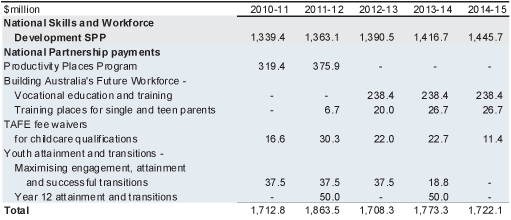
In 2011‑12, the Commonwealth will provide funding of $1.9 billion to support state skills and workforce development‑related services.
Table 2.5 provides information on payments to support state skills and workforce development‑related services.
Table 2.5: Payments to support state skills and workforce
development‑related services
National Agreement for Skills and Workforce Development
The National Agreement for Skills and Workforce Development aims to provide Australians with the opportunity to develop the skills and qualifications needed to participate in, and contribute to, the labour market.
Central to achieving this objective is a shared commitment to a national training system that is responsive to local needs and delivers high‑quality and nationally consistent training outcomes. This will help to ensure that the skills provided by the national training system are attuned to changing labour market demand.
The reforms needed to achieve the objectives and outcomes of the agreement include reforming training to achieve a more demand‑driven and client‑focused system, and to help drive the next wave of innovation and productivity.
The Commonwealth will offer the States a new reform‑focused National Partnership to deliver a higher quality and more productive sector. The Commonwealth will also negotiate a National Partnership to fund training places for single parents affected by changes to workforce participation requirements. A strong training system is fundamental to meeting longer term labour needs and sustaining economic growth.
National Skills and Workforce Development SPP

The National Skills and Workforce Development SPP is the funding associated with the National Skills and Workforce Development Agreement and is provided to work towards increasing the skill levels of all Australians, including Indigenous Australians.
Growth factor
The Intergovernmental Agreement defines the growth factor for the National Skills and Workforce Development SPP as the product of:
0.85 x wage cost index 1 + 0.15 x wage cost index 6
The growth factor is estimated to be 1.78 per cent in 2011‑12.
National Partnership payments for skills and workforce development
National Partnership on Productivity Places Program

The Commonwealth is providing funding for the National Partnership on Productivity Places Program targeting training to support the development of skills to meet existing and future industry demands. This National Partnership will be terminated on 30 June 2012. Funds for skills development will now support the Building Australia's Future Workforce package.
Building Australia's Future Workforce — National Partnership on vocational
education and training

The Commonwealth will provide funding for the National Partnership on vocational education and training. This National Partnership will provide funding of $1.75 billion over five years from 2012‑13 (including $516.3 million in both 2015-16 and 2016-17). It will support long term reform in the vocational education and training (VET) sector, particularly reforms that:
- increase training effort at Certificate III level and above, improve completion rates, and increase the proportion of students who have a proper assessment and recognition of their existing skills prior to commencing training;
- align training effort with emerging skills, innovation and technology needs and fast growing sectors of the economy;
- lift the participation rates and skills base of disadvantaged learners and regions;
- build stronger pathways between VET and higher education qualifications to enable more Australians to lift their skill and qualification levels; and
- lift the quality of teaching and learning and the level of student and industry satisfaction with providers.
Funding will be available to States who make a commitment to reforms. The National Partnership will complement the revised National Agreement on Skills and Workforce Development.
Funding for Building Australia's Future Workforce — National Partnership for vocational education and training is a new spending measure taken in the 2011‑12 Budget. This measure is discussed in further detail in Budget Paper No. 2: Budget Measures 2011‑12.
Building Australia's Future Workforce — National Partnership on training
places for single and teen parents(a)

- Yearly profiles and State splits are indicative distributions only and have been allocated on an equal per capita basis to all States. This distribution may change subject to negotiation with States on a National Partnership agreement and State participation in a competitive tendering process (where applicable). This indicative distribution does not entitle a State to the funds allocated against it.
The Commonwealth will provide funding for the National Partnership on training places for single and teen parents to assist them to return to work. The funding will provide training places, at the Certificate II level or above, for single and teen parents affected by changes to workforce participation requirements.
A training offer for single and teen parents is a new spending measure taken in the 2011‑12 Budget. This measure is discussed in further detail in Budget Paper No. 2: Budget Measures 2011‑12.
National Partnership on TAFE fee waivers for childcare qualifications

The Commonwealth is providing funding for the National Partnership on TAFE fee waivers for childcare qualifications.
This National Partnership removes fees for the Diploma and Advanced Diploma of Children's Services courses delivered at TAFE institutions, or by other government vocational education and training providers. This agreement supports the objectives of the National Partnership on early childhood education.
National Partnership on youth attainment and transitions
Maximising engagement, attainment and successful transitions component(a)

- The amount of funding paid to Victoria includes $43 million across all years to be used to implement the school business community partnership brokers program through its local learning and employment network.
Year 12 attainment and transitions component

The Commonwealth is providing funding for the National Partnership on youth attainment and transitions. This National Partnership was established to support the achievement of a national Year 12 or equivalent attainment rate of 90 per cent by 2015 and to halve the gap in Indigenous Year 12 or equivalent attainment by 2020. Measures under this National Partnership aim to increase the educational engagement and attainment of young people and to improve their transition to post‑school education, training, and employment through immediate, concerted action supported by broader long‑term reform.
If www.budget.gov.au responds slowly or you are having trouble downloading a document, try one of the Budget Website Mirrors
Note: Where possible, Budget documents are available in HTML and for downloading in Portable Document Format(PDF). If you require further information on any of the tables or charts on this website, please contact The Treasury.