




Delivering more productive, sustainable and liveable cities
To secure the ongoing prosperity and wellbeing of our communities, we must ensure that our cities meet the needs of current and future generations, and that economic growth can be sustained and increased without compromising the natural environment or our quality of life. This is the basis of a sustainable future.
The Australian Government has a role in planning for, and delivering, an urban Australia that is more productive, sustainable and liveable. The development and management of our cities affects national prosperity and the wellbeing of all Australians, no matter where they live.
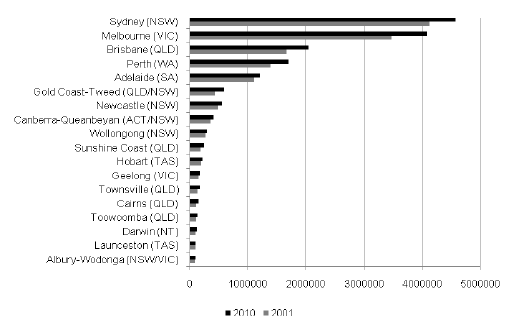
Three-quarters of Australians live in our 18 major cities (that have populations over 100, 000). Refer to Figure 1. While Australians are fortunate to enjoy some of the most liveable cities in the world, our cities face a number of long term challenges: the need to improve productivity growth; provide affordable and accessible housing; create safe community spaces; meet the needs of a growing and ageing population; ensure an inclusive and cohesive society; and address the implications of climate change. The way our cities develop to accommodate future growth and change will be critical to maintaining their status as some of the best cities in the world.
Figure 1 Population of Australia's 18 Major Cities
Quite reasonably, Australians expect their cities to provide a variety of social and economic opportunities, whilst also protecting valuable environmental and cultural resources. Australians also expect their governments, at all levels, to deliver these outcomes. Consistent policy objectives are needed to ensure that investments in, and management of, urban systems create more productive, sustainable and liveable outcomes for our cities.
Diversity of lifestyle choices, improved accessibility and affordability, and less carbon dependent ways of living, need to be adopted. This includes making the most of our people—our human capital—including through education and training programs that equip Australians for the jobs of the future; through facilitating an adequate supply of appropriate housing; through measures that lessen dependence on private motor vehicle use; and by re-thinking the way our cities and communities are planned.
- The National Urban Policy establishes the first long term national framework to guide policy development and public and private investment in cities.
- In establishing the framework the Australian Government is determined to improve the productivity, sustainability and liveability of our major urban centres.
Productivity
Productivity growth will be the key driver of economic growth and prosperity over the long term.
Our major cities generate around 80 per cent of our gross domestic product and employ 75 per cent of our national workforce. Cities are centres of economic activity where labour, industry and social institutions are concentrated.
How efficiently our cities connect people, knowledge, businesses and markets—and how effectively our economic and human capital is utilised—directly impact on the economic performance of our urban and regional environments and their ability to contribute to national productivity growth.
Sustainability
A more sustainable Australia will require better management of the consumption of resources and production of wastes to reduce our impact on the environment.
Our rapidly growing urban populations are placing pressure on the environment through increased demand for water, energy, land and other resources, and through the production of wastes and pollution.
We need to reduce the carbon pollution from our cities, and become more resilient to the impacts of climate change.
Liveability
Liveable cities offer a high quality of life and support the health and wellbeing of people who live and work in them.
Liveable cities are equitable, socially inclusive, affordable, accessible, healthy, safe and resilient. They have attractive built and natural environments and provide a diversity of choices and opportunities for people to live their lives, share friendships, and raise their families to their fullest potential.
Links between productivity, sustainability and liveability
In cities the challenges and opportunities of productivity, sustainability and liveability are part of an interrelated and dynamic system. Addressing one goal can have an impact, either positively or negatively, on the others. For example, efficient public transport can address congestion and improve access to jobs and opportunity (productivity); it can also reduce greenhouse gas emissions (sustainability); and enable affordable access to education, health and recreational facilities (liveability).
Likewise, access to affordable high speed broadband will speed up business transactions (productivity); reduce the need for physical movement and transportation of people and documents (sustainability); and enable enhanced social, cultural and educational participation (liveability).
If www.budget.gov.au responds slowly or you are having trouble downloading a document, try one of the Budget Website Mirrors
Note: Where possible, Budget documents are available in HTML and for downloading in Portable Document Format(PDF). If you require further information on any of the tables or charts on this website, please contact The Treasury.