




Notes to the general government sector financial statements
Note 1: External reporting standards and accounting policies
The Charter of Budget Honesty Act 1998 (the Charter) requires that the Mid‑Year Economic and Fiscal Outlook (MYEFO) be based on external reporting standards and that departures from applicable external reporting standards be identified.
The major external standards used for MYEFO reporting purposes are:
- the Australian Bureau of Statistics' (ABS) accrual Government Finance Statistics (GFS) publication, Australian System of Government Finance Statistics: Concepts, Sources and Methods, 2005 (cat. no. 5514.0), which in turn is based on the International Monetary Fund (IMF) accrual GFS framework; and
- Australian Accounting Standards (AAS), being AASB 1049 Whole of Government and General Government Sector Financial Reporting (AASB 1049) and other applicable Australian Equivalents to International Financial Reporting Standards (AEIFRS).
As required by the Charter, the financial statements have been prepared on an accrual basis that complies with both ABS GFS and AAS except for departures disclosed at Note 2.
A more detailed description of the AAS and ABS GFS frameworks, in addition to definitions of key terms used in these frameworks, can be found in Attachment A. Table B11 in Attachment A explains the key differences between the two frameworks. Detailed accounting policies, as required by AAS, are disclosed in the annual consolidated financial statements.
Budget reporting focuses on the general government sector (GGS). The GGS provides public services that are mainly non‑market in nature and for the collective consumption of the community, or involve the transfer or redistribution of income. These services are largely financed through taxes and other compulsory levies, user charging and external funding. This sector comprises all government departments, offices and some other bodies. In preparing financial statements for the GGS, all material transactions and balances between entities within the GGS have been eliminated. A list of entities within the GGS, as well as entities within and a description of the public non‑financial corporations (PNFC) sector and public financial corporations (PFC) sector, are disclosed in Table B10 in Attachment A.
The Government's key fiscal aggregates are based on ABS GFS concepts and definitions, including the ABS GFS cash surplus/deficit and the derivation of the underlying cash balance and net financial worth. AASB 1049 requires the disclosure of other ABS GFS fiscal aggregates, including net operating balance, net lending/borrowing (fiscal balance) and net worth. In addition to the ABS GFS aggregates, the Accrual Uniform Presentation Framework (UPF) requires net debt, net financial worth and net financial liabilities.
Comprehensive guidance has not been issued under either Australian Accounting Standards or Government Finance Statistics for the measurement of accrual revenue and expenses under the carbon price. Current estimates measure revenue and expenses at the market price for carbon in the year that emissions occur. Finance and Treasury will continue to review this treatment in consultation with the ABS and the Australian National Audit Office (ANAO).
Note 2: Departures from external reporting standards
The Charter requires that departures from applicable external reporting standards be identified. The MYEFO financial statements depart from the external reporting standards as follows.
General government sector
Departures from ABS GFS
ABS GFS requires that provisions for bad and doubtful debts be excluded from the balance sheet. This treatment has not been adopted in the financial statements or in any reconciliation notes because excluding such provisions would overstate the value of Australian Government assets in the balance sheet. The financial statements currently adopt AAS treatment for provisions for bad and doubtful debts.
ABS GFS treats coins on issue as a liability and no revenue is recognised. The ABS GFS treatment of circulating coins as a liability has not been adopted in the financial statements or in any reconciliation notes. Instead, the financial statements adopt AAS treatment for circulating coins (seigniorage). Under this treatment seigniorage revenue is recognised upon the issue of coins and no liability is recorded.
Under ABS GFS prepayments are classified as financial assets. In accordance with AAS, prepayments have been classified as non‑financial assets in the financial statements. This is a classification difference that impacts on net financial worth.
ABS GFS records defence weapons platforms (DWP) as a non‑financial asset on a market value basis (fair value), rather than expensing at time of acquisition. The value used by ABS is consistent with the National Accounts statistical methodology, and represents an early adoption of changes to the System of National Accounts 2008. ABS GFS treatment of DWP is consistent with AAS, as non‑financial assets can be valued at fair value as long as they can be reliably measured, otherwise cost is permissible. DWP will be valued at cost in the budget financial statements, as they have in previous budgets, while the Australian Government ascertains if a relevant and reliable fair value can be sourced.
Under ABS GFS, concessional loans are recognised at their nominal value, that is, they are not discounted to fair (market) value as there is not considered to be a secondary market. This treatment has not been adopted for the financial statements. Consistent with AAS, loans issued at below market interest rates or with long repayment periods are recorded at fair value (by discounting them by market interest rates). The difference between the nominal value and the fair value of the loan is recorded as an expense. Over the life of the loan the interest earned is recognised at market rates.
ABS GFS requires investments in unlisted public sector entities to be valued based on their net assets. Under AAS, investments in public sector entities can be valued at fair value as long as a fair value can be reliably measured, otherwise net assets is permissible. The AAS treatment has been adopted in the financial statements.
Movements in the provision for restoration, decommissioning and make‑good of assets have been included in the calculation of the fiscal balance capital adjustment because in many cases they involve legal obligations to expend resources. ABS GFS does not recognise adjustments for such provisions because they are considered a constructive obligation that may not materialise for many years.
Departures from AASB 1049
AAS requires the advances paid to the International Development Association and Asian Development Fund to be recognised at fair value. Under ABS GFS these advances are recorded at nominal value. ABS GFS treatment is adopted in the financial statements.
AASB 1049 requires the disclosure of the operating result and its derivation on the face of the operating statement. However, as this aggregate is not used by the Australian Government (and is not required by the UPF), it has been disclosed in Note 13 rather than on the face of the operating statement.
AASB 1049 requires disaggregated information, by ABS GFS function, for expenses and total assets to be disclosed where they are reliably attributable. ABS GFS does not require total assets attributed to functions. In accordance with ABS GFS, disaggregated information for expenses and net acquisition of non‑financial assets by function is disclosed in Attachment C of Part 3. In accordance with the UPF, purchases of non‑financial assets by function are also disclosed.
AASB 1049 requires AAS measurement of items to be disclosed on the face of the financial statements with reconciliation to ABS GFS measurement of items, where different, in notes to the financial statements. Reconciliation notes have not been included as they would effectively create two measures of the same aggregate.
AASB 1049 requires major variances between original budget estimates and outcomes to be explained in the financial statements. Explanations of variances for the 2011‑12 year from the 2011‑12 Budget are disclosed in Part 3. All decisions taken between the 2011‑12 Budget and MYEFO are disclosed in Appendix A.
In addition to above adjustments, there are specific adjustments made to the corporations sectors as outlined below.
Public non‑financial corporations (PNFC) sector and total non‑financial public sector (NFPS)
Departures from ABS GFS
AASB 1049 defines net worth for the PNFC sector and NFPS as total assets less total liabilities, however ABS GFS defines net worth as total assets less total liabilities less shares and contributed capital (which is equal to zero for the PNFC sector). Similarly, AASB1049 defines net financial worth for these sectors as financial assets less total liabilities, whereas under ABS GFS it is equal to financial assets less total liabilities less shares and contributed capital. The AASB 1049 treatment has been adopted in the PNFC and NFPS sector financial statements.
Departures from AASB 1049
The financial statements for the PNFC sector and NFPS comply with the UPF but do not include all the line item disclosures required by AASB 1049. Disaggregated outcome notes for the PNFC sector will be disclosed in the consolidated financial statements.
AAS requires dividends paid to be classified as a distribution of equity. Under ABS GFS, dividends paid are classified as an expense. ABS GFS treatment has been adopted for use in the financial statements.
Australian government public corporations use commercial tax effect accounting to determine their net tax liability while the ATO determines their tax liability on a due and payable basis. To ensure symmetry in treatment between Australian governments sectors the ABS remove tax effect adjustments. The GFS treatment has been adopted in the financial statements.
Note 3: Taxation revenue by type
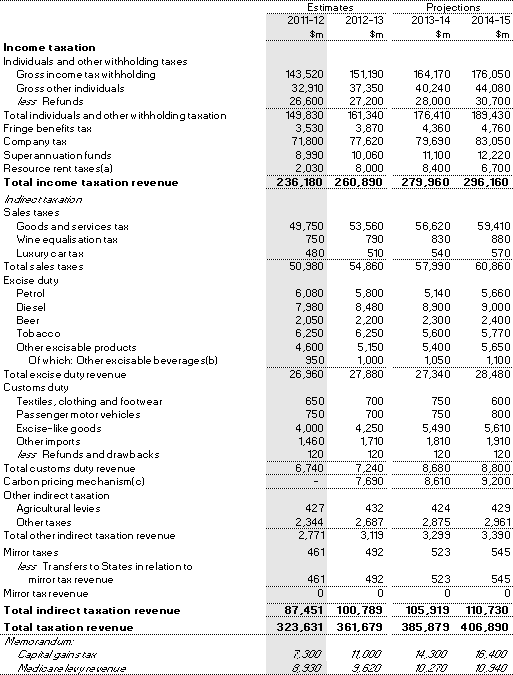
- Resource rent taxes include the PRRT and gross revenue from the MRRT. The net revenue from the MRRT is $3.7 billion in 2012‑13, $3.8 billion in 2013‑14 and $3.1 billion in 2014‑15, which represents the net impact on revenue across several different revenue heads. This includes the offsetting reductions in company tax (through deductibility) and interactions with other taxes.
- Other excisable beverages are those not exceeding 10 per cent by volume of alcohol.
- Tax revenue includes carbon accrual revenue measured at market price, with details of the accounting treatment of carbon revenue set out in Note 1 to the General Government Sector Financial Statements.
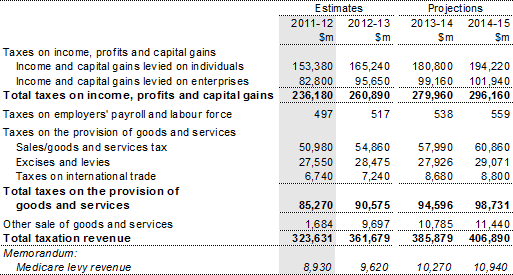
Note 3(a): Taxation revenue by source
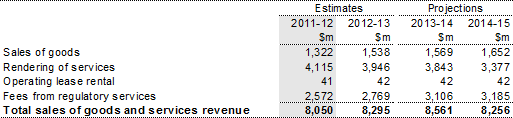
Note 4: Sales of goods and services revenue
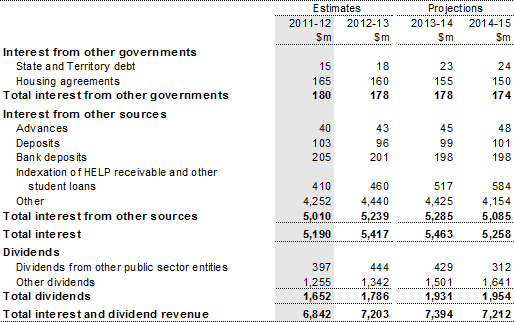
Note 5: Interest and dividend revenue
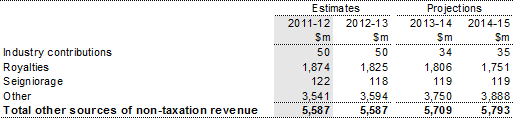
Note 6: Other sources of non‑taxation revenue
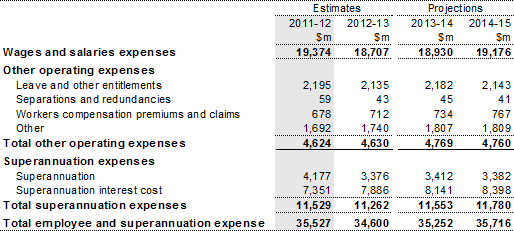
Note 7: Employee and superannuation expense
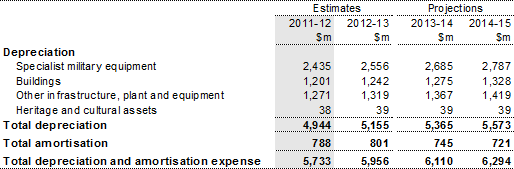
Note 8: Depreciation and amortisation expense
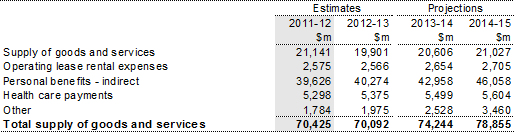
Note 9: Supply of goods and services expense
Note 10: Interest expense
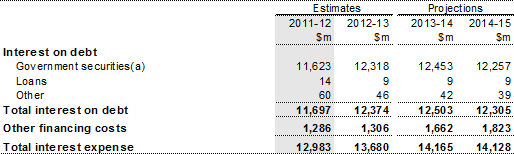
- Public debt interest estimates are calculated using the contract interest rates incurred on existing Commonwealth Government Securities (CGS) when issued and technical assumptions, based on prevailing market interest rates across the yield curve, for yields on future CGS issuance.
Note 11: Current and capital grants expense
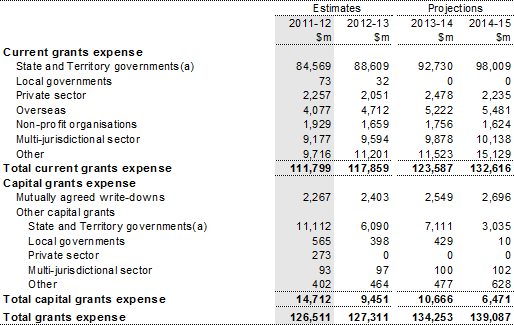
- Natural Disasters Relief payments to the States and Territory governments is reclassified from current to capital grants.
Note 12: Personal benefits expense
Note 13: Operating result and comprehensive result (total change in net worth)
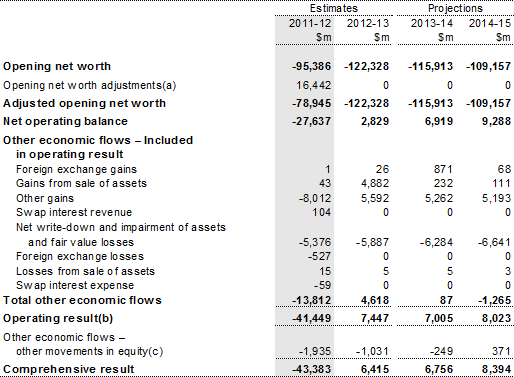
- Reflects a decrease in the superannuation liability mainly due to a difference in the estimated and actual discount rate. Refer to Note 18 for further details.
- Operating result under AEIFRS accounting standards.
- Other economic flows not included in the AEIFRS accounting standards operating result.
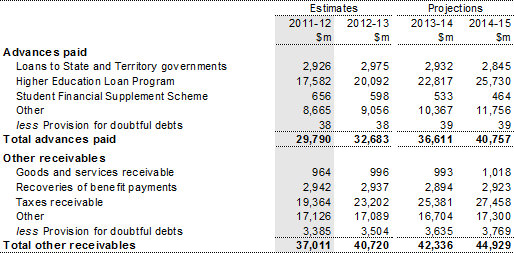
Note 14: Advances paid and other receivables
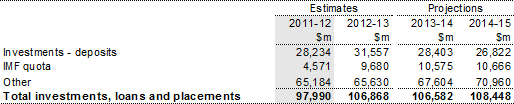
Note 15: Investments, loans and placements
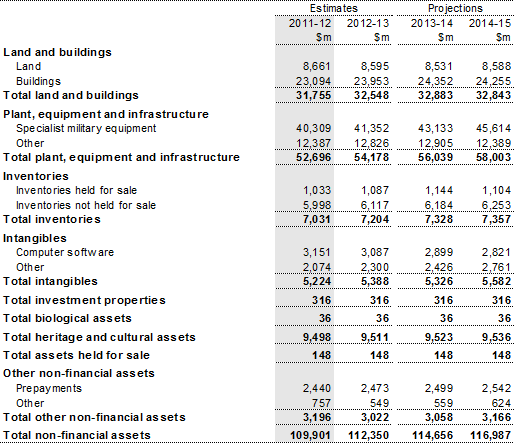
Note 16: Total non‑financial assets
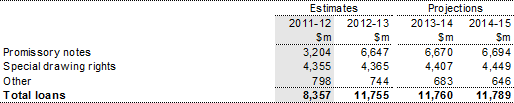
Note 17: Loans
Note 18: Employee and superannuation liabilities
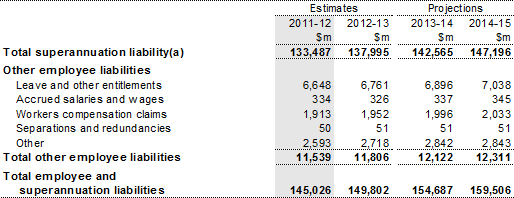
- For budget reporting purposes, a discount rate applied by actuaries in preparing Long Term Cost Reports is used to value the superannuation liability. This reduces the volatility in reported liabilities that would occur from year to year if the long‑term government bond rate were used. Consistent with Australian Accounting Standards, the long‑term government bond rate as at 30 June is used to calculate the superannuation liability for the purpose of actuals reporting.
Note 19: Provisions and payables
Note 20: Reconciliation of cash
Note 20(a): Consolidated Revenue Fund
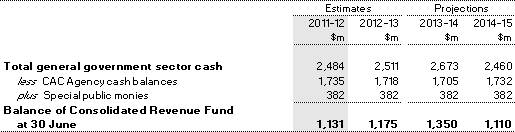
The estimated and projected cash balances reflected in the balance sheet for the Australian Government GGS (Table B2) include the reported cash balances controlled and administered by Australian Government agencies subject to the Financial Management and Accountability Act 1997, and the reported cash balances controlled and administered by entities subject to the Commonwealth Authorities and Companies Act 1997 (CAC Act), that implement public policy through the provision of primarily non‑market services.
Revenues or monies raised by the Executive Government automatically form part of the Consolidated Revenue Fund by force of section 81 of the Australian Constitution. For practical purposes, total Australian Government GGS cash, less cash controlled and administered by CAC Act entities, plus special public monies, represents the Consolidated Revenue Fund referred to in section 81 of the Australian Constitution. On this basis, the balance of the Consolidated Revenue Fund is shown above.
If www.budget.gov.au responds slowly or you are having trouble downloading a document, try one of the Budget Website Mirrors
Note: Where possible, Budget documents are available in HTML and for downloading in Portable Document Format(PDF). If you require further information on any of the tables or charts on this website, please contact The Treasury.