



Statement 1: Budget Overview (Continued)
Spreading the benefits of the boom
Strong demand for Australia's natural resources and record profits for resource companies continue to provide great opportunity for the Australian economy and people. The Minerals Resource Rent Tax (MRRT) is an historic economic reform which means that the benefits of the boom can be invested in Australia's future and spread to all Australians.
The Government is investing the proceeds of the resources boom from the MRRT to strengthen our whole economy. The Government will invest a total of $6.0 billion from the Regional Infrastructure Fund to address urgent infrastructure needs, and will pay for the tax concessions associated with the superannuation guarantee rate rises from 9 per cent to 12 per cent.
The Government was also going to use the proceeds of the MRRT to cut the company tax rate. However, the Government was not able to secure the necessary parliamentary support and for that reason will now adopt a different approach to spread the benefits of the boom to families and businesses.
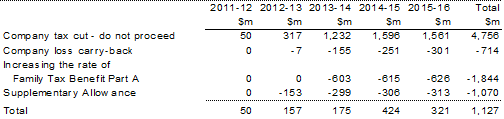
The Government's Spreading the Benefits of the Boom package will deliver much‑needed help for over 1.5 million families on low and middle incomes (Table 3). It also supports businesses through a loss carry‑back reform which builds on the instant asset write‑off due to start on 1 July 2012.
Table 3: Spreading the Benefits of the Boom
This package, combined with a new Schoolkids Bonus, will help families, students and those on low and middle incomes make ends meet. It will provide $5 billion in support to low and middle‑income households which will in turn support consumption and spending in businesses, including small businesses, across the country. The loss carry‑back measure will further support the economy by helping businesses struggling with the economy in transition to invest in a productive future.
The business community is engaging with the Government on future reforms through the Business Tax Working Group, and the Government continues to support future business tax reform that is paid for by savings from business and has the support of the Parliament. The final report of the Business Tax Working Group is due to be provided to the Treasurer by the end of 2012.
Additional support to help households with the costs of living
The Government is introducing new measures to help families on low and middle incomes with the costs of raising children through increases in family payments and a more timely and accessible payment to assist with educational costs. The Government is also introducing a new Supplementary Allowance to help individuals in receipt of income support, such as Newstart and Youth Allowance, with the cost of essential bills.
This builds on past substantial reforms the Government has made since 2007, including changes to the tax system to reward hard work, and increases to pensions, family payments and the Child Care Rebate. The Government is also providing substantial household assistance as part of the Clean Energy Future package, which will ensure all low‑income households will receive assistance that fully offsets their average expected price impact. Middle‑income households will also receive some assistance.
Targeted increase in family payments
The Government is committed to helping families with the costs of raising children and supporting families to keep children in school.
From 1 July 2013 Family Tax Benefit Part A (FTB‑A) will increase for all eligible families. The maximum rate for FTB‑A will increase by $300 per annum for families with one child and $600 per annum for families with two or more children. For families receiving the base rate, the increase will be $100 per annum for families with one child and $200 per annum for families with two or more children. The Government is providing $1.8 billion over four years for this measure.
This builds on the increase in FTB‑A for families with children aged 16 to 19 years in full‑time secondary school of up to $4,208 per year that came into effect on 1 January 2012. This will help families to meet the extra costs of raising teenagers and help them to support their children to stay at school.
Supplementary Allowance
The Government is investing $1.1 billion to create a new Supplementary Allowance for eligible recipients on income support to help them meet the costs of essential bills.
Recipients of Newstart Allowance, Youth Allowance, Austudy, ABSTUDY, Special Benefit and Parenting Payment will qualify for the Income Support Supplement. Transitional Farm Family Payment and Exceptional Circumstances Relief Payment recipients will also qualify.
Singles will receive an additional yearly allowance of $210 and couples will receive $350 combined, paid in two instalments in March and September, with the first payment commencing in March 2013. The payment will also be indexed by CPI twice a year.
The Supplementary Allowance will assist Australians who are hardest hit by the increases in costs of living — the unemployed, students, parents with young children and farmers.
In addition, the Government is doubling the liquid assets test to allow people with modest levels of savings to access income support sooner. The change doubles the threshold for liquid assets to $5,000 for singles without dependent children or $10,000 for all others, from 1 July 2013. This will allow newly unemployed people to have more assets (for example, money in a bank account) and still qualify for income support without a waiting period.
Previously, newly unemployed people who had liquid assets above a threshold amount of $2,500 if single and without dependent children, or $5,000 for all others would be forced to run down their savings before receiving government assistance.
Supporting parents with education costs
The Government will also provide an additional $2.1 billion over five years to introduce a new Schoolkids Bonus. The Bonus will replace the Education Tax Refund (ETR), and be paid directly to all eligible recipients. It will mean that all eligible families receive assistance with their children's education costs, and that many families receive increased assistance. Eligible families will also no longer need to keep receipts in order to claim the ETR several months later at tax time.
The Schoolkids Bonus will be $410 for primary school students and $820 for secondary school students, per year. From 2013 it will be paid in two equal instalments in January and July, at times when families are likely to incur extra costs. It will be paid to recipients of FTB‑A and other eligible payments. As a transitional arrangement, the full 2011‑12 ETR payment will be automatically paid to eligible families in June 2012, prior to the introduction of the new Bonus, so that they receive timely assistance equal to the full value of their entitlement.
This will provide families with more flexible and timely support. Furthermore, making the payment automatic ensures that no eligible families will miss out. In respect of the 2010‑11 ETR claims to date, 774,000 eligible families have missed out on the full amount of ETR, and 284,000 families have not claimed at all.
Tripling the tax‑free threshold
The Government has delivered $47 billion in personal income tax cuts since coming into office, and will deliver an additional $8 billion package of new structural reforms to the personal tax system that target additional tax cuts to low and middle income individuals over the next three years. From 1 July 2012 all taxpayers with incomes of up to $80,000 will get a tax cut, with most receiving at least $300 per year to assist with the cost‑of‑living impact of the carbon price.
From 1 July 2012, the tax‑free threshold will be more than tripled from $6,000 to $18,200, and the Low Income Tax Offset (LITO) will be reduced to $445. From 1 July 2015, further tax cuts will increase the tax‑free threshold to $19,400, with a reduction in the LITO to $300. The first two marginal tax rates will also increase; however, the combined changes mean that the statutory rates will more closely match the effective rates that people actually face. No‑one will pay more tax as a result of these reforms and, from 2015‑16, more than a million people will no longer need to lodge a tax return and around 700,000 fewer people will pay tax.
Payment increases
In addition to tax cuts, families will benefit from $6.3 billion of increases to government payments as part of the Clean Energy Future household assistance package. The annual maximum rates of pensions, allowances and Family Tax Benefit, and the base rate of FTB‑A, will be increased by 1.7 per cent. Assistance will first be delivered through the Clean Energy Advance from May 2012, before the carbon price is introduced.
Nine out of ten households will receive assistance through tax cuts and/or increases to payments, with over four million households receiving assistance that is at least 20 per cent more than their average expected price impact.
Secure and sustainable pensions
In addition to the assistance received through the Clean Energy Future household assistance package, around 3.4 million pensioners have also benefited from the Secure and Sustainable Pension Reforms the Government announced in 2009. These historic reforms provided an increase to the single and couple rates and improved the indexation arrangements of the pension. Since 2009, the maximum rate of the pension has increased by $154 per fortnight for singles and $156 per fortnight for couples combined. Pensioners will continue to benefit from the improved indexation arrangements announced as part of the reforms.
Supporting businesses during a time of transition
The Government will reduce the tax burden on companies, in sectors such as manufacturing, tourism and retail that are struggling with an economy in transition, to help them invest and innovate.
The Government understands how vital the small business sector is to the Australian economy, with 2.7 million businesses employing millions of people, and that many of these small businesses are facing challenges such as those flowing from a higher dollar.
The Government is introducing a range of measures from the 2012‑13 income year that will simplify taxation for small business and free up cash flow to enable small businesses to make investments they need to be competitive, support productivity and promote employment.
Loss carry‑back
As a first step to reforming the current company tax arrangements the Government will introduce a loss carry‑back reform for losses incurred in the 2012‑13 income year.
Mining Boom Mark II is generating record levels of investment in the resources sector. However, the historically high dollar is making trading conditions challenging for sectors of the economy outside resources and resources‑related parts of the economy, including the manufacturing, tourism and retail sectors.
This reform will support businesses struggling with an economy in transition, helping them make investments and take sensible risks to be able to adapt and restructure. It is particularly important that companies that are experiencing losses are able to make changes to their business to return them to profitability. That may mean undertaking investment in plant and equipment or retraining staff.
In 2012‑13, companies will be able to carry back losses incurred in that year of up to $1.0 million so they get a refund against tax previously paid. From 2013‑14 companies will be able to carry back losses for two years. It will be available to companies and entities that are taxed like companies, be subject to integrity rules, apply to revenue losses, and be limited to a company's franking account balance.
This means that a manufacturing, tourism, education, retail or construction business, which is currently profitable and paying tax, will know that if it undertakes investments in 2012‑13 that initially result in a loss, they will get a refund of up to $300,000 of tax they have previously paid when they lodge their 2012‑13 tax return.
This measure will cost $714 million over the forward estimates, and in its first four years of operation is estimated to provide assistance to nearly 110,000 companies.
Small business instant asset write‑off and simplified pooling
From the 2012‑13 income year, the Government will allow small businesses to immediately write off eligible business assets costing less than $6,500 — an increase from $1,000 under the old arrangements. This will benefit small business whether they are run through a sole trader, partnership, trust or company.
For example, a small business company that purchases four items of equipment costing $6,000 each will be able to get a tax deduction of $24,000 in the first year (rather than a deduction of $3,600 under the old arrangements). As a result, small business companies will pay around $6,120 less tax in the 2012‑13 income year. If the small business operates as a sole trader with a higher marginal tax rate, they may be able to get a bigger tax saving.
The Government is also introducing simplified depreciation pooling arrangements from the 2012‑13 income year to save time and improve cash flow for small businesses.
Small business depreciation — accelerated initial deduction for motor vehicles
The Government recognises that motor vehicles are important assets for many of Australia's small businesses and is introducing accelerated depreciation from the 2012‑13 income year to improve cash flow for small businesses. This will benefit small businesses whether they are run by sole traders, partnerships, trusts or companies.
Small businesses will be able to claim up to $5,000 as an immediate deduction for new or used motor vehicles acquired from the 2012‑13 income year.
The remainder of the motor vehicle's cost will be pooled in the general small business pool (depreciated at 15 per cent in the purchase year and then 30 per cent in other years).
A new Manufacturing Technology Innovation Centre
The Government will invest $30 million over four years to establish a Manufacturing Technology Innovation Centre to bring our brightest researchers and manufacturers together to drive innovation through new and improved industrial products and processes. It will establish sectoral collaboration to support major manufacturers, small and medium enterprises, industry bodies, and research agencies to create solutions in their production lines. It will also help them realise new market opportunities particularly in the Asian market through harnessing new technologies, business processes and technical knowledge. The Manufacturing Technology Innovation Centre is consistent with the Prime Minister's Taskforce on Manufacturing.
Advocacy and business support
The new Australian Small Business Commissioner will provide a one‑stop shop for small business services and information and ensure that the interests of small business remain at the forefront of Government policy‑making. Furthermore, the elevation of the Minister for Small Business to a Cabinet‑level position ensures Government decision‑making will take full account of the interests of Australia's small businesses.
The highly successful Small Business Advisory Service will be made an ongoing program, with an additional $28 million in funding over the next four years; and the Small Business Support Line, which provides information and referral services, will be extended to 2015‑16.
If www.budget.gov.au responds slowly or you are having trouble downloading a document, try one of the Budget Website Mirrors
Note: Where possible, Budget documents are available in HTML and for downloading in Portable Document Format(PDF). If you require further information on any of the tables or charts on this website, please contact The Treasury.