




Statement 2: Economic Outlook (Continued)
The outlook for the international economy
Global financial stresses eased somewhat in the early months of 2012, after the period of acute instability in late 2011, but the global outlook remains weak and uncertain, and substantial downside risks remain. It is likely that the uncertainty and associated volatility in financial markets will continue for some time. Economic conditions in the United States are looking more promising, but many advanced countries, including the euro area and the United States, face the significant task of rebuilding after the global financial crisis, while the euro area is also managing the effects of the sovereign debt crisis.
Output is well below potential in many advanced economies and these countries face a significant task of setting public finances on a sustainable footing, while supporting growth. The euro area appears to have, and the United Kingdom has, re‑entered recession, and while the downturn is expected to be moderate in the absence of a re‑intensification of the sovereign debt crisis, the recovery is also expected to be moderate at best.
Growth in the emerging economies as a whole remains relatively robust. While growth in China has moderated to a more sustainable pace in line with policy makers' intentions, the Chinese economy is expected to continue to grow solidly. This should provide some support for other emerging Asian economies which have been affected by weakness in the euro area and the subdued recovery in the United States.
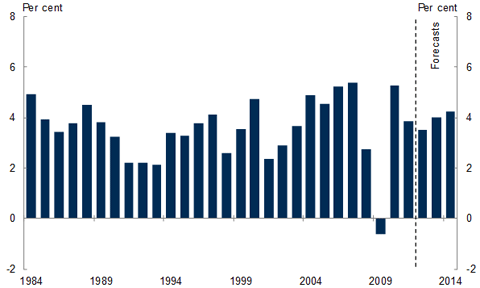
Chart 4: World GDP growth
Source: IMF World Economic Outlook April 2012, Thomson Reuters and Treasury.
Global economic growth is expected to improve over the forecast horizon, driven by the United States and emerging Asia, particularly China. Global GDP growth is forecast to be 3½ per cent in 2012, 4 per cent in 2013 and 4¼ per cent in 2014 (Chart 4).
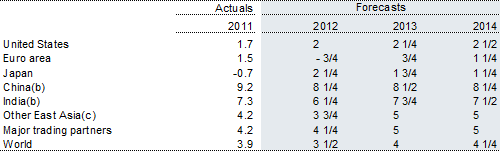
Australia's major trading partners (export weighted) as a group are expected to grow strongly over the forecast period, reflecting the rapid growth in emerging Asia, particularly China. Australia's major trading partners are forecast to grow 4¼ per cent in 2012 and 5 per cent in both 2013 and 2014 (Table 2).
Table 2: International GDP growth forecasts (a)
(a) World, euro area, and other East Asia growth rates are calculated using GDP weights based on purchasing power parity (PPP), while growth rates for major trading partners are calculated using export weights.
(b) Production‑based measure of GDP.
(c) Other East Asia comprises the NIEs of Hong Kong, South Korea, Singapore and Taiwan and the Association of Southeast Asian Nations group of five (ASEAN‑5), which comprises Indonesia, Malaysia, the Philippines, Thailand and Vietnam.
Source: National statistical publications, IMF, Thomson Reuters and Treasury.
Europe's poor growth outlook makes it unlikely that it will make a significant contribution to global growth over the forecast horizon. Encouragingly, there have been a number of policy measures which have helped to temporarily stabilise euro area financial conditions, including the provision of liquidity by the European Central Bank, strong fiscal adjustment programs implemented by euro area governments, and ambitious planned product and labour market reforms. These policy responses temporarily eased pressure on banks and on some sovereigns, although the positive impact is starting to wane. Fresh concerns continue to emerge, most recently around Spain. The euro area also faces a prolonged period of fiscal consolidation and a challenging reform agenda. Economic activity in many euro area economies is already well below potential and any recovery is likely to be tepid and drawn out. There is still a risk of a sharp, deep financial crisis if markets judge that there is insufficient progress in implementing the measures that have been agreed.
The pace of recovery in the United States is picking up a little, with the economy forecast to grow 2 per cent in 2012, 2¼ per cent in 2013 and 2½ per cent in 2014. The temporary factors that impinged on growth in the first half of 2011 (particularly the impact on automobile and electronics industry supply chains of Japan's earthquake and tsunami) have fully abated. Nevertheless, the recovery remains subject to risks arising from the deep underlying weaknesses in the labour and housing markets.
Two years after the end of the recession there have been some encouraging signs that the long‑awaited recovery in the United States' labour market may be underway. Employment growth is strengthening and the unemployment rate has been falling since the end of 2011. However, unemployment is still historically high, and includes a large number of long‑term unemployed. An historically low participation rate (around a 30‑year low) suggests that the labour market still has a long way to go before it returns to pre‑global financial crisis conditions. In addition, the depressed housing market remains a constraint on growth, with a recovery still some way off due to the need to absorb the large housing inventory.
A key risk for the United States' outlook beyond 2012 is the ability to strike the appropriate balance between short‑term fiscal support and medium‑term fiscal consolidation. While Congress delayed a fiscal contraction earlier this year by extending the payroll tax cut and unemployment benefits that were originally legislated to expire at the end of 2011, it will face some difficult fiscal policy decisions in late 2012 that will have a large bearing on subsequent years. Markets continue to be sanguine about the ability of the United States to meet its sovereign debt obligations, with the yield on 10‑year United States' Treasuries around a 60‑year low. However, there is a risk that market concerns will emerge in the absence of a credible and substantive medium‑term fiscal consolidation plan.
Economic conditions in China are expected to remain solid, despite some slowing in domestic activity and the deterioration in external demand, especially from the euro area. China is forecast to grow a little over 8 per cent in each of 2012, 2013 and 2014. Activity is generally moderating in line with the Chinese Government's intentions, with inflation having eased noticeably since mid‑2011. With inflationary pressure likely to continue easing, policy makers are turning their attention to supporting sustainable growth.
Should external or domestic conditions deteriorate, China has the capacity to use macroeconomic policy to stimulate growth. However, the Chinese Government is likely to be more cautious in funding stimulus through the banking system than at the time of the GFC. Monetary policy has already tentatively shifted towards supporting growth. Selective monetary easing and an increase in credit to relieve stress amongst small and medium‑sized enterprises are already underway. Furthermore, the extension of new loans is likely to be somewhat higher than last year, supported by government regulation to increase the funds available for banks to make loans.
Elsewhere in Asia, the outlook remains positive, with the region showing signs of recovery after being affected by weakness in the euro area last year. Japan's post‑disaster recovery stalled in the December quarter, due largely to external factors, but is expected to get back on track as 2012 progresses. India's economy experienced a policy‑induced slowing in 2011, but growth is expected to remain solid. Thailand's unprecedented floods led to sharply lower production in late 2011, but the economy, and affected regional production chains, are expected to recover strongly in 2012.
Global growth forecasts are for sustained, albeit below‑trend, growth this year. However, risks to the outlook remain firmly to the downside. A re‑escalation of the euro area sovereign debt crisis remains the key risk to the global recovery. Actions by the European Central Bank to inject liquidity into the European financial system in December 2011 and February 2012 have lessened the risk of a near‑term European banking crisis, providing some necessary breathing space for reforms. The recent agreement of the IMF membership to boost the institution's lending capacity by more than US$430 billion is also a positive development, helping to bolster the global firewall to better guard against contagion. Nevertheless, with uncertainty over the sustainability of agreed austerity and structural reform measures in a number of euro area countries, the threat of further contagion from the euro area sovereign debt crisis persists.
Conditions in Europe, and in global financial markets, are fragile. Indeed, the actions of the European Central Bank have wedded many financial institutions even more closely to the euro area's sovereign debt. Substantial fiscal and structural reforms are needed to resolve the euro area sovereign debt crisis and boost growth and employment. There is still the potential for events to derail the progress achieved to date and for this to happen quickly.
Global oil prices have been drifting upwards since mid‑February 2012, although it is difficult to disentangle how much of this reflects political tensions surrounding the Middle East, and how much stems from other factors. For example, improving sentiment over the economic prospects for the United States and the global economy, and oil supply disruptions in Syria, Yemen and Sudan have all played a role in pushing oil prices higher since the start of 2012. If tensions in the Middle East escalate, a sharp rise in oil prices could occur. A significant and sustained oil price shock would pose a major risk to global economic growth prospects.
If www.budget.gov.au responds slowly or you are having trouble downloading a document, try one of the Budget Website Mirrors
Note: Where possible, Budget documents are available in HTML and for downloading in Portable Document Format(PDF). If you require further information on any of the tables or charts on this website, please contact The Treasury.