
Government’s tax reform vision (continued)
Supporting structural change
While our economic fundamentals are strong, the Australian economy faces new challenges and opportunities from the transformation of the global economy. The strong terms of trade and high dollar are driving structural change in our economy. This makes the need for business tax reform imperative. The tax system should facilitate, not hinder, the economy’s response to structural pressures.
In order to boost living standards, it is important that we have the right tax settings to support investment and a productive allocation of resources, as well as not discourage sensible risk-taking. By reducing the burden of business tax, Australia becomes a more attractive place to invest. New investment means that workers will have more capital equipment to get the job done, thereby lifting productivity and real wages.
From 2012-13 the Minerals Resource Rent Tax (MRRT) will capture a better return for the use of our non-renewable resources, which is an important part of this nation’s wealth. The Government will also extend the Petroleum Resource Rent Tax to onshore oil and gas projects from 1 July 2012. This provides the Government greater flexibility to reform the business tax system. It also provides revenue for reforms to help business to adapt to structural change, including the introduction of a loss carry-back and significant small business tax reform.
The Government is engaged with the business community on future reforms through the Business Tax Working Group (BTWG). The initial focus of the BTWG’s work has been improvements to the tax treatment of losses.
The Government has acted on a recommendation of the BTWG by introducing a one-year loss carry-back in 2012-13, which will extend to a two-year loss carry-back in 2013-14. This is consistent with a recommendation of the AFTS Review.
Loss carry-back will provide immediate relief to once-profitable businesses to support their return to profit. They will receive a refund of some of the tax they have previously paid, based on their current losses. This will help companies to finance the investments, training and restructuring that is needed to improve competiveness, which will support productivity and promote employment. It will temporarily support business with volatile revenue flows (due to factors like weather events and currency fluctuations) and businesses that need to make large new investments, including the tourism sector and property sector.
The Government will also explore ways to relax the same business test, which the BTWG identified gets in the way of businesses taking up new opportunities.
The next stage of the BTWG’s work is to look at the long-term reform direction of the corporate tax system. This will involve considering cuts to the company tax rate or other reforms.
Encouraging small businesses to invest
The Government will support Australia’s 2.7 million small businesses through tax reform that will cut red tape and improve cash flows. These measures will support small businesses and encourage them to invest.
Consistent with the directions articulated in the AFTS Review, from 1 July 2012 small businesses will be able to immediately write-off each and every business asset they buy that costs less than $6,500. For example, a small business that purchases four items of equipment worth $6,000 each will get a deduction of $24,000 in the first year rather than $3,600 under current arrangements. As a result, a small business company will pay around $6,120 less tax. This could be even more valuable for an unincorporated business, if they are on a higher marginal tax rate.
From 1 July 2012, business assets costing $6,500 or more will be depreciated in a new single depreciation pool. In addition, small businesses will also be able to immediately deduct the first $5,000 of the cost of new or used motor vehicles they purchase from 2012-13.
Reducing borrowing costs
The Government will phase down the interest withholding tax (IWT) paid by financial institutions on their offshore borrowings and provide a more neutral treatment across financial institutions. This is expected to support competition in the banking sector.
- The rate of IWT for foreign bank branches which borrow from their overseas head office will fall from 5 per cent to 2.5 per cent in 2014-15, and to zero in 2015-16.
- The rate of IWT for other financial institutions which borrow from foreign financial institutions, and financial institutions which borrow from offshore retail deposits, will fall from 10 per cent to 7.5 per cent in 2014-15, and to 5 per cent in 2015-16.
This measure will help local subsidiaries and branches of foreign financial institutions, including smaller foreign banks, to access cheaper offshore funding from their parents, supporting them in putting more competitive pressure on the major banks over time. This is another reform which is consistent with the directions articulated in AFTS.
Improving productivity through state tax reform
There are also opportunities for tax reform at the state level to lift economic growth.
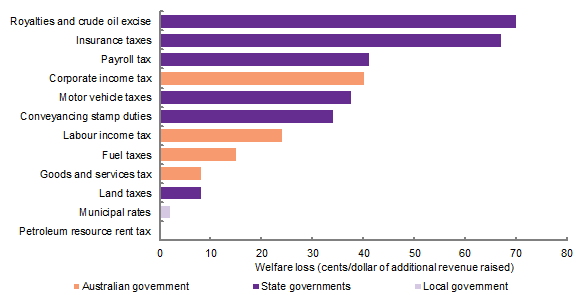
The AFTS Review confirmed that some taxes are more inefficient than others when it comes to the impact they have on living standards. Moving away from inefficient taxes to more efficient taxes will promote economic growth without increasing the total tax take.
CHART 4: MARGINAL EXCESS BURDENS OF SELECTED AUSTRALIAN TAXES
Source: KPMG Econtech 2009, CGE Analysis of the Current Australian Tax System. Reproduced from AFTS.
The AFTS review highlighted that many state taxes are particularly inefficient. The review found that royalties and insurance taxes are the most inefficient taxes (see Chart 4). It identified alternatives for revenue collection, including more efficient state taxes.
Stamp duty is recognised as a particularly inefficient tax. It raises the cost of moving house, or business premises, which slows activity and stifles efficient resource allocation. For example, stamp duty on housing deters homeowners from moving to take up a better job.
Royalties are also recognised as an inefficient form of state tax. Royalties do not account for the cost of production associated with mining, and hence, the overall level of profitability of the sector.
Going forward, State Treasurers will work on tax reform proposals with a view to discussion by all Treasurers before the end of 2012. The Commonwealth Government supports these efforts.

Tax Reform: Road Map


