
Boosting participation to help with an ageing population
The Government has a strong belief in the value of work for individuals, communities and our nation as a whole. By acting quickly to support economic activity during the Global Financial Crisis, the Government’s stimulus package helped to keep people in their jobs and connected to the workplace.
In the long-term, participation will become increasingly important as our population ages. The proportion of working age people is projected to fall markedly over the coming decades. Today there are about 4.8 people of traditional working age for every person aged 65 and over. This is expected to fall to around 4 people within the next 10 years and to around 2.7 people by 2050. This means there will be proportionately fewer people working to support the needs of an older population.
This makes it even more important to act now to lift workforce participation and increase the reward for effort through our tax and transfer system. Both personal income taxes and the withdrawal of benefits as income increases can lower participation incentives by lowering the returns from work. This makes it important that policies are designed with their impact on participation in mind.
Some are more responsive to effective tax rates than others. For example, the participation decisions of low income earners and secondary earners are more sensitive to effective marginal tax rates. This is particularly relevant to low income earners who may choose to reduce their hours or not work at all.
The Government has also recognised that the ageing of Australia’s population presents great opportunities for our community and economy. Seniors are not only living longer, they are generally better educated, healthier and more financially secure. The Government is responding positively to the Final Report of the Advisory Panel on the Economic Potential of Senior Australians. The $41 million package focuses on the opportunities presented by maintaining the skills and experience of older Australians in the workforce.
Many of the Government’s landmark tax and transfer reforms reduce the negative incentives created by the interaction of the tax and transfer systems so as to ensure that low and middle income earners see more of the rewards from their work.
Increasing the rewards from work
From 1 July 2012 the Government is more than tripling the tax free threshold, from $6,000 to $18,200. This is the largest increase in the tax free threshold ever and the first increase in more than ten years. From 1 July 2015, the tax free threshold will increase again to $19,400.
The higher tax free threshold means tax cuts for all taxpayers up to $80,000, lifting the returns from work for low and middle income earners. It provides more timely assistance than the Low Income Tax Offset, which is being scaled back, meaning that workers will receive more tax relief in their fortnightly pay packets, rather than having to wait until tax time.
This structural reform will also reduce the complexity of the tax system and is a key recommendation of the AFTS Review. Eventually over one million additional low income earners will be freed from the need to lodge a tax return. The Government aspires to further raise the tax free threshold to $21,000 when fiscal circumstances permit. This will provide timely tax relief for even more low-income Australians and promote the value of work.
CHART 5: MAKING WORK PAY FOR MORE AUSTRALIANS
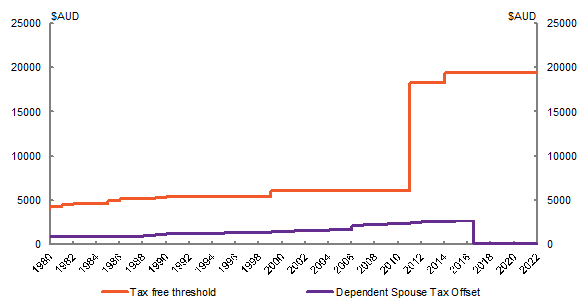
Note: DSTO line indicates the amount of offset available to taxpayers with a dependent spouse under age 65.
As the Government rolls out increases to the tax free threshold it will also be phasing out the Dependent Spouse Tax Offset (DSTO). The DSTO dates back to a time when male breadwinners were expected to maintain a housewife, even if they were without caring responsibilities or a disability. The DSTO effectively meant that spouses without children received $2,355 to stay at home. It also meant that secondary income earners faced a high effective tax rate of 25 per cent on the first $10,000 of income that they earned.
For these reasons, the Government is phasing out the DSTO. From 1 July 2012, the DSTO is being phased out for dependent spouses less than 60 years old at that point in time.
By 1 July 2017, nobody with a dependant spouse under Age Pension age will have access to the DSTO, representing an important reform furthering the Government’s participation agenda and reversing the trend of the past twenty years, over which government decisions led to the DSTO growing more rapidly than the tax free threshold. This simply entrenched barriers to workforce participation.
Finally, in this Budget, the Government is consolidating a further eight dependency tax offsets, as the AFTS Review recommended. This will provide more targeted assistance for individuals caring for dependants who are genuinely unable to work, but will remove offsets that are clearly anchored in yesteryear.
Removing barriers to participation from the transfer system
The Government is also reforming the transfer system to ensure that people with a weaker attachment to the workforce have the incentives and capabilities they need to participate. The Government has made decisions to improve incentives for unemployed people, young people who are not earning or learning, people with a disability and single parents.
For example, the Government will be reducing the taper rate for sole parents on Newstart Allowance to 40 per cent from 1 January 2013, meaning a single parent will be able to earn almost $160 per fortnight in additional income.
Many young people now also have stronger incentives to work because the Government has increased the amount of income that young people on Youth Allowance can earn before they start to lose benefits, from $62 to $143 a fortnight. Similarly, the Government has increased the number of hours that a person on the Disability Support Pension can work and retain access to their pension from 15 to 30 hours per week.
Long periods out of the workforce reduce a person’s chance of returning to work. The Government will strengthen participation incentives for parents by removing grandfathering arrangements for Parenting Payments from 1 January 2013. The age of the youngest child at which people move out of Parenting Payment will be 6 years for partnered recipients and 8 years for single parents, for all payment recipients.

Tax Reform: Road Map


