
Boosting participation to help with an ageing population (Continued)
Australians value a fair society where we create prosperity to spread opportunity. A progressive tax system is a key to delivering this fairness. Under Australia’s tax and transfer system, those who are able to pay more generally do pay more, and resources are made available to people who need the assistance the most.
Rising incomes in Australia have been shared far more evenly across the community than in other countries around the world. Incomes for the poorest 10 per cent of households in Australia have grown at more than double the OECD average in recent decades, while growth in the United States and the United Kingdom has been substantially below average.
Increasing fairness of the tax system
The personal income tax is the primary means of delivering a progressive tax system. The tax free threshold is an important feature of this structure, as are the progressive tax rate scales, under which a person’s average tax rate rises along with their income.
In its first three Budgets, the Government delivered three rounds of tax cuts worth $47 billion.
From 1 July 2012 the Government is more than tripling the tax free threshold, from $6,000 to $18,200. This is the largest increase in the tax free threshold ever and the first increase in more than ten years. From 1 July 2015, the tax free threshold will increase again to $19,400.
The tax cuts that are delivered as a result of this change will be targeted to low and middle income earners. The higher tax free threshold means tax cuts for all taxpayers up to $80,000, lifting the returns to work for low and middle income earners. It provides more timely assistance than the low income tax offset (LITO), which is being scaled back, meaning that workers will receive more tax relief in their fortnightly pay packets, rather than having to wait until tax time.
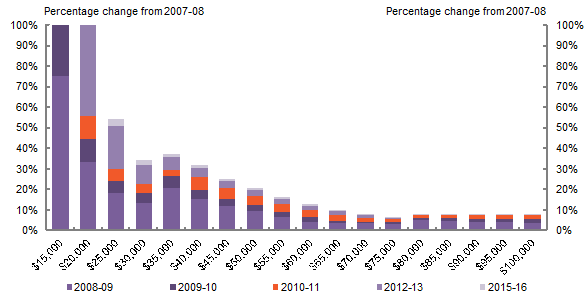
As can be seen from Chart 6, those on lower incomes will receive the greatest percentage reduction in tax compared to 2007-08. These changes mean that an individual on $50,000 a year will be paying:
- $1,750 less tax in 2011-12;
- $2,053 less tax in 2012-13; and
- $2,136 less tax in 2015-16.
CHART 6: CUMULATIVE PERCENTAGE REDUCTION IN TAX FROM 2007-08 BY TAXABLE INCOME
Source: Treasury
This structural reform is a key recommendation of AFTS Review and will make the tax system simpler. It will mean by 2015-16, over one million additional people need not lodge a tax return. The Government aspires to further raise the tax free threshold to $21,000 when fiscal circumstances permit. This will provide timely tax relief for even more Australians on modest incomes and promote the value of work.
Additionally, the Government is making tax simpler for families by converting the Education Tax Refund into a simple twice yearly payment — the Schoolkids Bonus. From 2013, the Schoolkids Bonus will be paid in two equal instalments in January and July. It will be $410 for primary school aged students and $820 for secondary school aged students. As a transitional arrangement, $409 for primary school age students and $818 for secondary school aged students will be paid automatically to eligible families in June 2012.
The introduction of the Schoolkids Bonus builds on the previous achievements of the Government, notably Family Tax Benefit (FTB) Part A reforms. From 1 January 2012, the maximum rate of FTB Part A for 16-17 year olds in secondary school will be increased by $4,208, and for 18-19 year olds in school by $3,741 per year. This will make the tax system fairer, as it helps modest income families with the cost of raising older teenagers and helps them to support their children to stay in school.
The Government is also committed to improving the fairness of the personal income tax system so that people on similar incomes pay similar amounts of tax on that income, regardless of the source of income or how they arrange their tax affairs (horizontal equity). This is an important outcome which improves fairness and promotes public confidence in the personal income tax system by reducing distortions and incentives for people to avoid paying their fair share of tax.
The Government has acted to address concerns about fairness in the personal income tax system through a range of reforms in successive Budgets. We will reform superannuation concessions, living-away-from-home allowances and benefits, golden handshakes, the mature age worker tax offset, net medical expenses tax offset, and dependency offsets. These reforms will build on the reforms in earlier Budgets including reforming the FBT concession on cars and removing access to the Low Income Tax Offset for the unearned income of minors.
These reforms will help broaden the personal income tax base. A broader base means that the revenue needed to provide the government services Australians want can be raised more sustainably by placing a relatively smaller tax burden across a larger number of taxpayers.
Boosting Retirement Incomes
Although the personal income tax is the cornerstone of a progressive tax system, it is not the only feature of the tax system that impacts on its progressivity.
The development of the modern superannuation system was motivated by a desire to deliver fairness through an adequate retirement income for all workers.
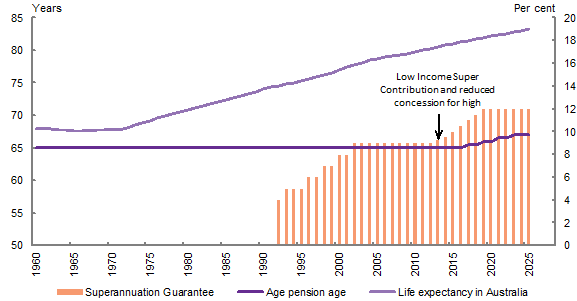
From 1 July 2013, the Government will begin gradually raising the Superannuation Guarantee to reach 12 per cent by 1 July 2019. This is in line with the original vision for superannuation, and also reflects increases in life expectancy and current community expectations about living standards in retirement. For example, a 30 year old on average full-time earnings will have an increase in their retirement benefit of $117,600 (in today’s dollars) as a result of the increase in the Superannuation Guarantee.
In lifting the Superannuation Guarantee the Government recognises that the current structure of superannuation taxation provides wealthier Australians with far greater benefits than low and middle income earners. The flat 15 per cent tax rate on concessional contributions provides a tax concession of 30 per cent (excluding the Medicare levy) to those on the top marginal tax rate, but a tax penalty to those below the tax free threshold.
In response, the Government is making the superannuation system fairer. From 1 July 2012, the Government will provide a Low Income Superannuation Contribution of up to $500 for those with taxable income up to $37,000. This will effectively refund the tax paid on their contributions under the Superannuation Guarantee. In addition, from 1 July 2012 the Government will reduce the tax concession on contributions received by very high income earners, with income above $300,000 a year, so that it is more in line with the concession received by average income earners.
These measures also improve the sustainability of the superannuation system. Our ageing population is a good example of a developing pressure on fiscal sustainability. As the population ages, demands on government spending will increase. Fewer people working, and therefore contributing to personal tax revenue, will only exacerbate this problem.
Since 2009, the Government has provided the biggest boost to the pension in Australia’s history, with the maximum rate increase by about $154 per fortnight for singles and $156 per fortnight for couples combined. The pension reforms in September 2009 not only addressed the adequacy of the pension system, but also helped ensure its sustainability. To reflect the longer and healthier working lives of Australians, the Age Pension age for men and women will be increased by six months every two years, commencing from 1 July 2017 and reaching 67 on 1 July 2023.
By lifting the Superannuation Guarantee together with other superannuation reforms, the Government will be boosting our retirement savings pool by $500 billion by 2037. Ensuring that the tax concessions on contributions into this pool are fair will help ensure the sustainability of the superannuation system long into the future.
CHART 7: A SECURE AND SUSTAINABLE RETIREMENT SYSTEM
Conclusion
While Australia is a low taxing country, we need to continue to reform the tax and transfer system and to make the most of the challenges and opportunities facing Australia.
Our tax reform agenda seeks to continue to attract investment for a productive economy, support participation and reward for effort, and establish a fairer and more sustainable tax system. This Government has already put in place a raft of historic tax reforms that will underpin this tax reform agenda.
We recognise this is a long-term process, and not something that can be done in a single Budget. Worthwhile reforms will continue to be rolled out, building on the work of the past.
Reform needs broad consultation and it needs to be rigorous. There are often short-term transitional costs to reform, and so many of these reforms will be introduced gradually, with a stream of benefits accruing over a number of years.
The Government will continue to lead a broad national debate to develop and build support for further good tax policy. The Government has established a set of policy development processes — covering business tax, superannuation, small business, not-for-profits and tax research more generally — that will inform future tranches of reform.
The Government understands that this reform will be challenging, especially in times of tight fiscal circumstances, but it is crucial to Australia’s prosperity in these changing times, and we will continue to meet this challenge in the years to come.

Tax Reform: Road Map


