




Chapter 3: Supporting Jobs and Industry
The Government's plan for a clean energy future is not only an economic reform which will deliver environmental benefits, it is also an industry and innovation policy which will modernise our industrial base. It will foster the investment that is needed to decouple continued economic growth in Australia from growth in pollution. This will improve Australia's competitiveness in the coming decades when clean energy and low pollution technologies will be a key to competitive advantage in a low carbon global economy.
Reducing the carbon intensity of Australia's industries is a foundation of our long-term competitiveness. The Government is committed to supporting jobs and industry competitiveness during this transition, and has implemented a range of programs to support businesses and jobs and to encourage investment in clean energy equipment, technology and innovation.
The Jobs and Competitiveness Program will safeguard jobs in industries which face strong international competition and produce a lot of pollution. This program will provide free carbon permits for businesses carrying on emissions-intensive, trade-exposed industrial activities. As a result of this support, an average highly emissions-intensive activity will face an effective carbon price of less than $1.30 per tonne of pollution in the first year of the carbon pricing mechanism. The Clean Technology Program will provide grants to help manufacturers invest in low pollution technologies. Tailored programs will support modernisation of equipment in food processing firms and metal foundries. The Steel Transformation Plan will help the steel manufacturing industry to transform into a more efficient and economically sustainable industry in a low carbon economy. There are also dedicated programs to support coal mining jobs.
The package of measures will support jobs and keep Australian industry strong while creating incentives for business to invest in clean energy and energy efficiency. This will ensure the Australian economy remains competitive as the world moves to reduce carbon pollution.
Achievements
- Regulations to implement the Jobs and Competitiveness Program are in place. The Regulations contain the rules governing the program, how it will operate, who may be an eligible applicant, and what the eligible activities and allocative baselines are.
- In March 2012 the Australian Parliament passed legislation to increase the small business instant asset write-off threshold to $6,500, as part of the mineral resource rent tax package and the clean energy future plan. This measure will take effect from 1 July 2012 and provides $2.3 billion savings for small business up to 2014‑15.
- Applications for competitiveness assistance advance payments under the Steel Transformation Plan Act 2011 opened in December 2011. A $100 million payment was made to BlueScope Steel on 18 January 2012, and a $64 million payment was made to OneSteel on 6 February 2012.
- Applications for funding under the Coal Sector Jobs Package closed on 29 February 2012.
- The Clean Technology Investment Program and the Clean Technology Food and Foundries Investment Program applications opened on 16 February 2012 to significant interest. The first payments to successful applicants will be made by 30 June 2012.
Figure 3: Overview of measures to support jobs
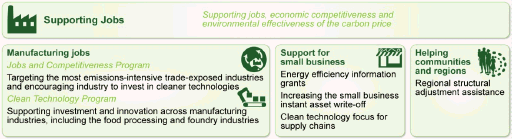
Programs supporting jobs and industry
Jobs and Competitiveness Program
The Jobs and Competitiveness Program will support local jobs and production, and encourage industry to invest in cleaner technologies. The ongoing program will provide an estimated $8.6 billion of assistance over the first three years of the carbon pricing mechanism. This support will be targeted at companies that produce a lot of carbon pollution but are constrained in their capacity to pass through costs in global markets.
The most emissions-intensive trade-exposed activities will receive assistance to cover 94.5 per cent of industry average carbon costs in the first year of the carbon price. Less emissions-intensive trade-exposed activities will receive assistance to cover 66 per cent of industry average carbon costs. Assistance will be reduced by 1.3 per cent each year to encourage industry to cut pollution.
Regular reviews will ensure that the Jobs and Competitiveness Program remains in step with international action on climate change and continues to support jobs and competitiveness.
Regulations to establish the rules for the Jobs and Competitiveness Program were made on 22 February 2012. Applications for the Jobs and Competitiveness Program will open on 1 July 2012.
Coal Sector Assistance Package
The Government recognises that a small number of existing coal mines are highly emissions-intensive and will face significant costs with the implementation of a carbon price. In response, the Government has developed a transitional assistance package for the Australian coal industry that recognises the adjustment challenges faced by the industry. The Coal Sector Assistance Package comprises two programs: the Coal Sector Jobs Package and the Coal Mining Abatement Technology Support Package.
Coal Sector Jobs Package
The Coal Sector Jobs Package is providing up to $1.3 billion over six years from 2011‑12 (five years of funding) for targeted transitional assistance to the most fugitive emissions-intensive mines to ease their transition to the introduction of a carbon price. Payments will be up to a maximum of 80 per cent of the extent to which the fugitive emission intensity is above the 0.1 tonne of CO2-e per tonne of saleable coal production threshold in 2008‑09.
To the extent that a mine reduces its fugitive emissions, it would stand to benefit as it would still be eligible for the same rate of assistance based on historical fugitive emissions intensity.
Program guidelines were published on 19 December 2011 and applications closed on 29 February 2012. First payments to eligible mines will be made by 30 June 2012.
Coal Mining Abatement Technology Support Package
The Coal Mining Abatement Technology Support Package will provide $70 million over five years commencing 1 July 2012 to supplement and support the coal industry's own research activities aimed at developing technologies and processes that will reduce carbon pollution safely. This funding will be directed at three program elements, namely:
- research, development and pilot deployment of abatement and avoidance measures, and measurement and verification technologies in the coal sector;
- safety and regulatory issues associated with the introduction of coal sector abatement technologies, including work with state and territory governments on safety requirements associated with the development and deployment of new abatement related technologies, equipment and processes; and
- assistance to small and medium coal sector participants to develop abatement plans or undertake feasibility studies to reduce emissions from current and proposed mines.
A Technical Advisory Committee has been established to provide advice and guidance to the Minister for Resources and Energy on the development and implementation of the Coal Mining Abatement Technology Support Package. The Technical Advisory Committee draws on representatives from the coal sector with a working knowledge and understanding of coal mining greenhouse gas emission abatement and safety issues.
Steel Transformation Plan
The Steel Transformation Plan (STP) is a $300 million program operating over six years from 2011‑12. The STP is already supporting the transformation of the Australian steel manufacturing industry into an economically sustainable industry in a low-carbon economy, by encouraging investment, innovation and competitiveness.
The STP contains two elements: competitiveness assistance advance payments of $164 million (draw down advances of eligible participants' future entitlements) made in 2011‑12; and a self-assessment scheme that will operate over five years from 2012‑13.
Applications for competitiveness assistance advance payments opened on 9 December 2011. A $100 million payment to BlueScope Steel was made on 18 January 2012, and a $64 million payment was made to OneSteel on 6 February 2012. The registration period for the self-assessment scheme is scheduled to commence on 1 July 2012.
Clean Technology Program
The $1.2 billion Clean Technology Program has three components helping manufacturing businesses identify and implement technologies that will improve their energy efficiency and reduce their exposure to the impact of changing electricity prices from the carbon price:
- the Clean Technology Investment Program;
- the Clean Technology Food and Foundries Investment Program; and
- the Clean Technology Innovation Program (covered in Chapter 4: Innovation in Renewable Energy).
Clean Technology Investment Program
The Clean Technology Investment Program is providing $800 million over seven years from 2011‑12 in competitive grants. The grants will help manufacturers invest in new plant and equipment which cuts their energy costs or reduces carbon pollution. These grants will support jobs and add to the incentive created by the carbon price for manufacturers to become more efficient, more competitive and more sustainable. Projects that can be supported include switching to less carbon intensive energy sources or installing new manufacturing equipment, processes and facilities to reduce energy consumption and carbon emissions.
The funding will be provided on a co-investment basis with the co-investment ratios designed to make the grants attractive and affordable for smaller manufacturers. Manufacturers with turnovers of less than $100 million a year requesting funding under $500,000 will be required to match the grants on a dollar for dollar basis. For all other grants under $10 million, applicants will be required to contribute two dollars for every dollar from the Government, while for grants of $10 million or more applicants will be expected to make a co-investment of at least three dollars for every dollar of government support. This means the Program will leverage significant additional private investment. This investment will help modernize sections of Australian industry which will help manufacturers compete at a time of significant pressures on manufacturing.
Applications for the program opened on 16 February 2012, and interest in the program to date is high. More than 1900 people attended information sessions for the Clean Technology Investment Programs held in capital cities and regional areas around Australia. The first payments for successful applicants will be made by 30 June 2012.
Clean Technology Food and Foundries Investment Program
Special assistance will be provided to the food and foundry manufacturing businesses, which are trade-exposed and have a higher exposure to energy costs than general manufacturing businesses. $150 million in grants over six years are available to the food and beverage industry, and up to $50 million over six years to the metal forging and foundry industries.
The grants will help these industries invest in energy-efficient equipment and low-pollution technologies, processes and products. Funding will be provided on a co-investment basis. The first payment for successful grants will be awarded by 30 June 2012.
Clean Technology Focus for Supply Chains
Clean Technology Focus for Supply Chains provides $5 million over four years from 2011‑12 to enhance the clean technology focus of industry supply chains. This is being done through existing business development and facilitation programs, including Supplier Advocates and Enterprise Connect. The program targets small to medium enterprises wishing to improve competitiveness in the clean technology sector, developing capabilities and linking suppliers with clean technology projects.
On 20 December 2011, Dr Marc Newson was appointed as the Government's Clean Technologies Supplier Advocate, to work with local manufacturers to develop and showcase their clean technology capabilities.
Small business instant asset write-off threshold increase
The Government has legislated an increase in the small business instant asset write-off threshold to $6,500, to support small businesses with an aggregated turnover of less than $2 million a year. This increase has two components:
- an increase from $1,000 to $5,000 as part of the mineral resource rent tax package; and
- a further increase from $5,000 to $6,500 as part of the clean energy future plan.
The existing instant asset write-off improves business cash flow by providing an immediate income tax deduction for the cost of eligible assets, with no annual limit to the number of times the deduction is claimed. Increasing the amount businesses can write off will increase cash flow and assist small business to grow and invest in new equipment. The increase comes into effect from the 2012‑13 income year. The clean energy future reforms to increase the threshold from $5,000 to $6,500 will deliver a benefit to small businesses of $200 million to 2014-15.
Clean Energy and Other Skills Package
The Government is investing up to $32 million over four years from 2011‑12 in the Clean Energy and Other Skills Package. Funding is being provided to help educational institutions and industry develop the materials and expertise needed to promote and build clean energy skills and workforce capability.
The package will enable tradespeople and professionals in key industries to develop the skills needed to deliver clean energy services, products and advice to Australian communities and businesses. This will help transition workers of all types to a low carbon economy by providing them with the skills that will become increasingly important as businesses adapt to a clean energy future. Key occupations include builders and workers in:
- electrocomms (to promote low-cost energy efficiency design);
- facility managers (to support better management of existing buildings to ensure maximum performance);
- engineers (to support whole-process redesign of industrial applications); and
- financial managers (to ensure good understanding of the business advantages of energy efficiency investments).
To date in 2011‑12, the Government has invested more than $8.5 million in 19 clean energy and energy efficiency skills and workforce development projects under the package.
Productivity Commission reviews
The Government is providing $18 million over four years from 2011‑12 to the Productivity Commission to undertake reviews relating to industry assistance and fuel tax arrangements, and to undertake ongoing work to quantify mitigation policies in other major economies. The Productivity Commission will also review industry assistance under the Jobs and Competitiveness Program and the Coal Sector Jobs Package.
The Productivity Commission released a consultation paper in December 2011 setting out the nature of each of the tasks. This was a first step in consulting with stakeholders. It is anticipated that further consultation papers will be released in 2012, with particular focus on the Commission's approach to undertaking this work.
If www.budget.gov.au responds slowly or you are having trouble downloading a document, try one of the Budget Website Mirrors
Note: Where possible, Budget documents are available in HTML and for downloading in Portable Document Format(PDF). If you require further information on any of the tables or charts on this website, please contact The Treasury.