




Chapter 5: Supporting Energy Markets
With its ready access to low-cost coal, Australia relies more heavily on coal-fired electricity generation than most other countries. Coal-fired generation accounted for around 75 per cent of Australia's electricity in 2009‑10. However, burning coal puts large amounts of carbon pollution into the atmosphere.
Generating electricity from renewable resources like wind or solar power puts no carbon pollution into the atmosphere. If we further develop Australia's solar, wind and other renewable energy resources, and combine coal-fired generation with new technologies such as carbon capture and storage, then our reserves of coal can continue to underpin cleaner electricity generation.
The Government's plan for a clean energy future encourages a smooth and orderly transformation of Australia's energy sector from a high-pollution mix towards a greater share of generation from renewable sources. It is designed to facilitate a transition to lower emissions generation without compromising the secure supply of energy essential to economic growth, jobs, and the prosperity and wellbeing of all Australians.
The key measures for maintaining a secure energy supply and ensuring a stable energy market during this transition are:
- an Energy Security Fund that provides around $5.5 billion in assistance for generators significantly affected by the introduction of a price on carbon pollution; and
- an Energy Security Council to advise the Government on emerging risks to energy security.
Achievements
- The Energy Security Council has been established, board members appointed and Dr Michael Vertigan AC appointed as Chair.
- Applications from eligible electricity generators for cash payments under the Energy Security Fund opened on 1 December 2011, and outcomes were announced on 30 March 2012.
- A Cooperative Agreement was signed with the Victorian Government supporting the transition of the Latrobe Valley economy.
- Key Principles and Operational Guidance for the Energy Security Council Category A Loan Scheme were released on 22 February 2012, providing emissions-intensive generators with information on how to apply for refinancing loan assistance.
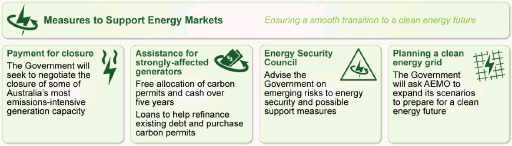
Figure 5: Overview of measures to support energy markets
Energy security programs
Energy Security Fund
The Energy Security Fund will help smooth the transition to a clean energy economy and maintain energy security through two key initiatives: seeking to negotiate payment for the closure of up to 2000 megawatts (MW) of very highly emissions-intensive coal-fired generation capacity by 2020; and the provision of transitional assistance to highly emissions-intensive coal-fired power stations in Australia in the form of both cash payments and free carbon units.
Both measures require that energy security and market stability outcomes be delivered before any electricity generation capacity can be withdrawn, and structural adjustment impacts carefully managed.
To ease the impact of structural change on those regions most likely to be affected, funding will be available under the Regional Structural Adjustment Assistance package for initiatives such as support for displaced workers and their families, and for community development and economic diversification programs.
Contract for closure
The Government is seeking to negotiate the orderly closure of up to 2000 MW of emissions-intensive generation capacity by 2020 to make room for investment in lower-pollution plants. The Contract for Closure program promotes energy security by providing new investors with a degree of certainty about the closure of old capacity, and minimises the risks to energy security that may arise from an unplanned exit of electricity generation capacity from the market.
An essential security element of the program is that the timeframe for closure allows enough time for replacement capacity to be built. The Australian Energy Market Operator (AEMO) will advise the Government on the proposed closure timetable to ensure it is consistent with maintaining secure energy supplies.
Detailed closure proposals were submitted by generators and five generators have been invited to proceed to the negotiation phase:
- Playford B Power Station (Alinta Energy);
- Energy Brix (HRL);
- Hazelwood Power Station (Hazelwood Power Partnership, 91.8 per cent owned by International Power GDF Suez Australia);
- Collinsville Power Station (RATCH); and
- Yallourn Power Station (TRUenergy).
This negotiation process is expected to conclude by 30 June 2012. The Government has indicated the preferred closure timeframe for eligible generators is between 1 July 2016 and 30 June 2020.
The Government is committed to ensuring that measures are put in place to assist workers and communities affected by any Contract for Closure.
Transitional assistance for strongly affected generators
The Government will help highly emissions-intensive coal-fired electricity generators facing asset value losses adjust to the introduction of a carbon price by providing transitional assistance in the form of a limited free allocation of cash payments and free carbon units until 2016‑17. This assistance is valued at $5.5 billion (in nominal terms), amounting to around 23 per cent of the coal-fired power stations' expected liability over this time.
Applications for Energy Security Fund Cash Payments closed on 31 January 2012 and the assessment outcomes were announced on 30 March 2012.
A combined application for cash payment and free carbon units was made available for convenience, so that applicants did not have to lodge two separate applications. All applications for cash payments submitted on 31 January 2012 that used the combined application option for free carbon units have been passed to the Clean Energy Regulator.
Cash payments will be made by 30 June 2012 and the first allocation of free units will be issued by the Clean Energy Regulator on 1 September 2013.
Energy Security Council
An Energy Security Council has been established to advise the Government on emerging risks to energy security and on possible support measures to avert those risks. It will advise on risks emerging from financial impairment from any source, not just from carbon pricing. The Council is able to recommend a range of support measures and will advise on the provision of loans to electricity generators for the refinancing of existing debt.
Dr Michael Vertigan AC, chairs the Council, which also includes energy and financial market experts, and the chairs of the Australian Energy Market Commission (AEMC), the Australian Energy Regulator (AER) and the Australian Securities and Investments Commission (ASIC).
The Council is now meeting regularly and Dr Vertigan has commenced discussions with State and Territory energy ministers on ways to identify and manage potential energy security issues.
Loan assistance
Recognising the difficult borrowing conditions faced by many highly emissions-intensive generators and the amount of refinancing to be undertaken in the industry in the near future, the Government may offer loans to support the refinancing of existing debt. Loans will be offered on terms that encourage generators to seek private finance in the first instance.
The Energy Security Council assesses applications for assistance and provides advice to the Government on whether financial assistance should be provided in response to those applications. Applications may be made for:
- Category A loans for generator owners which need to refinance their debt if finance on reasonable commercial terms is not otherwise available in line with conditions in the documents referred to below; and
- Category B loans or other assistance to seek to address systemic risk to energy security in light of the financial distress of an energy market participant.
Key Principles and Operational Guidance for the Energy Security Council Category A Loan Scheme (for refinancing) were posted online (www.energysecuritycouncil.gov.au) on 22 February 2012, and the Program Administrative Guidelines and application form are available to generators upon request.
Loans may also be offered to support the acquisition of future year carbon permits at early auctions. Provisions for Loans for the Purchase of Future Vintage Permits have been included in the Clean Energy Act 2011.
Regional structural adjustment assistance
Under the Government's plan for a clean energy future up to $200 million will be made available for workers, regions and communities that remain strongly affected by the carbon price after other forms of assistance have been provided.
The potential impact of carbon pricing on regions will be closely monitored to identify any communities that require help to ease the transition. Where required, the Government will work in close consultation with communities to develop and deliver structural adjustment assistance. This may include support for displaced workers and their families and affected small businesses, community development and economic diversification. Funding for any region under the program will be determined on a case-by-case basis, and will be available from 2012‑13.
On 13 December 2011, the Australian and Victorian governments signed an Agreement for Cooperative Arrangements for the Gippsland Region to support the transition of the Latrobe Valley economy, positioning this key energy region to transition to a more diversified and low-carbon economy.
Planning a clean energy grid
The Australian Energy Market Operator (AEMO) plays a key role in planning the national electricity transmission grid, centering on the annual National Transmission Network Development Plan. The Government has asked AEMO to expand its planning scenarios to prepare for greater use of renewable energy. This will include further consideration of energy market and transmission planning implications of moving towards 100 per cent renewable energy.
If www.budget.gov.au responds slowly or you are having trouble downloading a document, try one of the Budget Website Mirrors
Note: Where possible, Budget documents are available in HTML and for downloading in Portable Document Format(PDF). If you require further information on any of the tables or charts on this website, please contact The Treasury.