



Broadband, Communications and the Digital Economy
The Broadband, Communications and the Digital Economy portfolio is committed to improving services to regional, rural and remote Australia. Over the past 12 months there has been significant progress made in delivering the National Broadband Network (NBN), with a priority rollout commitment to regional areas. The NBN provides regional Australia with opportunities for individuals and businesses to connect via high-speed broadband to distant markets, both in Australia and overseas, and can also provide better access to health, education and a range of other services.
The Department administers the switchover to digital television, which includes programs to assist eligible Australians. To date, the Household Assistance Scheme and the Satellite Subsidy Scheme has assisted over 100,000 Australian households to switch to digital mainly in regional and remote Australia. Switchover has already occurred in several areas of regional Australia in Victoria, South Australia, New South Wales and Queensland.
Many regional communities will benefit from the number of digital productivity initiatives the Department is implementing. This includes the Digital Local Government, Digital Hubs and Digital Enterprise programs, as well as a number of telehealth and education program trials, through the Digital Regions Initiative.
The Department continues to improve access to telecommunications for Australians living in remote Indigenous communities through the provision of public internet access and training opportunities as well as the installation and maintenance of community phones in small remote communities. In addition, the Indigenous Broadcasting Program enriches the regional and remote Indigenous communications landscape by supporting Indigenous radio in these areas. Indigenous radio is a critical communication tool that enables local messages to be distributed cost effectively, provides entertainment and training, helps in the maintenance of Indigenous languages and promotes Indigenous culture and identity.
Spatial Reporting
Table 3 illustrates a summary of expenditure by program disaggregated between regional Australia, non-regional and non-specific location for the budget year and forward estimates for the Broadband, Communications and the Digital Economy portfolio.
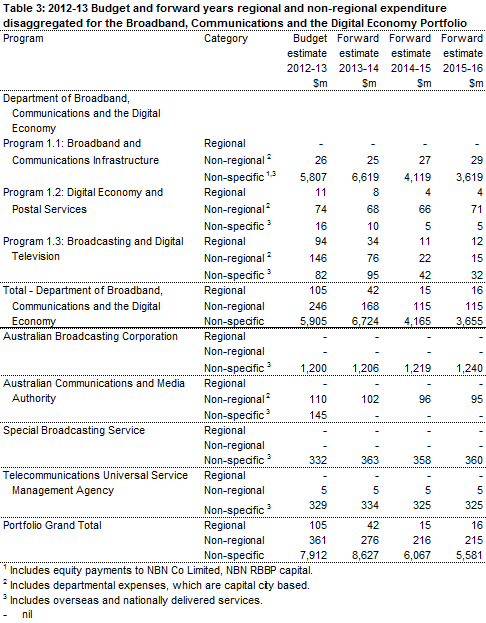
Expenditure in the Broadband, Communications and the Digital Economy portfolio is through five agencies.
- Department of Broadband, Communications and the Digital Economy, which delivers a range of programs delivering benefits to regional Australia, including:
- provision of $20.1 billion in equity funding to the NBN Co Limited (NBN Co) over the Budget and forward years, including for capital expenditure of $9.9 billion on fibre-to-the-premises technology and $2.2 billion on next-generation fixed wireless and satellite technologies providing speeds of 12 megabits per second;
- $271.2 million over the period 2012‑13 to 2015-16 to continue programs to support the switchover to digital television, including to support the Viewer Access Satellite Television (VAST) service, the Satellite Subsidy Scheme and the Household Assistance Scheme. It is expected $139.9 million of this funding will be provided to support services in regional Australia;
- $87.2 million over the next three years will be provided to meet the costs of digital television services being reorganised (or restacked) across the nation. This will enable spectrum (the digital dividend) to be reallocated, via an auction process, to support the introduction of new communications services;
- $64.1 million over four years for the Indigenous Broadcasting program which provides assistance to Indigenous community radio stations, Indigenous media organisations and Indigenous broadcasting services;
- $29.7 million over two years for the Digital Productivity program, to enable local governments to maximise opportunities provided by the NBN, and to establish digital enterprise services and a digital hub in each of the first 40 communities to be connected to the NBN; and
- $19.2 million over four years for the Satellite Phone Subsidy program and the Indigenous Communications program (Regional Telecommunications Review Response), which provides and maintains community phones in remote Indigenous communities.
- Australian Broadcasting Corporation (ABC) and the Special Broadcasting Service Corporation (SBS) are national broadcasters, providing a range of nationally delivered television, radio and online services.
- Australian Communications and Media Authority (ACMA), which is responsible for regulating broadcasting, radio communications, telecommunications and online content.
- Telecommunications Universal Service Management Agency (TUSMA), which is responsible for the administration of contracts and grants to ensure standard telephone services and payphones are reasonably accessible to all people in Australia on an equitable basis, wherever they reside or carry on business.
New Initiatives
Special Broadcasting Service — Free-to-Air Indigenous Television Indigenous Television Channel
The Government is providing $63.0 million over four years for SBS to establish a free-to-air national Indigenous television channel for all Australians, including those in regional areas. The channel will be available through the full reach of SBS's terrestrial network and on the Viewer Access Satellite Television (VAST) service. SBS will launch the new Indigenous television channel during 2012‑13.
The new Indigenous channel on SBS, which replaces the National Indigenous Television Service, will realise the government's aims to increase both the amount and overall quality of original Australian Indigenous content on free-to-air television. The new channel will have its own distinctive identity, a high level of editorial independence and appropriate Indigenous representation.
Current Initiatives
National Broadband Network
The Australian Government's goal for the NBN is to re-shape the telecommunications sector and ensure every home and business in Australia, including those in rural, regional and remote areas, has access to affordable high-speed broadband. The Government has established NBN Co to design, build and operate the NBN, connecting 93 per cent of Australian homes, schools and businesses with fibre-to-the-premises technology capable of providing broadband speeds of up to one gigabit per second. Seven per cent of Australian premises will have access to next-generation fixed wireless and satellite technologies providing peak speeds of 12 megabits per second.
The NBN provides regional Australia with opportunities for individuals and businesses to connect via high-speed broadband to distant markets, both in Australia and overseas. It can also provide better access to health, education and a range of other services.
The Government's 2010 Commitment to Regional Australia included an undertaking to prioritise regional areas in the rollout of the NBN and to fast track the introduction of NBN fixed wireless and satellite services so that regional Australia can get better broadband access sooner.
The planning and construction of the NBN is well underway. Commercial services on the NBN fibre network are now available in eight Australian communities:
- Armidale and Kiama Downs/Minnamurra (New South Wales);
- Brunswick (Victoria);
- Townsville (Queensland);
- Willunga (South Australia); and
- Midway Point, Scottsdale and Smithton (Tasmania).
On 29 March 2012, NBN Co released its first three year rollout plan. The plan shows that over 3.5 million premises will be covered between 1 April 2012 and 30 June 2015.
NBN Co also released an updated 12 month rollout schedule on 15 February 2012 which lists 66 locations covering over 758,000 premises across all States and Territories where construction of the fibre network is expected to commence or be completed by the end of December 2012.
The NBN will provide access to enhanced broadband services to all Australian premises and aims to close the gap for those in rural and regional areas. NBN Co's fixed wireless network will provide peak speeds of 12 megabits per second. The first trial services on the fixed wireless network have commenced in Armidale (New South Wales).
On 3 August 2011, NBN Co announced the first five communities to receive the fixed wireless service. These sites cover the less densely populated areas surrounding Geraldton (Western Australia), Toowoomba (Queensland), Tamworth (New South Wales), Ballarat (Victoria) and Darwin (Northern Territory).
NBN Co is delivering on the Government's commitment to regional Australia. The Interim Satellite Service was successfully launched on 1 July 2011 and as at 3 April 2012 there were nine retail service providers to choose from and 5,050 interim satellite service end users connected to the service.
The Interim Satellite Service offers peak speeds of six megabits per second downlink and one megabit per second uplink which provides a significant improvement in speed and service performance for satellite customers in regional and remote Australia. This service is a transition service to the long term satellite service which will be available in 2015.
NBN Co reached a major milestone in the delivery of the long term satellite service when it announced on 8 February 2012 that it had signed a contract valued at approximately $620.0 million with Space Systems/Loral for the delivery of two next generation Ka-band satellites and associated tracking, telemetry and control systems.
The two new satellites mean that upon launch in 2015, NBN Co will be able to offer a 12 megabit per second download/one megabit per second upload service, at uniform national wholesale prices, to premises outside the fibre and fixed-wireless footprints. In terms of speed and reliability, this will deliver a step-change in performance for satellite users compared with existing satellite services.
Additionally, 6,000 kilometres of fibre optic cable rollout under the Government's $250.0 million Regional Backbone Blackspots Program (RBBP) has been completed, providing more competitive broadband services for regional Australia. The RBBP has provided competitive fibre backhaul services in more than 100 regional locations and will enable service providers to deliver high quality and better value broadband services. Locations to benefit from the program include Geraldton (Western Australia), Darwin (Northern Territory), Broken Hill (New South Wales), Victor Harbor (South Australia), Emerald and Longreach (Queensland) and south west Gippsland (Victoria).
On 7 March 2012, Definitive Agreements between NBN Co and Telstra were finalised and came into force. These agreements allow NBN Co access to suitable Telstra infrastructure and for Telstra to progressively migrate customers from the old copper network to the new NBN. The Definitive Agreements will mean less disruption to communities, less use of overhead cables and faster access to the NBN for Australians.
NBN Co will be funded with Government equity until NBN Co has sufficient cash flows to support private sector debt without explicit Government support. The Government has currently provided equity injections totalling $2.8 billion into NBN Co.
Digital Switchover
The switchover to digital television has already occurred in the Mildura/Sunraysia, regional South Australia and Broken Hill, regional Victoria and regional Queensland switchover areas. It is scheduled to occur in regional southern and central New South Wales, the Australian Capital Territory and Murrumbidgee Irrigation Area on 5 June 2012 and regional northern New South Wales on 27 November 2012. Switchover in all parts of Australia will be completed by the end of 2013. To date around 1.2 million households are now digital-only, almost entirely in regional and remote Australia.
Digital Switchover programs include:
- a targeted communications campaign with a local focus to make sure people are informed about switchover in their area and the steps they need to take;
- the Household Assistance Scheme, which is successfully providing in-home practical assistance to eligible pensioners in the form of installation of a set top box, any necessary cabling and antenna work and an in-home after care service - all free of charge;
- the VAST satellite service, to enable Australians in remote areas and those in signal blackspots to receive the same number of channels as Australians in metropolitan areas;
- the Satellite Subsidy Scheme which assists people in communities previously served by analog self-help towers to move to the VAST service; and
- infrastructure assistance programs to enable regional commercial broadcasters to provide new digital services.
Indigenous Broadcasting Program
The Government allocated $15.4 million to the Indigenous Broadcasting Program in 2012‑13. Funding is aimed at assisting Indigenous community radio stations and support is provided to five urban, 23 regional and remote radio stations, nine Remote Indigenous Media Organisations and 124 Remote Indigenous Broadcasting Services situated in remote communities. The Program funds a range of organisations such as Imparja Television, Indigenous Community Television and peak bodies and activities such as broadcasting training and content production.
A funding round for the program has been conducted each year since 1987, with applications assessed against the published program guidelines and assessment criteria.
Digital Local Government
The Government's $17.1 million Digital Local Government program is assisting local councils in the first 40 communities to benefit from the high-speed broadband connectivity that the NBN provides to deliver improved online services, particularly to homes and businesses.
Each eligible council can apply for funding of up to $375,000 (GST exclusive). Twenty four of the eligible councils provide local government services to regional (as per the ABS Remoteness Structure) Australians. In total, $9.0 million in funding is being made available for councils representing regional Australians.
Eligible councils are expected to begin making new NBN enabled services available to their residents from the second half of 2012.
The benefits of these services for regional Australians are expected to include:
- reduced travel times for local council staff and ratepayers between locations and across local government areas;
- improved customer service by enabling local residents and businesses to access council staff and services by video;
- more efficient use of council resources, enabling the re-allocation of staff to other priority tasks; and
- more efficient dissemination of information to local residents and businesses.
Digital Regions Initiative
The four-year $60.0 million Digital Regions Initiative commenced in July 2009 and co‑funds digital enablement projects with State, Territory and local governments through a National Partnership Agreement. The initiative takes a collaborative approach to improve services in the key sectors of health, education, and emergency services in regional, rural and remote Australian communities. The initiative concludes on 30 June 2013.
Examples of projects include:
- introducing telehealth services into remote communities across Australia;
- implementing chronic disease management systems;
- creating a broadband-based virtual data centre to enable schools and organisations across Tasmania to share resources; and
- developing a bushfire simulator to improve bushfire prediction.
In addition to the fourteen digital enablement projects, funding has been provided for the following three trials that will take advantage of the NBN:
- the NBN Diabetes Telehealth Trial in Townsville is delivering high quality in-home telehealth services to improve the health outcomes of patients with type 2 diabetes who live in Townsville;
- the New South Wales NBN Telehealth to the Home Trial will deliver high quality in-home telehealth services to improve the health outcomes of older Australians with chronic conditions who live in Armidale and Kiama, as well as video-based mental health services for young people in Kiama; and
- EduONE — Education Our New England NBN-enabled tele-education trial is trialling new models of education services and resources using the NBN by providing state-of-the-art virtual interactive training rooms, laboratories and community learning capability.
Indigenous Communications Program
Telephones
The Indigenous Communications Program provides and maintains community phones in remote Indigenous communities with baseline populations of less than 50 people. Community phones provide access to emergency and other medical and support services as well as to family and friends. In 2012‑13, around 500 phones in remote Indigenous communities will be monitored and maintained.
Public Internet Access
The public internet access and training component of the Indigenous Communications Program is delivered in collaboration with participating State and Territory governments through the Closing the Gap: National Partnership Agreement on Remote Indigenous Public Internet Access. Approximately 1,900 Indigenous Australians have received basic training in computer use across 106 communities since the inception of the program in 2009.
Satellite Phone Subsidy Scheme
The Satellite Phone Subsidy Scheme improves the affordability of mobile communications for people living, working and travelling in those areas which do not have terrestrial mobile coverage by providing subsidies for the purchase of satellite phone handsets.
The scheme provides up to $1,000 for eligible applicants who live in areas without terrestrial mobile coverage, or up to $700 for eligible applicants living in areas that have coverage but spend more than 180 days across a two year period in non-coverage areas.
Those eligible to apply include individuals, small businesses, community groups, not-for-profit organisations, Indigenous corporations, emergency service organisations, health organisations and educational institutions.
Since the Scheme's inception in June 2002, over 18,000 subsidies have been provided.
If www.budget.gov.au responds slowly or you are having trouble downloading a document, try one of the Budget Website Mirrors
Note: Where possible, Budget documents are available in HTML and for downloading in Portable Document Format(PDF). If you require further information on any of the tables or charts on this website, please contact The Treasury.