




Immigration and Citizenship
The Immigration and Citizenship portfolio is committed to supporting rural and regional communities in Australia. A number of Immigration and Citizenship programs specifically target regional Australia, encouraging migrants and humanitarian entrants to settle in regional areas.
Spatial Reporting
Table 8 illustrates a summary of expenditure by program disaggregated between regional Australia, non-regional and non-specific location for the budget year and forward estimates for the Immigration and Citizenship portfolio.
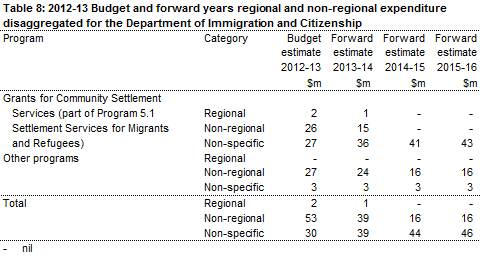
The Grants for Community Settlement Services Program (SGP) is an ongoing grants program with funding provided through a grants application round each year for services over a maximum of three years, though the majority of funding usually occurs in the first year. The successful applicants for each year's funding round are announced shortly after the Budget. The analysis for 2012‑13 and 2013‑14 is based on second and/or third year funding for the 2010‑11 and 2011‑12 SGP rounds.
Humanitarian entrants frequently arrive unfamiliar with cultural and social norms, a lack of family or social support, limited education or employment experience and with limited English language proficiency. Those settling in regional locations may face the challenges of limited local availability of a range of relevant services, limited local experience in delivering services to culturally and linguistically diverse clients and limited understanding of the particular settlement needs of each group.
The Department provides a range of settlement support through the SGP in both metropolitan and regional locations to overcome these barriers.
Funding to organisations is made on a service basis, with funding priorities for particular regions and communities determined by an annual need based planning process. Regional locations receive a higher weighting in recognition of the higher cost of delivering services in those areas and possible lack of access to mainstream services that are available in metropolitan areas.
New Initiatives
Focus on Regional Migration
The Government will continue to focus on using Australia's Migration Program to benefit regional Australia. It will continue to encourage migrants to settle in the regional areas where their skills and expertise are greatly needed.
Skilled migrants who settle in regional Australia help support and grow regional economic activity. They help sustain and strengthen regional communities by filling critical skills shortages. They add vitality, diversity and innovation to our regional economies. The Government will continue to build on its suite of packages to encourage beneficial migration outcomes for regional Australia.
The following elements form part of the Government's commitment to continuing to build and strengthen our strong regional migration arrangements:
- applicants for permanent regional migration visas continue to be afforded the highest level of processing priority, ensuring their applications are processed and finalised as quickly as possible;
- the Regional Sponsored Migration Scheme (RSMS) is expected to deliver 16,000 skilled migrants to regional areas in 2012‑13, filling vacancies which employers cannot fill from the local labour force; and
- the Government will deliver a streamlined RSMS, which will enable existing temporary regional skilled workers to transition more easily to permanent residence with an employer sponsored skilled position. Their employers and local communities will find it simpler to retain their skills in the region.
Strengthening the Regional Sponsored Migration Scheme
The Government will allocate up to 16,000 places to the RSMS in 2012‑13 to help fill regional vacancies that cannot be met domestically.
This allocation recognises the significant demand regional communities have for skilled migrants. The RSMS is a demand-driven and employer sponsored scheme which ensures that regional Australia gets the skills it needs when it needs them.
From 1 July 2012, the Government will also introduce reforms to fast-track the pathway from a temporary subclass 457 visa, Australia's principal temporary work visa, to a permanent visa under the RSMS. A broader range of skilled occupations will be accessible under the RSMS. The upper age limit will be raised from 45 to less than 50 years and market salaries will be introduced to better respond to regional variations in salaries within industries. Semi-skilled occupations will also be available to regional areas where there are genuine unmet vacancies through the negotiation of a Labour Agreement or a Regional Migration Agreement.
In addition, existing 457 visa holders seeking RSMS or other permanent regional migration visas will continue to be afforded the highest level of processing priority, ensuring their applications are processed and finalised as quickly as possible. This makes migrating to Australia faster for applicants who have skills and qualifications that are in demand in regional Australia — ensuring they can make a timely contribution to regional areas.
Current Initiatives
Regional Sponsored Migration Scheme
Skill shortages pose major challenges to regional Australian businesses, with significant implications for the viability of towns and local economies. The Government is committed to supporting regional communities to address these issues, to find local, sustainable solutions that allow the flexibility for businesses to find the workers they need, while also protecting regional skilled workers' employment opportunities.
The RSMS is a migration initiative that allows employers in regional Australia to recruit skilled workers from overseas, or those who are working in Australia on a temporary visa, to fill vacancies in their businesses that are unable to be filled by an Australian worker. Employers in all areas of Australia, except for Melbourne, Wollongong, Newcastle, Sydney, Brisbane and the Gold Coast, can access the RSMS.
Employers must be able to show there is a genuine need for the skilled worker in their business, and the nominated position must be certified by a Regional Certifying Body. The employer must also be able to provide the skilled worker with at least two consecutive years of full-time employment.
Regional Migration Agreements
The Government has been working to introduce Regional Migration Agreements (RMAs). The agreements bring together employers, local, State and Territory governments and unions to cooperate on addressing local labour needs.
RMAs recognise the unique circumstances of some localities and tailors migration solutions accordingly. In particular, RMAs are a coordinated response to labour needs, helping local areas to implement workforce strategies that support growth while ensuring Australian workers remain the first choice for employers and industry. By utilising RMAs, local communities are able to gain streamlined access to temporary overseas workers where there is a genuine need.
RMAs are custom-designed, geographically-based migration arrangements that set out the occupations and numbers of overseas workers needed in the regional area. Individual local employers can then directly sponsor workers under the terms of the RMA. RMAs are another vital tool in helping deliver strong, highly-targeted and supportive migration arrangements for regional Australia.
Labour Agreements
The Labour Agreement program offers regional employers a viable avenue to address skill vacancies that cannot be filled from the local labour market by sponsoring overseas workers. Labour agreements are negotiated arrangements between the Commonwealth and an employer which facilitate the entry of overseas workers where employers can demonstrate a need. A range of labour agreements are in place across regional Australia, including in the meat processing, fishing and snow sports industries. Labour agreements are also in place to help meet the skill needs of the resources sector.
Labour agreements provide a balanced response to the labour needs of regional Australia by ensuring that employers seeking access to overseas labour also make strong efforts to recruit and train Australian workers.
State and Territory Government Nominated and Family Sponsored Migration
Applicants under the General Skilled Migration program may be sponsored to regional Australia as the holder of a provisional Skilled — Regional Sponsored visa, leading to permanent migration after the holder has lived (for at least two years) and worked (for at least one year) in regional Australia.
The Skilled — Regional Sponsored Subclass 475 and Subclass 487 visas are provisional visas which provide access to the Subclass 887 permanent visa, provided that holders meet criteria requiring them to live and work in regional Australia. Both of these provisional visas allow for sponsorship by either a family member or nomination by a State or Territory Government. These visas are accessed by State and Territory Governments under State Migration Plans.
There are concessions under the points test for the Skilled — Regional Sponsored visas. The Government introduced a revised General Skilled Migration points test on 1 July 2011. The revised points test maintains regional sponsorship points for the Skilled - Regional Sponsored visa.
Diversity and Social Cohesion Program
The Diversity and Social Cohesion Program (DSCP) evolved from the 'Living in Harmony' program, which was established in 1998. The DSCP is funded under the Government's Social Inclusion Agenda for new initiatives to address the particular needs of vulnerable migrants and refugees and build community cohesion in regional locations.
Under the program, grants of up to $50,000 are available for eligible not-for-profit organisations to develop projects that help build stronger community relations. Multicultural Arts and Festivals Grants of up to $5,000 are also available for eligible not-for-profit organisations to stage events that encourage social cohesion and mutual understanding.
Sustainable Regional Settlement
A key objective of the Government's migration program is to successfully settle humanitarian entrants arriving in Australia.
While the vast majority of settlement occurs in metropolitan areas, regional settlement is an important component of this strategy. The settlement of refugees in regional areas is beneficial for both the refugees and the receiving communities. Regional settlement can provide refugees with good social and economic prospects, while at the same time reduce the load on services in metropolitan cities, offset regional population decline and increase community diversity in regional areas.
The Government has directly settled humanitarian entrants in regional areas for some years now. Up to 13,750 new humanitarian entrants are settled in Australia each year, 15 to 20 per cent of whom are directly settled in regional locations. Other migrants will move to regional areas as part of secondary movement and as a result of local initiatives by businesses and councils to attract new residents. A range of settlement related services (including Humanitarian Settlement Services, the Adult Migrant English Program and the SGP) are available to clients in regional, as well as metropolitan, locations.
The Government is working across all levels of government and with Regional Development Australia (RDA) committees to make better use of existing capacity in regional areas to support settlement and ensure appropriate government funding is available to do this.
If www.budget.gov.au responds slowly or you are having trouble downloading a document, try one of the Budget Website Mirrors
Note: Where possible, Budget documents are available in HTML and for downloading in Portable Document Format(PDF). If you require further information on any of the tables or charts on this website, please contact The Treasury.