




Sustainability, Environment, Water, Population and Communities
The Sustainability, Environment, Water, Population and Communities portfolio continues to support environment and sustainability programs in rural and regional communities across Australia. New initiatives in the 2012‑13 Budget and ongoing programs seek to achieve a variety of environmental and economic objectives to support sustainable regional communities.
Spatial Reporting
Table 12 illustrates a summary of expenditure by program disaggregated between regional Australia, non-regional and non-specific location for the budget year and forward estimates for the Sustainability, Environment, Water, Population and Communities portfolio.
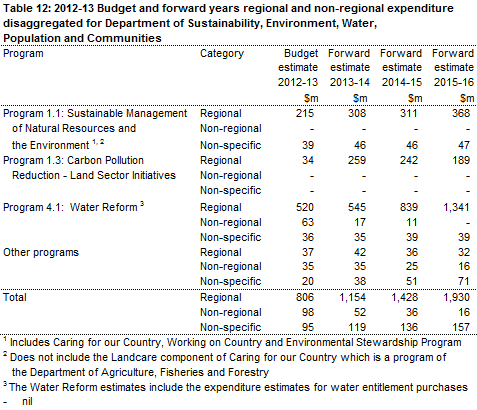
The Sustainability, Environment, Water, Population and Communities portfolio contributes to the development of regional Australia primarily through three larger programs: Sustainable Management of Natural Resources and the Environment; Carbon Pollution Reduction — Land Sector Initiatives; and Water Reform. These programs represent over 90 per cent of administered expenditure for the portfolio over the forward estimates period.
The Sustainable Management of Natural Resources and the Environment program incorporates Caring for our Country and the Environmental Stewardship Program. Due to the nature of these programs, the majority of the funding for activities is delivered in regional and rural areas across Australia.
Carbon Pollution Reduction — Land Sector Initiatives includes the Biodiversity Fund, the Regional Natural Resource Planning for Climate Change Fund, the Indigenous Carbon Farming Fund and the Land Sector Carbon and Biodiversity Board. These initiatives will support landholders to undertake projects that establish, restore, protect or manage biodiverse stores. The Biodiversity Fund will improve the resilience of Australia's unique species to the impacts of climate change, enhance their environmental outcomes or carbon farming projects, and help landholders protect carbon and biodiversity values on their land. The funding of these projects is subject to competitive grants processes which are still being undertaken and has therefore been defined as non-specific.
Water Reform, incorporating the Water for the Future program, is a long-term Australian Government initiative to better balance the water needs of communities, farmers and the environment. While it contains urban projects, such as desalination and stormwater capture, the majority of the program includes funding for irrigation modernisation and recycling in regional areas.
New Initiatives
Expansion of On-Farm Irrigation Efficiency Program
Expansion of the Commonwealth-led On-Farm Irrigation Efficiency Program (OFIEP) (part of Water for the Future Program) will allow the Government to continue to provide grants to irrigators to modernise their on-farm irrigation infrastructure while returning water savings to the environment. The expanded program will provide a further $150.0 million over six years from 2012‑13 and will be funded using existing Sustainable Rural Water Use and Infrastructure Program funding.
In the longer term, the program will allow irrigation and related industries to maintain or expand production levels while at the same time returning water to the environment to help 'bridge the gap' to the sustainable diversion limits under the Basin Plan.
Strategic Sub-System Reconfiguration Program
As part of the Australian Government's commitment to 'bridge the gap', the Government will fund a new Strategic Sub-System Reconfiguration program. The goal of this program is to integrate water purchasing with strategic opportunities for decommissioning or reconfiguring underutilised off-farm water delivery infrastructure. This will assist in maintaining the delivery efficiency of shared irrigation networks in regional irrigation communities. The Government has committed $200.0 million over four years to this program to be funded from within the Sustainable Rural Water Use and Infrastructure program and the Restoring the Balance in the Murray-Darling Basin program.
This program complements other activities that are underway to recover water access entitlements from regions where the draft Basin Plan indicates there is further water required for the environment. This program will also encourage irrigation water providers to position themselves to better service their irrigation industries.
Ensuring the Resilience of the Great Barrier Reef
A number of measures in the 2012‑13 Budget will provide benefits to the Great Barrier Reef Marine Park (GBRMP) and surrounding communities. The Great Barrier Reef (the Reef) is an Australian environmental and cultural icon. The Reef supports important marine and tourism industries and is critical to the economic and social wellbeing of over one million Australians from diverse industries and communities.
Funding of $8.0 million over two years under the Caring for our Country program will ensure the Great Barrier Reef Marine Park Authority (GBRMPA) can continue its management of the GBRMP and community-based Reef Guardian programs effectively. This initiative will have a positive impact on regional communities, engaging them in actions to ensure the long term sustainability of the Reef.
A temporary reduction in the standard tourism program charge applied by the GBRMPA will provide a positive benefit to the tourism industry and the North Queensland community. Commencing from April 2012 until 31 March 2015, the amount paid by a tourist on a full day trip to the GBRMP with a commercial operator has been reduced from $6.00 to $3.50 for full day trips, and from $3.00 to $1.75 for part day trips. Tourism is a fundamental part of the north-eastern Australian economy. The Reef supports around 54,000 full time jobs and generates approximately $5.4 billion annually through tourism and important marine industries.
Bureau of Meteorology — Forecasting Services
One measure relating to the Bureau of Meteorology will improve the Bureau's capacity to respond to future extreme weather and natural disaster events which affect regional communities. Funding of $4.8 million in 2012‑13 will enable the retention of up to 20 internationally-recruited meteorologists and the training of up to an additional ten meteorologists sourced from within Australia. This will support 24 hour, seven days per week forecast and warning services and an increase in response capacity during the 2012‑13 summer season. Flood forecaster numbers will also be boosted, enabling an increased response capacity to any severe flood events in the 2012‑13 summer season.
This measure is an interim response to a review of the Bureau's capacity to respond to future extreme weather and natural disaster events and to provide seasonal forecasting services.
Australian Antarctic Program
Three measures in the 2012‑13 Budget will continue the Australian Government's commitment to Australia's engagement in the Antarctic. Two measures will continue Australian research and expedition activities through providing shipping ($6.7 million over two years) and aviation support ($23.1 million over two years). In addition, funding of $11.2 million will ensure that all four existing Australian Antarctic stations can be fully operational in 2012‑13. These measures will have a positive effect on the Tasmanian economy as a significant portion of Antarctic program expenditure is paid to Tasmanian staff and suppliers.
Remediation of Land Affected by the Tiwi Islands Plantation Project
Funding of $1.0 million over four years from 2012‑13 will be provided to the Tiwi Land Council to contribute to the implementation of the Rehabilitation Management Plan (RMP) for lands adversely affected by the Tiwi Islands Plantation project in the Northern Territory. This initiative will be funded using the return of an unconditional bank guarantee of $1.0 million held as security for the implementation of the RMP. The implementation of the RMP is likely to provide economic benefits to the community living in and around the Tiwi Islands.
Current Initiatives
Clean Energy Future — Land Sector Package
The Land Sector Package announced in 2011 includes seven initiatives to assist regional land managers to reduce carbon pollution and increase the amount of carbon stored on land. The Department of Sustainability, Environment, Water, Population and Communities administers four of those initiatives.
The ongoing Biodiversity Fund will provide $946.0 million over six years to support land managers to restore, manage and better protect biodiversity on public and private land. It will also support land managers who wish to take advantage of emerging opportunities in the new carbon market. The Biodiversity Fund will provide support to establish new carbon stores or better manage carbon stores of existing native habitat.
The $22.3 million Indigenous Carbon Farming Fund provides assistance to Indigenous Australians to participate in the carbon market. Funding for this program, commencing in 2012‑13, is provided for specialists to work with Indigenous communities on Carbon Farming Initiative projects, through providing training, legal support and advice on engagement in the carbon market.
The five year $44.0 million Regional NRM Planning for Climate Change Fund will support the 56 regional NRM organisations across Australia to update existing regional NRM plans to incorporate climate change mitigation and adaptation components, and help to guide the location of biodiversity and carbon farming projects in the landscape.
Funding of $4.4 million to support the establishment and operation of the Land Sector Carbon and Biodiversity Board will provide advice to the Government on the implementation of land sector measures.
Extractive Industry Activities — Independent Expert Scientific Committee
The Australian Government has committed $150.0 million over five years to establish a new Independent Expert Scientific Committee that will provide scientific advice to Governments about relevant coal seam gas and large coal mining approvals where they have significant impacts on water resources; oversee research on impacts on water resources from coal seam gas and large coal mining projects; and commission and fund water resource assessments for priority regions. This initiative, which commenced in 2011‑12, will provide regional Australians with additional assurance that projects will be subject to rigorous and objective scientific assessment. Independent assessment will help build trust and community confidence in coal seam gas and coal mining development in sensitive areas.
Water for the Future
Water for the Future is a long-term Australian Government initiative that provides national leadership in water reform for all Australians. Launched in 2008, the initiative is built on four key priorities including: taking action on climate change; using water wisely; securing water supplies; and supporting healthy rivers. These priorities will be delivered through investment in strategic programs, improved water management arrangements, and a renewed commitment to deliver a range of water policy reforms in both rural and urban areas.
A key priority of Water for the Future is to underpin reform in the Murray-Darling Basin through programs to improve the efficiency and productivity of irrigation water use, to purchase water entitlements and to return water to the environment. The Government is committed to delivering a healthy river system, strong regional communities and sustainable food production.
Caring for our Country
The Australian Government has committed to a new phase of the ongoing Caring for our Country initiative. The next stage of the initiative from 2013‑14 to 2017-18 will provide funding of $2.2 billion to continue investment in projects across regional Australia, including remote and very remote areas, to improve biodiversity and promote the adoption of sustainable farm practices. The Government will continue working with NRM regional bodies to effectively manage natural resources throughout Australia. The initiative remains committed to achieving an environment that is healthier, better protected, well managed, resilient and provides essential ecosystem services in a changing climate.
Environmental Stewardship Program
The ongoing Environmental Stewardship Program is a part of the Caring for our Country initiative and aims to maintain and improve the condition and extent of targeted matters of national environmental significance under the Environment Protection and Biodiversity Conservation Act 1999.
The program contracts successful eligible private land managers for up to 15 years to provide agreed management activities to protect, rehabilitate and improve specific matters of national environmental significance.
The program provides Australian farmers and Indigenous communities with market-based opportunities to be involved in long-term conservation on their land and recognises the vital role they play in biodiversity conservation and stewardship of our natural environment.
Working on Country Indigenous Rangers Program
Working on Country is an ongoing program forming part of the Caring for our Country initiative, and provides funds to Indigenous ranger groups to deliver environmental services. Building on Indigenous people's tradition of caring for country, the Australian Government established this program recognising shared responsibilities to protect and manage Australia's environment. The program provides real employment and training for Indigenous people, many of whom live in very remote parts of regional Australia. Currently, more than 680 Indigenous rangers are employed in 85 ranger teams across Australia.
On 14 November 2011, the Government announced an expansion of the Working on Country Indigenous Ranger Program in the Northern Territory. The four year $19.1 million expansion, commencing in 2012‑13, will deliver 50 more Indigenous ranger jobs and was one of several measures linked to the Stronger Futures in the Northern Territory package.
Sustainable Australia — Sustainable Regional Development
As part of the Australian Government's Sustainable Population Strategy, the four year $29.2 million Sustainable Regional Development program supports better sustainability planning and strategic assessments in regions around Australia. Through the program, up to seven additional strategic assessments of sustainability plans developed by State and Local Governments for priority high growth areas will be conducted by the Commonwealth under the Environment Protection and Biodiversity Conservation Act 1999.
The plans provide a basis for more affordable housing, higher community amenity through protection of environmental values, and deliver landscape scale biodiversity conservation. This collaborative process will result in an endorsed planning and decision making framework that reduces red tape for business, delivers substantial economic benefits, and provides certainty for public and private investment in regional development and infrastructure provision.
Sustainable Australia — Measuring Sustainability
The Measuring Sustainability program provides $10.1 million over four years to improve the availability of information and data relating to sustainability. The program supports the development of a set of Sustainability Indicators for Australia, covering economic, social and environmental issues that are relevant to communities. It will also oversee the establishment of a Directory of Sustainability Measurement to support access to sustainability information at a national and regional scale. The Department of Sustainability, Environment, Water, Population and Communities is delivering this program in collaboration with key data agencies, including the Australian Bureau of Statistics. This program is part of the Government's Sustainable Population Strategy.
National Wildlife Corridors Plan
The Australian Government is supporting the development of a national framework for wildlife corridor planning, to guide future investments in conservation management through an investment of $10.0 million over three years which commenced in 2011‑12. The strategy to develop the National Wildlife Corridors Plan is based around working with the community to plan a system of national wildlife corridors which is a critical element of preparing our native plants and animals as well as our agricultural sector for climate change.
This process involves extensive stakeholder consultation to ensure that, under the plan, actions to create wildlife corridors are strategic, and recognise economic and social opportunities in regional Australia. The planning process is linked with other regional activities to minimise the burden on volunteers and other community resources.
Public consultation on the draft plan (developed by the National Wildlife Corridors Plan Advisory Group) has recently closed and preparation of the final plan is underway. On completion, the plan will be actioned under relevant Australian Government programs, including the Biodiversity Fund and the next phase of the Caring for our Country initiative. The plan will provide new land management and planning opportunities for many land managers in regional and peri-urban Australia.
Yellow Crazy Ants Control on Christmas Island
The Australian Government is implementing a long term strategy to control invasive yellow crazy ants on Christmas Island. Crazy ants represent an extreme risk to the unique biodiversity and ecosystem integrity of Christmas Island. They dominate areas of forest and destroy native species such as Christmas Island red crabs, which play a key role in the region's rainforest structure and ecosystem. The Government is committed to controlling the ants and protecting Christmas Island's unique environment as demonstrated by the 2011‑12 commitment of $4.0 million over four years.
If www.budget.gov.au responds slowly or you are having trouble downloading a document, try one of the Budget Website Mirrors
Note: Where possible, Budget documents are available in HTML and for downloading in Portable Document Format(PDF). If you require further information on any of the tables or charts on this website, please contact The Treasury.