




Part 1: Overview (Continued)
Economic outlook
Against a weaker international backdrop and the structural change taking place domestically, the Australian economy has continued to grow strongly and outperform every major advanced economy. The unemployment rate has remained low and underlying inflation is at the bottom of the Reserve Bank's target band. However, global economic conditions have weakened since Budget, weighing on confidence and causing a larger‑than‑anticipated decline in the prices of Australia's key non‑rural commodity exports.
Economic growth has slowed in the major advanced economies. The euro area is in recession and new policy interventions have been necessary to prevent the sovereign debt crisis from escalating. The recovery in the United States has remained moderate, despite substantial monetary policy easing, reflecting persistent underlying weakness in the housing and labour markets.
This weakness in the major advanced economies is now having a larger bearing on growth in the emerging market economies of Asia. China's economic growth, while still robust, has eased, reflecting both weaker external demand and a policy‑induced slowdown in the property sector. This has been reflected in slower growth in industrial production and investment, reducing demand for resources and driving larger‑than‑anticipated falls in non‑rural commodity prices.
Global growth forecasts have been downgraded from 3½ per cent to 3¼ per cent in 2012 and from 4 per cent to 3¾ per cent in 2013. Growth expectations have been revised down in the euro area for 2013 and across the forecast horizon in the large emerging market economies. However, growth in the emerging market economies of Asia is still expected to be relatively robust, including in China, where the authorities retain significant capacity to support growth. The emerging market economies in aggregate are expected to contribute over three‑quarters of total global growth in 2012 and 2013.
Risks to the international growth outlook remain firmly on the downside. The threat of financial contagion from the crisis in the euro area remains significant, while the potential fiscal cliff in the United States threatens an already fragile recovery. In both cases, policy makers face difficult political challenges, but the risks to global economic and financial conditions of not acting decisively are substantial.
These uncertainties are complicating macroeconomic management elsewhere, including in China, where there is a risk that the combination of weaker‑than‑anticipated external demand and the authorities' efforts to place their economy on a more sustainable growth path could result in a larger slowdown in economic activity than desired. As seen in recent months, a larger‑than‑anticipated slowdown in China can have significant implications for global commodities markets and Australia's export revenues.
With few signs of an immediate resolution to the euro area debt crisis or the United States fiscal cliff, the risks and uncertainties surrounding the international outlook are likely to persist into 2013.
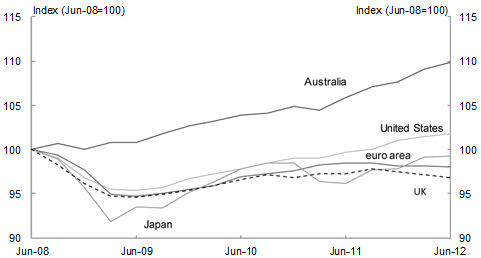
In the face of substantial global headwinds, the Australian economy has grown strongly. Australia's level of economic activity is significantly above its pre‑GFC level, in stark contrast to the major advanced economies (Chart 1.1). The outlook for the Australian economy also remains positive. Australia's real GDP is expected to grow at around trend over the forecast period, faster than every major advanced economy.
Chart 1.1: GDP levels for advanced economies
Source: ABS cat. no. 5206.0, national statistical agencies, Thomson Reuters and Treasury.
Australia's real GDP is forecast to grow 3 per cent in both 2012‑13 and 2013‑14. While this is a downgrade of ¼ of a percentage point in 2012‑13 compared with Budget, this follows stronger‑than‑anticipated growth in 2011‑12. The downward revision to forecast nominal GDP growth since Budget is more significant, primarily because of larger‑than‑anticipated falls in global prices for some of Australia's key non‑rural commodity exports that have already occurred.
Global energy and steel demand growth has eased as world GDP growth has moderated, reducing demand for raw materials such as coal and iron ore. The decline in iron ore and coal prices to mid‑September, while consistent with lower demand, appeared to exceed market fundamentals. Iron ore prices have since increased and it is anticipated they will regain further ground over the coming months.
Still, consistent with a weaker international growth outlook, global prices for these commodities are expected to remain below the levels forecast at Budget. Consequently, while Australia's terms of trade are expected to remain high by historical standards, the decline over the forecast period is expected to be greater than anticipated at Budget, driving a downward revision to forecast nominal GDP growth to 4 per cent in 2012‑13 from 5 per cent at Budget.
Australia's unemployment rate is forecast to remain low, albeit rising slightly from 5¼ per cent in the September quarter 2012 to 5½ per cent by the end of 2012‑13, consistent with moderate employment growth over the forecast period. Australia's low unemployment rate stands in stark contrast with the high unemployment rates in the major advanced economies and is an important measure of Australia's relative economic strength.
Headline and underlying inflation are forecast to remain in the bottom half of the Reserve Bank's target band, abstracting from the one‑off impact of introducing the carbon price. This is consistent with the forecast slight rise in Australia's unemployment rate and continued pass‑through of the high exchange rate to consumer prices.
Table 1.2 presents the major economic parameters used in preparing the 2012‑13 MYEFO.
| Forecasts | Projections | ||||
|---|---|---|---|---|---|
| 2012-13 | 2013-14 | 2014-15 | 2015-16 | ||
| Real GDP | 3 | 3 | 3 | 3 | |
| Employment | 1 | 1 1/4 | 1 1/2 | 1 1/2 | |
| Unemployment rate | 5 1/2 | 5 1/2 | 5 | 5 | |
| Consumer Price Index | 3 | 2 1/4 | 2 1/2 | 2 1/2 | |
| Nominal GDP | 4 | 5 1/2 | 5 1/4 | 5 1/4 | |
(a) Real and nominal GDP are year‑average growth. Employment and CPI are through‑the‑year growth to the June quarter. The unemployment rate is the rate for the June quarter.
Source: Treasury.
The outlook for Australia's real GDP growth continues to be underpinned by a surge of investment in the resources sector, strong growth in the volume of commodity exports and solid household demand.
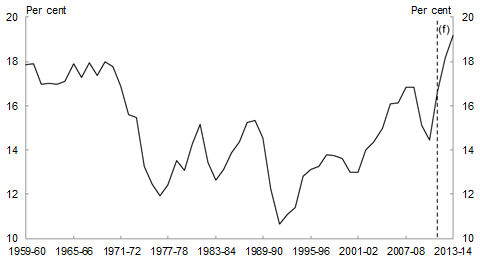
New business investment is expected to reach 50‑year highs as a share of GDP over the forecast period (Chart 1.2), driven by the resources sector. Over $260 billion of resources investments have received final investment approval and the majority of these projects are already under construction. Resources investment as a share of GDP is expected to peak during the forecast period and remain at historically high levels through to at least the middle of this decade, converting the largest terms of trade boom in Australia's history to an enduring increase in our economic capacity. Following 75 per cent growth in 2011‑12, the latest capital expenditure survey suggests a further 45 per cent increase in mining investment in 2012‑13.
Chart 1.2: New business investment (share of GDP)
Source: ABS cat. no. 5206.0 and Treasury.
Recent falls in global commodity prices have led to some scaling back of investment plans, largely in the coal sector where the pace of expansions has been slowed and the closure of a few high‑cost mines has been brought forward. However, the resources investment pipeline is dominated by large LNG projects where investment decisions are taken over long time horizons, underpinned by projections of the energy needs of the Asian region over a period of decades.
The resources investment peak will coincide with the start of the production and exports phase of many projects, with the resources sector expected to make a significant contribution to real GDP growth over the forecast period. Australia's non‑rural commodity exports are expected to grow 15 per cent over the next two years, notwithstanding a modest downgrade to forecast growth in coal exports since Budget, partly reflecting announced production cuts.
Conditions across the economy remain uneven, with some sectors experiencing challenging conditions. Investment intentions outside the resources sector for 2012‑13 remain relatively subdued, with the uncertain global environment, household deleveraging, shifting household expenditure patterns and the high exchange rate weighing heavily on some sectors.
Notwithstanding these pressures, household consumption remains solid in aggregate and there are tentative signs that residential building activity may be starting to improve. As resources investment passes its peak, the forecasts are for low interest rates and rising incomes to support modest growth in dwelling construction and non‑mining business investment in 2013‑14. These forecasts incorporate the 150 basis point reduction in the official cash rate since November 2011 and broadly reflect the market's expectations for future movements in official interest rates.
The key risks to Australia's economic outlook are external. The crisis in the euro area is at risk of further escalation, the imminent fiscal tightening in the United States threatens an already weak recovery and the new Chinese leadership face the challenging task of placing their economy on a more sustainable growth path in the context of a weak and uncertain outlook for external demand. These uncertainties are driving considerable volatility in global commodities markets, with attendant risks to Australia's terms of trade and nominal GDP growth.
Still, with a low unemployment rate, solid GDP growth, a strong financial sector, room to manoeuvre on monetary policy and strong public finances, Australia is well‑placed to manage the effects of any further deterioration in the global economy.
If www.budget.gov.au responds slowly or you are having trouble downloading a document, try one of the Budget Website Mirrors
Note: Where possible, Budget documents are available in HTML and for downloading in Portable Document Format(PDF). If you require further information on any of the tables or charts on this website, please contact The Treasury.