Moving to a clean energy future
With international action underway to tackle climate change, the Government is introducing a price on carbon from 1 July that will drive investment and jobs in new industries powered by clean energy.



Transforming Australia's economy
There is clear consensus among climate scientists that climate change is real and will have significant environmental and economic impacts if no action is taken to cut global greenhouse gas emissions
It is in Australia's national interest to reduce the environmental and economic risks of climate change.
A carbon price is the cheapest and most efficient means of gradually transforming the economy to a clean energy future. It creates incentives for business to invest in clean technology or find smarter, less energy-intensive ways of operating.
Around $100 billion of investment in new clean energy sources such as solar and wind will be unleashed.
This economic transformation will occur while sustaining strong economic growth. By 2020, Treasury modelling has projected employment to increase by 1.6 million jobs and average incomes to increase by about 16 per cent.
As the world takes action
Most countries are taking steps to reduce climate change. Australia needs to be part of the global solution.
90 countries representing over 80 per cent of global emissions and over 90 per cent of the global economy have pledged to cut emissions. This was reinforced at the Durban Climate
Change Conference. All the world's major emitters, including China and the US, committed to negotiate a new legal framework to cut emissions from 2020.
Carbon prices are operating in the EU, New Zealand and several US states, with further schemes in prospect, including in China and Korea.
Changes commence on 1 July
From 1 July 2012, around 500 of Australia's biggest polluters will be required to pay for their emissions.
A carbon price is not a tax on households. While a carbon price will see cost increases of around $9.90 per week on average, households will receive tax cuts and increases in payments of $10.10 per week on average. This is before the new measures included in the Spreading the Benefits of the Boom package.
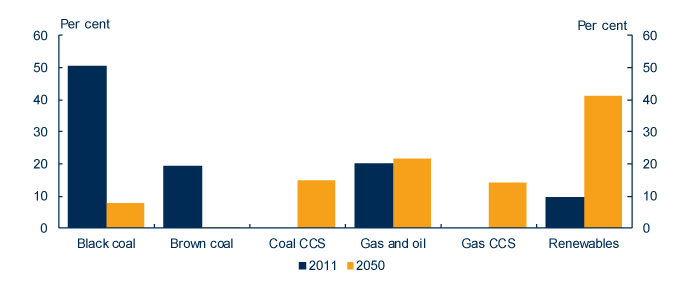
Transforming the energy sector: share of electricity generation