


A stronger, smarter, fairer retirement income system
The Government's vision for a stronger, smarter and fairer retirement income system means ensuring that incentives to save for retirement are available for all working Australians, access to superannuation tax concessions is distributed fairly and Australians are assured of dignity in retirement.
'Three Pillars' Retirement Income Policy
One of the most important public policy goals for any government is to ensure that older Australians are able to retire with a level of income sufficient to underpin a decent standard of living in retirement.
Meeting this challenge is the core goal of Australia's 'three pillars' retirement income system: the publicly funded age pension; compulsory superannuation paid by employers on behalf of employees; and voluntary savings through superannuation and other savings vehicles.
The Government is acting to strengthen each of these three pillars, not just for this year or next, but for decades into the future.
Policy Making For The Long Term
Retirement income policy is by its nature long term. In their twenties, people must make savings decisions that will affect their standard of living when they get to their seventies. The Government believes a stronger, smarter and fairer superannuation system is one that gives people the confidence and certainty to save for the long term.
The Government is establishing a Council of Superannuation Custodians to ensure that future changes to the superannuation system are consistent with an agreed Charter of Superannuation Adequacy and Sustainability. Changes to superannuation policy should only be made if they serve the long-term objectives of certainty, adequacy, fairness and sustainability.
The Government is meeting this vision through reforms which secure the age pension, boost superannuation savings, distribute superannuation tax concessions fairly and ensure the superannuation system is sustainable for the long term.
Boosting the Superannuation Guarantee rate
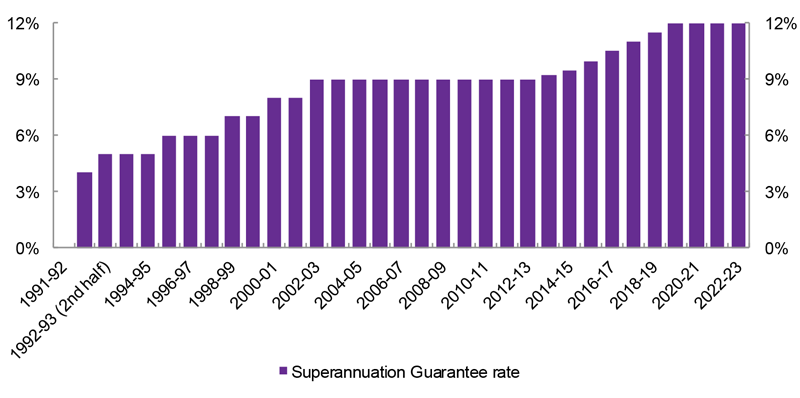
Note: A lower Superannuation Guarantee rate applied between 1992-93 and 1995-96 where the employer's payroll was below $1 million in 1991-92.