Base erosion and profit shifting
There is increasing concern in the international community about the impact of base erosion and profit shifting by multinational enterprises to avoid taxation. Australia is at the forefront of G20 efforts in this area.



International tax rules that give multinational enterprises access to tax arrangements that are not available to domestic firms provide them an unfair competitive advantage.
It also means other taxpayers either face a larger tax burden or accept a lower level of government services.
If not addressed, base erosion and profit shifting raises serious concerns about the efficiency, equity and sustainability of the income tax system.
International tax reform is also increasingly on the agenda of G20 Finance Ministers and Leaders.
There is growing concern — in Australia and globally — that many of
the key rules of international taxation may not have kept pace with the evolution of the global economy.
A key issue is whether tax concepts developed for the industrial age are still applicable in the era of the digital economy.
The OECD report Addressing Base Erosion and Profit Shifting outlines the underlying causes of base erosion and profit shifting and highlights the need for a comprehensive approach. The OECD will present an 'action plan' to G20 Finance Ministers in July 2013.
Consistent with the OECD report, the Government is taking immediate action to address base erosion and loopholes in Australia's corporate tax system.
It is also taking steps to improve the transparency of the system. Yet there is a limit to what any one country can do acting alone.
Fundamental reform will require international cooperation to reach a broad consensus on the way forward.
Australia is at the forefront of international efforts in this area, building on the leading role it played in fostering greater exchange of information networks globally.
As G20 chair in 2014, Australia can play a prominent role in determining and driving the base erosion and profit shifting reform agenda.
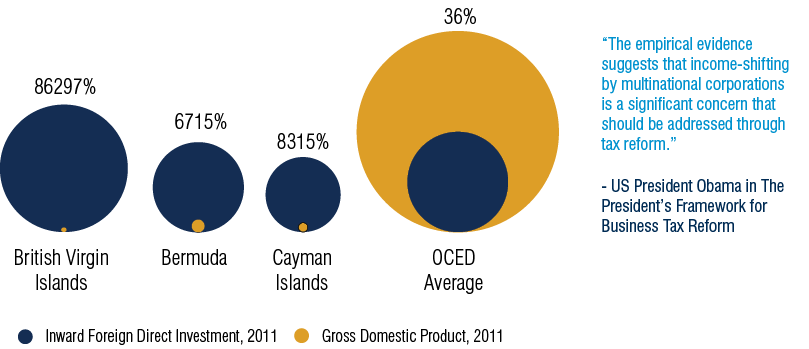
Comparison of inward Foreign Direct Investment and GDP (2011)