

Statement 2 (continued)
Appendix B: Comparison with consensus forecasts
Consensus Economics collect forecasts on key macroeconomic variables from a number of prominent economists. The mean and range of these forecasts provide benchmarks with which to compare the Government's economic forecasts. Forecasts from the International Monetary Fund (IMF) provide a benchmark from an international institution.
IMF and Consensus forecasts are provided on a calendar year basis. The 2014‑15 Budget forecast for real GDP growth in calendar year 2014 is lower than the Consensus Economics mean forecast and broadly in line with the IMF's forecast (Chart B.1). The Budget forecast for calendar year 2015 is broadly in line with the Consensus Economics mean forecast and higher than the IMF's forecast (Chart B.2).
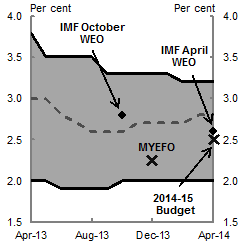
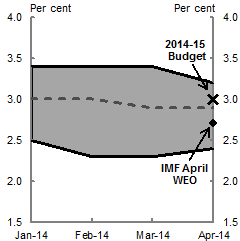
Note: Top and bottom lines represent range of Consensus Economics forecasts. Centre dotted line represents Consensus Economics mean forecast.
Consensus Economics forecasts for 2015 were published for the first time in January 2014. The 2013‑14 MYEFO did not contain forecasts for the full 2015 calendar year.
Source: Consensus Economics, IMF and Treasury.
The 2014‑15 Budget unemployment rate forecast for calendar year 2014 is broadly in line with the Consensus Economics mean forecast and lower than the IMF's forecast (Chart B.3). The Budget forecast for calendar year 2015 is higher than the Consensus Economics mean forecast and in line with the IMF's forecast (Chart B.4).
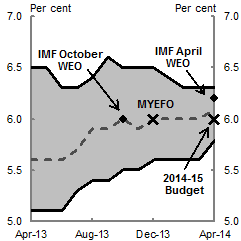
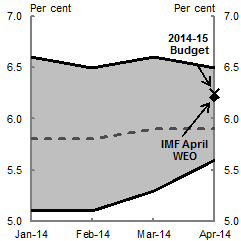
Note: Top and bottom lines represent range of Consensus Economics forecasts. Centre line represents Consensus Economics mean forecast.
Consensus Economics forecasts for 2015 were published for the first time in January 2014. The 2013‑14 MYEFO did not contain forecasts for the full 2015 calendar year.
Source: Consensus Economics, IMF and Treasury.