

Changes to family payments
The Government will improve the sustainability of the Family Tax Benefit system while continuing to support those most in need
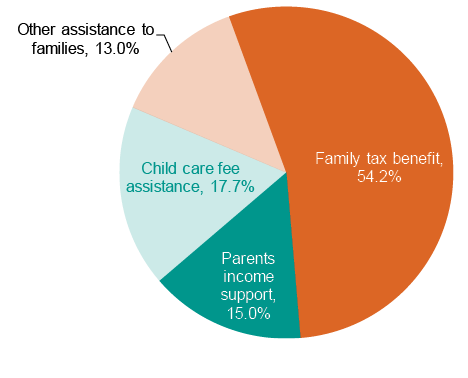
The Government will continue to provide payment assistance to families to supplement their income. In 2014‑15, the Government will provide around $19 billion in Family Tax Benefit (FTB).
FTB should provide assistance to families who need it most and encourage everyone who can work, to do so.
Current assistance
In addition to Family Tax Benefit Part A (FTB‑A) and Family Tax Benefit Part B (FTB‑B), assistance is provided to families through the Newborn Supplement and Upfront Payment, Stillborn Baby Payment and Paid Parental Leave scheme. Families may also be eligible for a range of other allowances and benefits, depending on their circumstances.
Better targeting payments
Repairing the Budget and ensuring the welfare system remains sustainable requires payments to be targeted to those most in need.
Families who can support themselves will receive less assistance from government.
The FTB‑B higher income earner test will be changed to $100,000 from 1 July 2015. Families with one parent earning over $100,000 will not be eligible for FTB‑B.
The payment rates of FTB‑A and FTB‑B, excluding supplements, will stay at current levels until 30 June 2016.
The Clean Energy Supplement will now be known as the Energy Supplement and will remain at its current rate from 1 July 2014. It will continue to provide assistance for living expenses like utility costs without a carbon price.
Summary of 2014‑15 Budget measures
From 1 July 2014:
- The rates of FTB‑A and FTB‑B will remain at current rates for two years
- FTB eligibility thresholds will remain at current levels for three years
- The Energy Supplement will remain at current levels
From 1 July 2015:
- FTB‑B payments will be paid until the youngest child turns six
- The FTB‑B higher earner income test will be $100,000
- Single parents who receive the maximum rate of FTB‑A will receive additional assistance of $750 per year per child aged between six and 12 once their youngest child turns six
- The FTB‑A and FTB‑B end of year supplements will be $600 and $300 respectively
- FTB‑A High income free area will be $94,316 for all families.
- The Large Family Supplement will be paid for the fourth and each subsequent child in a family
FTB income thresholds will stay at current levels for three years from 1 July 2014. The income threshold for the maximum rate of FTB‑A will remain at $48,837 and the lower income earner threshold for FTB‑B will remain at $5,183 until 30 June 2017.
The Large Family Supplement will also be better targeted. From 1 July 2015, it will be paid for the fourth and subsequent children in a family. The FTB‑A and FTB‑B end of year supplements provide additional assistance at the end of the year to reconcile FTB debts. From 1 July 2015, the FTB‑A end of year supplement will be $600 per child and the FTB‑B end of year supplement will be $300 per family.
Encouraging workforce participation
It is important for families to be able to take some time out of the workforce with young children. However, assistance should be limited once children are at school.
From 1 July 2015, FTB‑B payments will be available to families until the youngest child turns six. Those families already receiving FTB‑B for children over six at this time will continue to receive payment until 30 June 2017.
A genuine Paid Parental Leave (PPL) scheme will be introduced from 1 July 2015 and will include superannuation. This PPL scheme recognises the vital contribution women make to our workforce. The PPL will provide recipients up to 26 weeks replacement wage at no less than the minimum wage.
Protecting low income single parents
The Government recognises single parents have greater difficulties balancing work and caring for their children. From 1 July 2015 the Government will provide low income single parents with extra assistance of $750 a year for each child aged between six and 12 once their youngest child turns six.
Schoolkids Bonus and Income Support Bonus
The Government will keep its commitment to repeal the Minerals Resource Rent Tax and the associated spending measures, including the Schoolkids Bonus and Income Support Bonus. These programmes were to be funded from the anticipated revenue from the mining tax, but are now being funded by debt.
Government payments available to families will continue including:
- FTB‑A — up to $5,840 per child
- FTB‑A end of year supplement — $600 per child
- FTB‑B — up to $3,818 per family
- FTB‑B end of year supplement — up to $300 per family
- Newborn Supplement and Upfront Payment — up to $2,001 per child
- Multiple Birth Allowance — up to $4,997 per annum
- Energy Supplement — up to $113 per annum
- Large Family Supplement — up to $314 for the fourth and subsequent children
- Child Care Benefit
- Child Care Rebate — up to $7,500 per child
- Jobs, Education and Training Child Care Fee Assistance
- Family Support Programme
- Health Care Card
- Rent Assistance — up to $4,362 per annum
- Carer Allowance — up to $3,082 per annum
- Carer Supplement — $600 per annum