
Our welfare system must be sustainable
The Government will improve the sustainability of the welfare system by establishing more equitable eligibility criteria and indexation arrangements across a range of welfare payments
Pressure on Age Pension payments
Someone who retires today could expect to receive the Age Pension for about 20 years after retirement. Without policy change the spending on the Age Pension is projected to increase by 70 per cent over the next decade. Over the past 100 years, there has been little change in the Age Pension eligibility age; however, over the same period the average life expectancy has increased by 25 years to around 85 years.
Pension reform
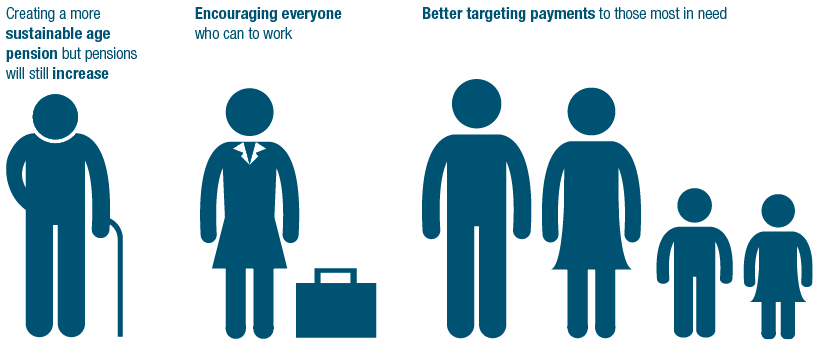
Building on the former Government's move to increase the pension age to 67 by 1 July 2023, we are further increasing the Age Pension age to 70 by 1 July 2035.
The Government will also index pensions, including the Age Pension and the Disability Support Pension, to inflation rather than wages from September 2017. At the same time, eligibility thresholds will be paused for three years. This will assist in meeting the rising costs of providing the pension, while ensuring pensions keep up with the cost of living.
The Government is delivering on its election commitment to index the Commonwealth Seniors Health Card income thresholds from September 2014. To ensure people with similar incomes are treated consistently, untaxed superannuation income will be included in the income test for the Commonwealth Seniors Health Card for new recipients.
Payment reform
The Government is targeting family and working age payments to those who need it most by:
- changing indexation arrangements; and
- tightening eligibility for Family Tax Benefit Part B (FTB-B), particularly where the youngest child is six years or older.
Low income single parents will receive new assistance of $750 per annum for each child aged between 6 and 12.