
Reducing regulation
The Government has cleared the backlog of unenacted tax legislation and is reducing the regulatory burden on business, individuals and the community by $1 billion a year through an aggressive agenda to cut red and green tape
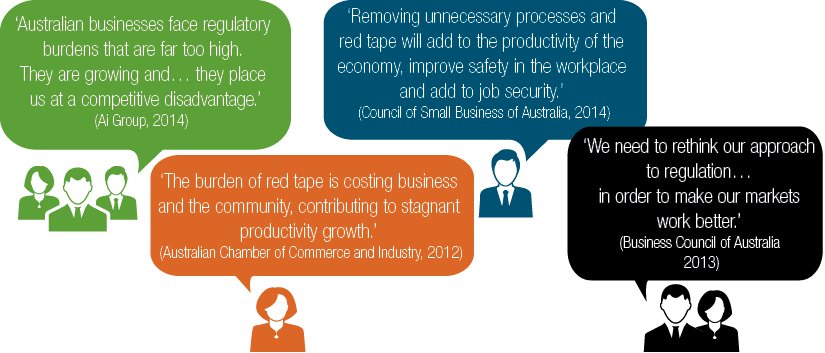
Regulation has grown rapidly over recent decades, creating substantial costs for business and the community. This has led to complexity and uncertainty, particularly in the tax system, and risks impeding innovation and entrepreneurship.
The Government has set a target of reducing regulatory compliance costs on businesses, individuals and the community by $1 billion every year.
The first Repeal Day in March reduced the stock of regulation, with over 1,000 Acts and 9,500 legislative instruments, totalling over 50,000 pages, submitted to be abolished.
The Government is dedicating at least two sitting days each year to further repeals.
In a further move to reduce red tape and provide taxpayer certainty, the Government has made decisions on 92 tax and superannuation measures that had been agreed by previous governments but not enacted.
To manage the flow of new regulation, the Government is requiring compliance costs to be calculated for all new regulatory proposals. Where a proposal would increase those costs, the Government will not proceed unless offsetting cost reductions are found.
To reduce green tape, the Government is delivering a 'one-stop shop' for environmental approvals. This has already led to the approval of $400 billion in new projects and will simplify the process and improve Australia's investment climate, while maintaining high environmental standards.
How regulation is implemented affects compliance costs. The Government has issued statements of expectations to major regulators, stating the importance of administering regulation in a way that reduces compliance costs where feasible. A framework to assess regulators' performance is being developed.