

Preface
In 2015-16 Australian Government agencies will have responsibility for administering approximately $434.5 billion in expenses.
The Government will continue to progress its Smaller Government reform agenda, to ensure those government agencies are the most efficient and effective they can be, by transforming and modernising the public service while eliminating waste and duplication.
Budget Paper No. 4 sets out the funding for agencies, their funding sources and the purposes of that funding under the Outcome statements as agreed for each agency in the General Government Sector.1
Additionally, information is provided on the staffing of agencies delivering services to the Australian community. Taken together, the information in Budget Paper No. 4 shows the way resources are used across government.
While Australia has a long history of innovation in public sector management, the Government has been and continues to pursue a particular reform effort aimed at streamlining our systems of public administration.
This will help ensure Australia is better able to cope with the economic and demographic challenges ahead. Specifically, the Government’s public sector reforms are delivering greater value to taxpayers through better services, delivered faster and at a lower cost. It is a central part of the Government’s plans to put Australia on a stronger foundation for the future.
Transforming Government
The Government is methodically examining all parts and aspects of the public sector, from the functions of agencies to how they operate and are structured. Further specific reforms in the 2015-16 Budget are making a material contribution to budget repair, while improving the responsiveness and effectiveness of government.
Key elements of the Government’s ongoing Smaller Government reforms include:
- Reducing the size of the Commonwealth public service. In 2015-16, total staffing in the General Government Sector is expected to fall below levels last recorded in 2006-07. Further information on the size of the public sector is covered in Part 2: Staffing of Agencies.
- Public sector wage restraint. Over the past decade, Commonwealth public servants received annual median wage increases totalling 42 per cent, well above CPI increases of 28 per cent over the same period. This included strong wage rises through the Global Financial Crisis, when private sector wage growth and employment were both lower. Future wage rises will be offset by productivity gains, to ensure that they are affordable, sustainable and in line with community expectations.
- Functional and Efficiency Reviews. In the months preceding the Budget, the Government commissioned two independent reviews to consider the functions and the efficiency of the Departments of Health and Education and Training. These in-depth reviews are the pilots for a rollout of reviews to determine whether the current functions of all departments and large agencies are aligned with the Government’s policy priorities and whether they are working as efficiently as possible. In response to the review of the Department of Health, the Government will achieve net savings of $96 million through efficiencies in contracting, corporate, staff and property costs, which better align departmental functions with the Government’s strategic objectives. Reforms in the Department of Education and Training to implement recommendations from its review will achieve savings of $131 million by ceasing and redesigning programmes which are not sufficiently consistent with the Government’s core priorities and national strategic policy settings for education; $7.6 million of these savings are in the operations of the department. Further recommendations from the Education and Training review will be considered after the Budget, focused on the administrative costs of the department. In 2015-16 further Functional and Efficiency Reviews will be undertaken into the Departments of Agriculture, the Environment, Foreign Affairs and Trade, Treasury, Attorney-General’s and Social Services, as well as the Australian Taxation Office and the Australian Bureau of Statistics.
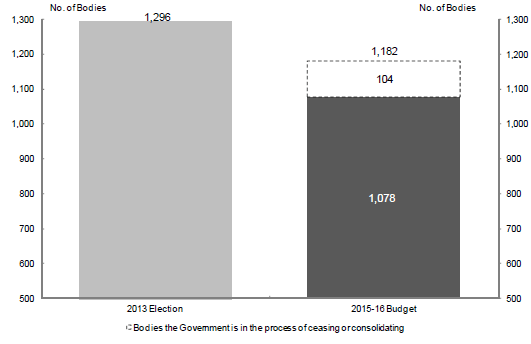
- Streamlining Government bodies. Complementing this examination of public sector functions, the Government is delivering the fourth phase of its Smaller Government reforms to address the shape and size of government. The 2015-16 Budget will reduce the number of government bodies by a further 35, bringing planned reductions to 286 since the 2013 election. Box A shows the impact of all reductions on the number of government bodies that have been implemented as well as anticipated reductions as a result of decisions taken by the Government. A smaller number of government bodies will help clarify lines of accountability, and make the public sector more agile and better able to address changing pressures and Government priorities. The Smaller Government announcements in the 2015-16 Budget will deliver $497.0 million in savings (including savings from the Functional and Efficiency Reviews of the Departments of Health and Education and Training and further efficiencies in the Attorney-General’s Department and the Department of Immigration and Border protection). This will take total savings from the Government’s Smaller Government agenda to $1.4 billion.
Box A: Australian Government Organisations Register
In December 2014, the Australian Government Organisations Register (AGOR) was launched on the Department of Finance’s website. AGOR was developed as part of the Government’s package of Smaller Government reforms, and provides information on the function, composition, origins and other details of all Australian Government bodies. It makes the size of government more transparent to taxpayers than it has ever been before.
AGOR enables individuals, businesses and other stakeholders to:
- connect with government bodies and agencies that can assist them with different services or issues;
- identify available opportunities to collaborate with the public sector; or
- understand the shape and size of the public sector by providing a more accurate and current count of government bodies and agencies.
- Public sector savings — shared services. The Government is returning the Efficiency Dividend to the base rate of one per cent from 2017-18, subject to ongoing monitoring. Following successive years of large efficiency dividends being applied uniformly to most agencies to help reduce the size of government after a period of peak growth, efficiencies are increasingly being sought from reforms that target known areas of inefficiency in specific agencies. The Government’s use of more targeted savings began in the 2014-15 Budget, with savings made to the communications resources of agencies. The 2015-16 Budget continues the implementation of targeted savings by standardising certain information technology and related business processes, known as Enterprise Resource Planning Systems. This saving is apportioned among agencies to take account of the relative opportunity for more efficient arrangements in different agencies. Similarly, software licensing will also be purchased on a more coordinated basis.
- Opening government business activities to fair competition. Consistent with the Smaller Government agenda, scoping studies have been commissioned into the future ownership options of a number of government businesses. Scoping studies provide information and recommendations to assist the Government’s decision-making on how key services are best delivered in future. Scoping studies examine the industries in which agencies operate, and assess the capacity of other providers to offer new technology, innovative service models or new sources of investment. Following a thorough scoping study looking at the Australian Securities and Investments Commission (ASIC) Registry, the Government will undertake a competitive tender process over the next 12 to 18 months, to market test the capacity of a private provider to upgrade and operate the ASIC Registry and offer value-added products.
- A more rational property portfolio. The Government has also announced an approach to market to test investor interest in the long term lease and upgrade of four ageing properties within the parliamentary triangle. The Government’s wider property portfolio will be further rationalised, to ensure that every property the Commonwealth owns is appropriate to its expected needs. Significant public money is currently locked up in surplus Commonwealth property holdings, which includes several blocks and facilities that are no longer used by the public sector and not maintained at an appropriate level. There are significant maintenance and opportunity costs associated with continued ownership of these surplus properties and the Government will continue to progress divestment in an orderly fashion where appropriate.
- Reducing vacant lease holdings. The Government is reviewing its current leases to ensure that those identified as surplus to requirements are promptly filled where they can be. Priority is being given to a strategy to reduce surplus office space in the Australian Capital Territory, with vacancies filled by agencies identified as having similar requirements and upcoming lease expiry dates. Large vacant legacy leases which were previously regarded as problems for individual agencies will be handled through a responsible whole-of-government approach. Initial analysis reveals that there is scope to save up to $200 million over 10 years through this initiative.
- Digital innovation. The Government’s Digital Transformation Agenda will improve the experience of individuals and business when transacting with government. The community expects that the public sector will provide personalised services that offer greater choice in how services are accessed, while removing red tape and inefficiency.
- Streamlined and targeted programme delivery. The Government is eliminating wasteful fragmentation in service delivery and removing unnecessary complexity in rules, which undermine policy effectiveness. In the 2015-16 Budget, the skilled migration and temporary activity visa programme will be simplified by consolidating the number of visa categories. In 2014-15 over 150 Indigenous programmes were streamlined into five broad programme categories, to improve their focus and coordination and to reduce the red tape burden on service delivery organisations that partner with government. Similar reforms in the Social Services portfolio have streamlined 18 grants programmes into seven, thereby reducing reporting burdens for providers. Additionally, grants administration in the Department of Health has been consolidated into a single division, to promote the development of expertise and more efficient delivery across all stages of the grant life cycle.
- Sensible risk management. The Government has implemented a streamlined and risk-based approach to the governance of the public sector by implementing the Public Governance and Performance Act 2013 (PGPA Act) and introducing more consistent practices across approximately 250 Acts that govern Australian Government bodies. The new rules require public officials to sensibly manage risk, rather than over-invest in unrealistic efforts at risk elimination. This will support a shift away from regulatory frameworks which are excessively prescriptive and out of step with commercial reality. Further reforms are underway, focusing on improving the performance, evaluation and transparency of the public sector.
- User pays where appropriate. The Government is also introducing a charging framework from 1 July 2015 which will improve consistency in charging for government activities. The framework will lead to additional revenue to support Budget repair and other policy priorities. It will also assist particular agencies to be more responsive to user demand. The charging framework will promote greater fairness, involving charging those who create demand for certain government services and other activities, while preserving the Government’s central role of delivering quality public-benefit programmes in ways that do not adversely impact disadvantaged groups.
The Government’s Smaller Government reform agenda is already delivering results, with the Commonwealth public sector becoming more efficient and responsive. However there is more work to be done to ensure changing community needs are better met than they have been before. Transforming Government is about making the public dollar go further in creating public value where it is needed and matters most.
SIGNED
Senator the Hon Mathias Cormann
Minister for Finance
1 Government departments and agencies that provide non-market public services and are funded mainly through taxes (2015-16 Budget, Budget Paper No. 1, Statement 9, Appendix A).