
Budget overview
The Government’s economic plan to ensure Australia continues to successfully transition from the mining investment boom to a stronger, more diversified, new economy.
Responsible spending restraint
Spending restraint underpins a sustainable path to balancing the budget
The Government remains strongly committed to returning the budget to balance as soon as possible.
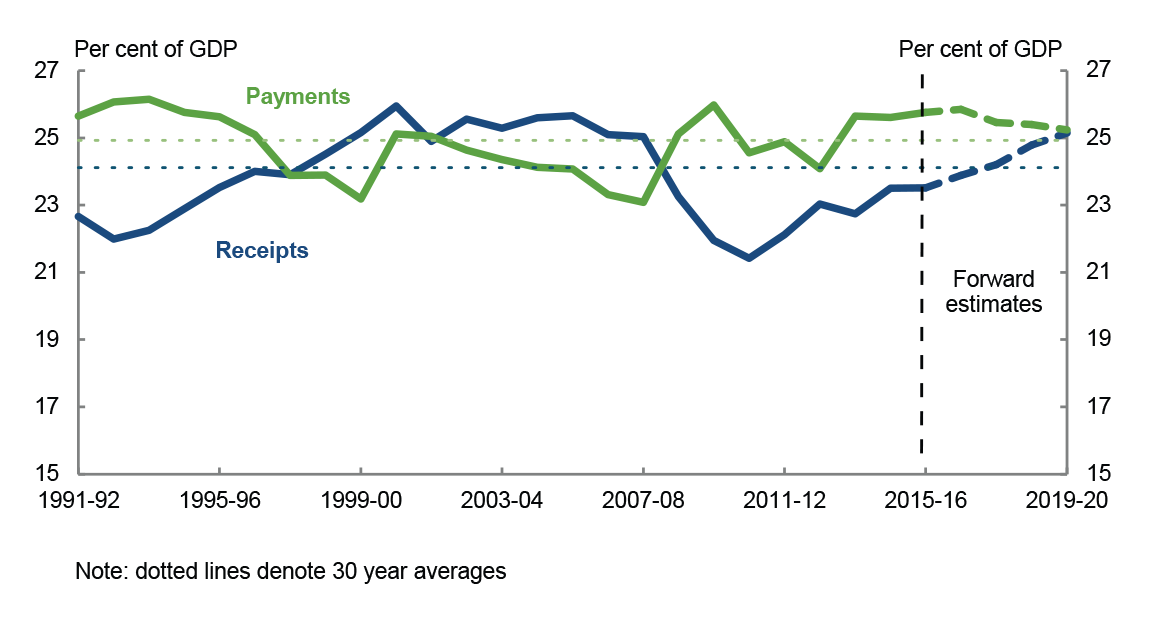
Government spending as a share of the economy has remained close to post-GFC highs and would be even higher without the savings measures taken by the Government to date.
Even with these measures, Government spending as a proportion of GDP is projected to remain above its long-run average. In contrast, receipts are expected to recover to their long-run average levels by 2017-18.
Spending restraint is essential to remain on a path towards a balanced budget, lower Government debt, and a lower tax burden over time.
Since the 2013-14 mid-year budget review, the Government has announced overall savings of $144 billion through sensible reductions in spending and targeted measures to make Australia’s tax system more sustainable.
In particular, increases in Government payments have been more than offset by reductions in payments in other areas — rather than funded by increasing taxes on Australians.
As a result of this spending restraint and fiscal discipline, Government payments as a share of GDP are forecast to decline from 25.8 per cent of GDP in 2016-17 to 25.2 per cent of GDP in 2019-20.
It is essential that the Government continues to focus on responsible spending restraint. The Government is committed to ensuring that the $13 billion of unimplemented expenditure savings measures are passed by the Senate or alternative savings measures identified to continue on the path to a balanced budget.
A continued path to a balanced budget
Living within our means
The Government remains on a continued path to a balanced budget despite the challenges presented by changes in the economic outlook.
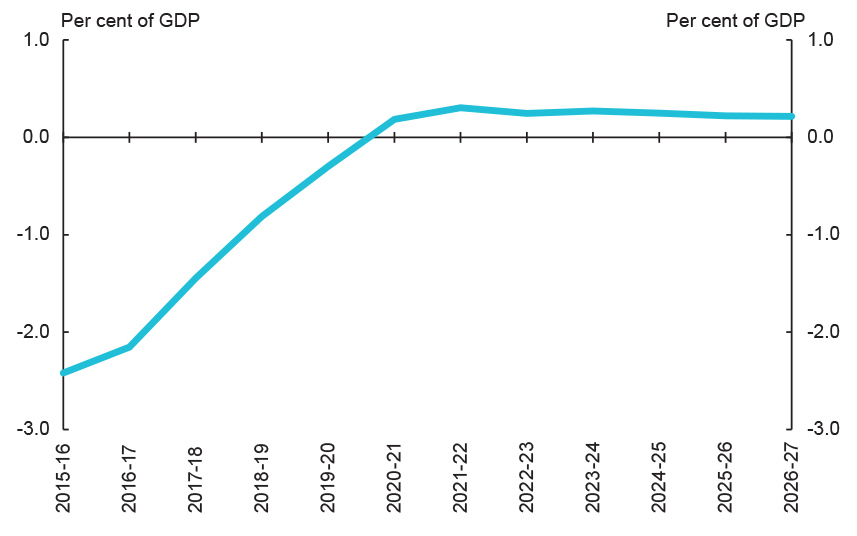
- The underlying cash balance is expected to improve in each and every year over the forward estimates period, from a deficit of 2.4 per cent of GDP in 2015-16 to 0.3 per cent of GDP in 2019-20.
- The overall impact of policy decisions in this Budget has improved the bottom line by $1.7 billion.
- Payments remain steady or less than 2015-16 mid-year budget review levels.
- Real payments growth has been limited to an annual average of 1.9 per cent over the forward estimates by controlling expenditure.
- Payments as a proportion of GDP are expected to fall to 25.2 per cent by the end of the forward estimates period but more needs to be done.
- Despite lower than anticipated growth in tax receipts, resulting in a decrease in forecast receipts of $14.7 billion over the four years to 2018-19, the tax-to-GDP ratio is expected to return to its long-run average of 22.3 per cent by 2017-18.
- The budget is projected to return to balance by 2020-21.
The Government is committed to reducing the deficit by constraining spending while keeping taxes as low as possible.
A Ten Year Enterprise Tax Plan
Boosting the economy while improving the sustainability of the tax system
Creating sustainable growth and jobs, with a focus on small businesses
Our future depends on how we continue to support growth as we transition to a stronger, more diversified economy.
Australia needs a sustainable tax system that supports economic growth. Our Ten Year Enterprise Tax Plan will help underpin Australia’s future economic success, attract new investment and create jobs.
This plan will support growth, higher wages and jobs by lowering the tax rate for companies over time to an internationally competitive level.
To grow and prosper, Australia must attract new investment to support economic growth, create jobs and improve living standards.
Our corporate tax rate is high by international standards and well above the average for OECD countries and those in the Asian region. If Australia is going to be competitive in the 21st century, we need a competitive tax system.
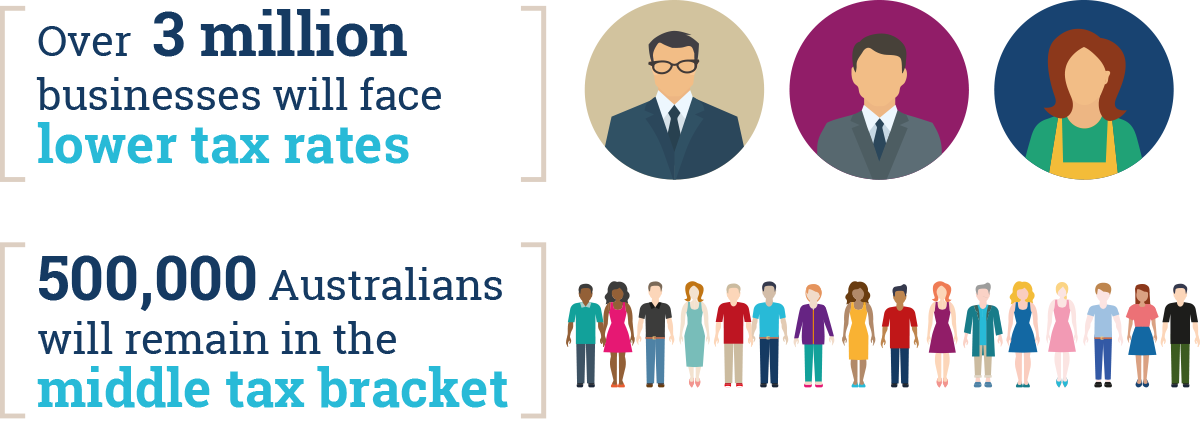
Small businesses contribute significantly to the Australian economy, employing over 3 million workers. To make it easier for businesses to invest, grow and hire more workers, the tax rate for companies will be lowered, starting with small business.
From 1 July 2016, businesses with annual turnover less than $10 million will have a company tax rate of 27.5 per cent. The company tax rate will be progressively lowered to 25 per cent by 2026-27 for all companies.
The Government will also extend a range of concessions already available to small businesses with turnover less than $2 million to all businesses with turnover less than $10 million from 1 July 2016.
The Government will make sure assistance is available for all small businesses by increasing the tax discount to 8 per cent for unincorporated businesses with annual turnover less than $5 million, capped at $1,000. This discount will be further increased in phases to reach 16 per cent by 2026-27.
Reducing the tax burden on hardworking Australians
Punishing tax rises
Australians understand that our outdated tax system is punishing hard work, hindering growth, limiting opportunity and hampering innovation.
We need to modernise our economy and our tax system or we risk being left behind.
This Budget is giving hard working Australians greater incentive to earn more without being taxed more.
Middle income Australians are bearing a growing tax burden.
In recent years, those on low incomes have benefited from tax cuts and the carbon tax compensation that has been retained despite the carbon tax being abolished.
Without action, the average full time wage earner would face the second highest marginal tax rate this year and nearly half of all taxpayers would be in the top two brackets in ten years’ time.
Making a start on tax relief
In this Budget, the Government is making a start on personal income tax relief.
The Government will prevent average full time wage earners from moving into the second top tax bracket until 2019-20 by increasing the 32.5 per cent tax threshold from $80,000 to $87,000. This will stop around 500,000 taxpayers facing the 37 per cent marginal tax rate.
By pushing up the tax threshold on the middle tax bracket we’ll keep full time average wage earners on the lower rate for longer.
This will reward hard working Australians for doing more overtime, picking up more shifts, taking a promotion or a better new job, without being penalised by paying more tax through the higher rate.
The Government will consider further measures to reduce the burden of tax as fiscal settings allow.
This Ten Year Enterprise Tax Plan will boost new investment, create and support jobs and increase real wages.