
APPENDIX F: COMMONWEALTH GENERAL GOVERNMENT SECTOR
This appendix presents forward estimates of the underlying
balance - and the revenue and outlays components -
for the Commonwealth general government sector. The
Commonwealth general government sector comprises both
a budget and non-budget component. The budget sector,
which dominates the general government sector, consists
of those departments and agencies whose transactions
are recorded on the Commonwealth Public Account (CPA).
The non-budget sector includes Commonwealth government
authorities such as the ABC and CSIRO, which operate
outside the CPA through their own bank accounts. A
more detailed description of these sectors can be found
in Statement 7.
The estimates provided in Table
F1 are based on GFS classification principles.
However, as is the case in the budget sector, in order
to provide an estimate of the underlying balance broadly
consistent with the 'net lending' concept in the national
accounts, no adjustment is made for increases in provisions.
[18] As
required by the Charter of Budget Honesty Bill 1996,
general government estimates are also presented on
a GFS consistent basis in Appendix
D of Statement 7. A discussion of the GFS concepts
and how these differ from the budget presentation is
also provided in that appendix.
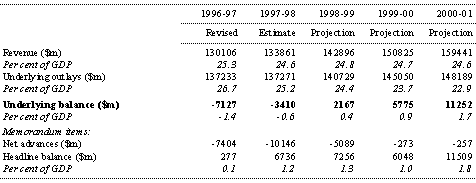
Table
F1: Summary of General Government Aggregates ($m)
General government aggregates in Table
F1 essentially mirror equivalent budget aggregates,
although components of Commonwealth outlays can vary
substantially between the general government and budget
sectors. This reflects the elimination of transfers
to the Commonwealth non-budget sector in the general
government sector, and the inclusion in other outlay
categories of spending by the non-budget sector. An
economic type presentation of general government outlays
and revenue is presented in Statement
7. Major differences to the equivalent budget sector
presentation include:
- higher final consumption expenditure in each year reflecting
non-budget spending on goods and services;
- higher personal benefit payments reflecting medicare
and pharmaceutical benefits paid by the Health Insurance
Commission (a non-budget authority); and
- higher grants to other governments includes payments
by the Australian National Training Authority (a non-budget
authority).
Table F1 shows
that the Commonwealth general government sector is
expected to move from underlying deficit to underlying
surplus from 1998-99, consistent with expected movements
in the budget sector. This movement equates to a change
from an underlying deficit of around ½ per cent of
GDP to an underlying surplus of around ½ per cent of
GDP. Compared with the general government estimates
provided in the MYEFO, the move into underlying surplus
is expected to occur one year earlier reflecting a
stronger budget fiscal position.
The relative movements in the general government underlying
and headline balance are dependent on changes in net
advances. For instance, there is a larger increase
in the headline surplus in 1997-98 compared to the
fall in the underlying balance in the same year as
a result of an increase in net advances in 1997-98
(mainly reflecting a higher level of equity asset sales).


