
Reflecting differing developments in the components of demand in 1996-97, conditions also varied across industry sectors. The slowing in private consumption growth materialised in weak activity in retail trade. Strong growth in non-residential construction was partly offset by the housing downturn, resulting in only modest growth in the construction sector overall. Agriculture and mining both grew strongly. However, parts of manufacturing experienced poor trading conditions as a result of the housing downturn and a temporary easing in the growth of exports. Services sector output growth slowed in aggregate, although there were pronounced differences in conditions across the sector, with communications, in particular, continuing to grow very solidly.
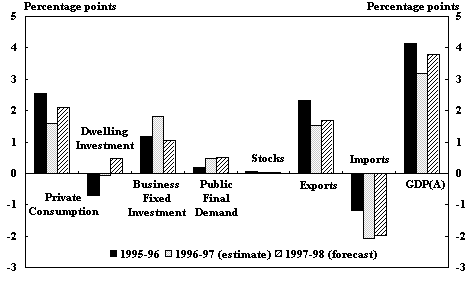
In 1997-98, private demand growth is forecast to accelerate. Private consumption should grow more quickly as growth in real household income strengthens and the recovery in the dwelling sector becomes established. Business investment growth should remain strong, supported by ongoing private infrastructure investment, Olympics-related construction and some continuing pressures to expand capacity. Public demand growth should continue at a modest rate. Net exports are forecast to make a modest detraction from GDP growth as import growth again outpaces that of exports.
On an industry basis, the strengthening in private consumption should help to boost retail trade while stronger demand overall, particularly the anticipated broadening of the housing recovery, should contribute to an improved outlook for manufacturing and construction. Mining and services are likely to experience further solid growth. However, activity in agriculture is expected to decline slightly after growing rapidly in each of the last two years.
CHART 1: CONTRIBUTIONS TO GDP GROWTH
Source: ABS Cat. No. 5206.0 and Treasury.
Growth in real household disposable income is forecast to accelerate in 1997-98, reflecting a pick-up in non-wage income growth and ongoing strong growth in wages, salaries and supplements. Sharp falls in interest income and farm income (a large fall in farm product prices more than offset continued growth in production) dampened household income growth in 1996-97, but these factors should wane in the coming year - farm incomes, in particular, should benefit from rising farm product prices during 1997-98.
Growth in consumption is expected to be slightly slower than growth in real household disposable income in 1997-98, although the household saving ratio will remain broadly unchanged, after rising in 1996-97. As always, estimates of the household saving ratio should be treated with caution, given the large and frequent revisions to estimates of saving. For example, the December quarter 1996 National Accounts published large upward revisions to the history of household saving, removing part of the apparent downward trend in the saving ratio over recent years (Chart 2).
CHART 2: NET HOUSEHOLD SAVING RATIO [6]
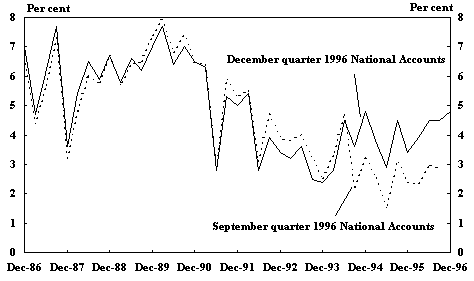
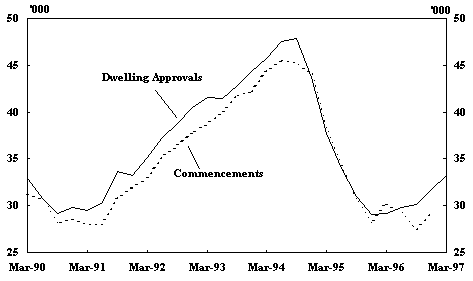
CHART 3: PRIVATE DWELLING APPROVALS AND COMMENCEMENTS
Business confidence is rising and surveyed aggregate capacity utilisation remains at a high level. The price of investment goods has fallen over the last year or so, reflecting declines in import prices (see Chart 6). Nominal interest rates have fallen and profitability remains high - the corporate profit share is forecast to increase for the sixth successive year in 1997-98. [9]
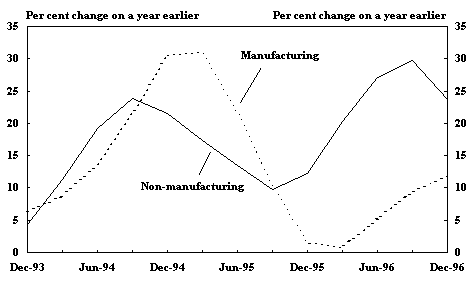
Business investment has grown strongly in aggregate over recent years, but the pattern of investment has varied in line with the different conditions in each sector. Investment in services and mining has been strong. On the other hand, manufacturing investment, while strengthening in recent quarters, has been weaker than the other sectors in line with relatively weaker trading conditions in that sector (Chart 4). Business investment intentions suggest that some variation across sectors is likely to continue, with investment growth continuing to be concentrated in mining and services.
CHART 4: BUSINESS INVESTMENT BY INDUSTRY (TREND SERIES)
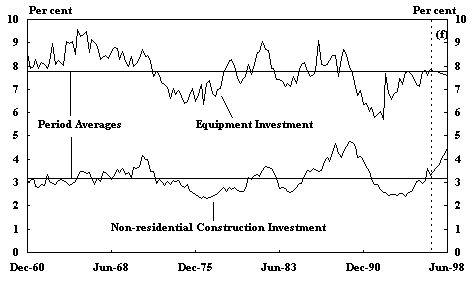
Non-residential construction investment has grown at a rapid rate in recent years and is expected to continue to grow faster than equipment investment in 1997-98.
Engineering construction investment has increased rapidly over the past few years (on projects such as major roads in Sydney and Melbourne and mining-related investment). Nevertheless, strong investment in buildings, such as shops, has represented the bulk of non-residential construction investment. The momentum in this sector will be sustained by projects already under way, continued strength in the mining sector and in private infrastructure investment, new projects related to the Olympics and a gradual pick-up in office building in response to lower vacancy rates in some capitals.
Chart 5 shows that non-residential construction as a share of GDP (in nominal terms) is expected to increase to a level comparable with that of the late 1980s. There are significant differences between the two episodes, however, with the current strength in the sector more broadly-based and encompassing a number of large projects which might previously have been undertaken by the public sector.
CHART 5: NOMINAL BUSINESS FIXED INVESTMENT AS A SHARE OF GDP
Source: Actual data are from ABS Cat. No. 5206.0.
The strength of public investment in 1997-98 mainly reflects the significant investment programmes planned by the New South Wales and Queensland Governments and the expectation that investment by Commonwealth business enterprises will remain at a high level. Information from Commonwealth public enterprises and State governments suggests that some growth in public investment planned for 1996-97 may have slipped into next financial year. Moreover, it appears that investment in 1996-97 will be heavily weighted towards the second half of the year, resulting in slow average growth for the year as a whole.
Growth in public consumption is expected to slow in 1997-98, reflecting fiscal consolidation at both the State and Commonwealth government levels. Public consumption is estimated to have increased at a relatively modest rate in 1996-97.
The flow-through of the recent rise in the exchange rate to lower import prices, and the expected pick-up in private demand growth, should result in another year of strong import volume growth in 1997-98. This follows a substantial acceleration in 1996-97 when: import volumes reacted to continuing strong growth in demand, especially for import-intensive equipment investment goods; lower import prices flowed from the appreciating Australian dollar (Chart 6); and 'exogenous' imports (such as ships and aircraft) were high.
Taken together, the trade forecasts imply that net exports are likely to detract modestly from GDP growth in 1997-98, slightly less than is estimated to have been the case in 1996-97.
The risks surrounding the consumption forecast primarily relate to uncertainties around the forecasts for wages and employment (and hence disposable income). It is also possible that the household saving ratio could resume declining (as was the case up to the early 1990s). Such an outcome would pose an upside risk to the consumption and imports forecasts. Alternatively, if households are concerned about current levels of debt (which remain moderate by world standards), they may rebuild their savings more rapidly than anticipated, leaving consumption growth and imports lower than expected.
The risks to the dwelling investment forecast hinge mainly upon the extent of excess supply in the market. While movements in vacancy rates suggest that excess supply is diminishing and forward indicators clearly indicate that a housing recovery is under way, the extent of excess supply in various parts of the market, and hence the speed of recovery, remains uncertain.
At this stage, only the first set of CAPEX data is available for 1997-98. Initial investment intentions are almost always revised up over the course of the year, although the extent of those revisions can vary significantly from year to year. While investment fundamentals are very positive, the extent to which initial intentions will be revised remains uncertain. Moreover, the timing of large investment projects is always uncertain and small variations in commencement dates can have a major impact on the amount of work undertaken in a given year. As a result, there may be some further slippage into 1997-98 of investment planned for 1996-97. [11] Nevertheless, it is clear that business investment will record very strong growth across the two years.
The forecast for growth in gross farm product in 1997-98 depends on the assumption of normal seasonal conditions. If seasonal conditions differ significantly from this assumption, growth in farm product would be different to that forecast, with possible flow-on effects to rural exports and GDP.
The exchange rate has appreciated significantly since last Budget to be around 25 per cent higher on a trade-weighted basis than its low point in June 1995. A further substantial appreciation or a marked depreciation of the exchange rate from its current level could have implications for a number of components of activity but net exports, in particular, would be significantly affected.
The risks surrounding the wages outlook appear evenly balanced. Enterprise bargaining outcomes remain a key uncertainty, particularly the extent to which current high wage claims in the construction, transport and metals sectors lead to more generalised wage rises in the context of a strengthening economic environment.
Influences that may moderate future wages growth include a further fall in inflation expectations on the basis of continued low inflation and increased competitive pressures. The Workplace Relations Act 1996, by increasing the spread of genuine bargaining, should reduce the extent to which wage increases flow on to other firms without reflecting the commercial circumstances of those firms.
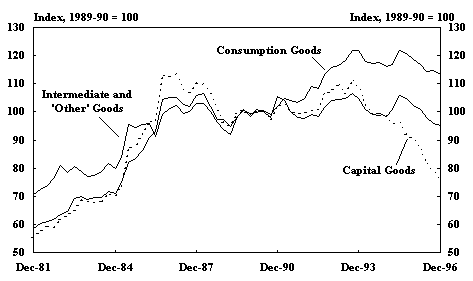
Underlying inflation outcomes over the past few quarters have been heavily influenced by import price falls (Chart 6) stemming from the strength of the exchange rate over the last year and by sustained price competition in the retail sector. Import prices have affected underlying inflation directly, via lower prices for imported consumption goods, and indirectly, through the impact of lower prices of imported capital and intermediate goods used in the production process - and, importantly, by raising competitive pressures in the traded goods and services sectors more generally. Experience suggests that much of the impact of past exchange rate appreciation is yet to be seen, suggesting that the exchange rate will remain an important influence on underlying inflation through the remainder of 1997 and into 1998.
As import prices stabilise, ongoing growth in nominal unit labour costs should again emerge as the main influence on underlying inflation. Growth in the components of nominal unit labour costs (wages less labour productivity) is expected to remain broadly steady through the course of 1997-98.
Broader measures of inflation, such as the gross non-farm product deflator, are forecast to remain low in 1997-98, partly reflecting the lagged influence of recent increases in the exchange rate. The non-farm product deflator is expected to grow at a faster rate than either the domestic demand or gross national expenditure deflators reflecting a forecast improvement in the terms of trade.
The uncertainties surrounding the forecasts of growth in wages and productivity discussed earlier also pose a risk to the inflation forecasts. If the exchange rate moved significantly from its current level, it would also influence inflation outcomes.
The strengthening in employment growth during the course of 1997-98, following two years of only modest growth, should be accompanied by solid labour productivity growth. [12]
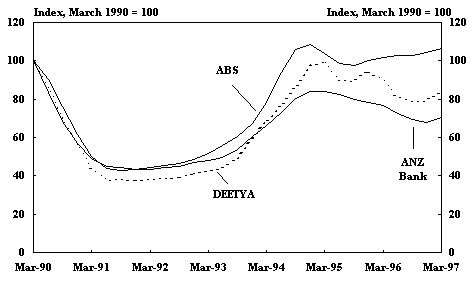
Employment growth has traditionally displayed a marked cyclical trend, moving with some delay in response to changes in growth in activity and real wages. [13] The modest pace of employment growth in recent years may also reflect a lagged response to the surprising strength of employment growth in the first half of 1995. However, growth in employment should strengthen in 1997-98 in response to the acceleration in activity and continuing restrained growth in real labour costs. Measures of job vacancies support this outlook - all three major vacancies series have risen in trend terms recently, with the broadest measure, the ABS series, increasing for the sixth consecutive quarter (Chart 7). [14] Overtime worked also appears to have reached a cyclical trough in late 1996.
CHART 7: JOB VACANCIES (TREND SERIES)
Source: ABS Cat. No. 6354.0, the Department of Employment, Education, Training and Youth Affairs (DEETYA) and the ANZ Bank.
An acceleration in employment growth should encourage more people to seek work during 1997-98 so that not all of the increase in employment will translate into lower unemployment. Nevertheless, employment growth should be strong enough to reduce the unemployment rate to around 8 per cent by the end of 1997-98, following little change over 1996-97 when movements in the working-age population and the participation rate broadly offset growth in employment.
The main risks to the labour market forecasts centre on uncertainties surrounding the activity and real wage forecasts and the future path of the participation rate, which has been sensitive in the past to social and demographic factors. Risks surrounding the outlook for labour productivity growth also have implications for employment, as well as for activity and inflation. Although it appears likely that part of the strong growth in labour productivity from 1991-92 onwards reflects structural improvements as a result of ongoing reforms to product and labour markets, it is difficult to determine the magnitude of structural changes. This matter is discussed further in Statement 3. There is also a timing risk attached to the labour market forecasts as employment growth generally lags changes in activity. If firms have a greater than anticipated capacity to meet demand growth with current staffing levels, then the forecast pick-up in employment growth in 1997-98 could occur a little later than expected.
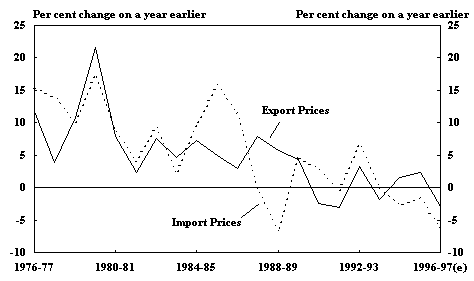
The current account deficit in 1996-97 represents a marked reduction relative to the cyclical peak of 5¾ per cent of GDP reached in 1994-95. Chart 8 illustrates that the improvement in recent years reflects a sharp turnaround in the dollar value of the balance on goods and services. This mainly reflected the recovery in export volumes in 1995-96, but a major factor more recently has been the increase in the terms of trade in foreign currency terms, primarily reflecting higher commodity prices - combined with the appreciation of the dollar, this resulted in import prices falling more sharply and rapidly than export prices (Chart 9).
CHART 8: COMPONENTS OF THE CURRENT ACCOUNT BALANCE
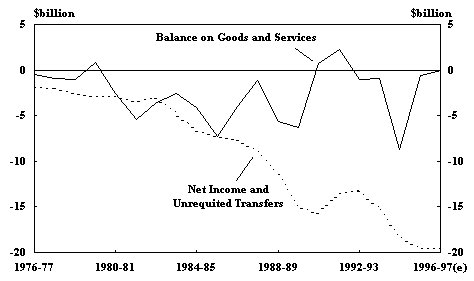
CHART 9: EXPORT AND IMPORT PRICES
Source: ABS Cat. No. 5302.0.
In saving-investment terms, the small increase in the current account deficit in 1997-98 as a share of GDP reflects an increase in national investment which is largely accommodated by the anticipated rise in national saving. The forecast rise in national investment reflects the continued strength of business investment and the acceleration of the housing recovery. At the same time, national saving is expected to reach its highest level (as a share of GDP) since 1989-90, building on the estimated rise in 1996-97 that resulted from higher household and general government saving. This improved saving performance is helping to ease one of the traditional constraints to growth, allowing the forecast acceleration in demand growth to be accompanied by only a slight deterioration in the current account deficit.
The primary risks to the outlook for the current account deficit relate to the uncertainties surrounding the forecasts for domestic demand (the prime determinant of import volume growth) and world economic growth (which affects commodity prices and demand for Australia's exports).


