
Table 9: Summary of Budget Sector Revenue
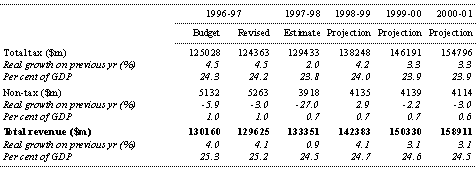
Over the period 1997-98 to 2000-01 total revenue is expected:
Table 10 reconciles revenue estimates at the time of the 1996-97 Budget, the MYEFO and the 1997-98 Budget in terms of policy decisions and parameter and other variations.
At the time of the MYEFO, the revenue estimates were revised downwards substantially. This primarily reflected downward revisions to company tax revenues as a result of lower than anticipated collections in 1996-97. Some large companies used stock valuation options to take advantage of the lower company tax rate applying to the 1994-95 income year. Company tax revenue in 1997-98 was expected to recover with the end of these one-off tax planning activities. In addition, lower inflation than forecast at budget time and a more favourable outlook for wages reduced revenue. Slightly lower forecast consumption also reduced expected revenue from sales tax and excise.
Table 10: Reconciliation of Budget and Forward Estimates of Revenue in Aggregate
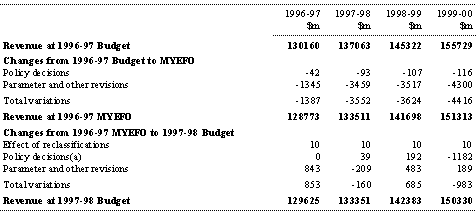
Revenue policy decisions in the period since the 1996-97 Budget have little impact in 1997-98, increase revenue slightly in 1998-99, but reduce revenue substantially from 1999-2000 with the introduction of the savings rebate. The decision to introduce a savings rebate scheme through the taxation system is expected to decrease revenue by $350 million in 1998-99 rising to $1.4 billion in 1999-2000 (the first full year of implementation).
The Government has taken action in the 1997-98 Budget to remove or wind back some tax incentives, as well as replacing one with a more effective outlays measure. Appendix C discusses in more detail the revenue impacts associated with concessional taxation treatment of specific groups and/or activities.
Table 11 provides a summary of all revenue measures introduced up to and including the 1997-98 Budget. A full list of revenue measures is included in Appendix A of Statement 5 and described in full in Budget Paper No. 2.
The major measures include:
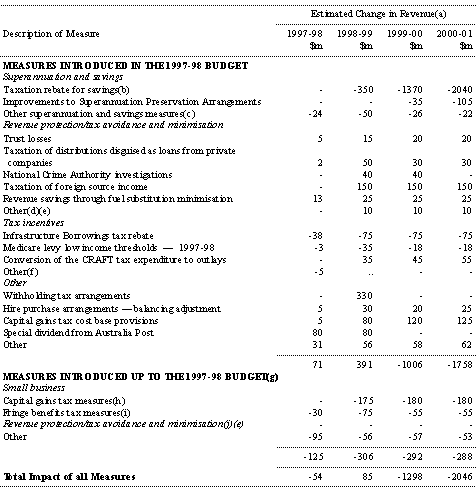
(b) This measure will reduce outlays compared with forward estimates for matching Government superannuation contributions as described in the 1995-96 Budget. The net fiscal impact of implementing the savings rebate, but not going ahead with matching Government superannuation contributions, will be positive.
(c) Includes superannuation measures regarding: freezing the trustee tax rate for friendly societies; broadening the definition of 'complying' pensions and annuities in the Superannuation Industry (Supervision) Regulations; choice of superannuation fund; opting out of the Superannuation Guarantee system; and some preservation measures.
(d) Includes measures regarding: taxation of trusts; trading in franking credits and dividend streaming; passive income of life and general insurance companies; and the interaction of controlled foreign company measures and capital gains tax provisions.
(e) These measures will protect the revenue base used for the forward estimates by removing opportunities for significant future expansion of tax minimisation practices. In the absence of these measures there generally would be a significant revenue loss compared to the forward estimates. In some cases, there will also be an unquantifiable revenue gain to the extent of any existing tax minimisation.
(f) Includes measures regarding: provisional tax exemption for pensioners and tax deductibility for Constitutional Convention election expenses.
(g) Includes measures amended or rejected by the Senate up to the 1997-98 Budget.
(h) Includes measures regarding: capital gains tax (CGT) rollover relief for small business - removal of like kind test and extension of rollover relief through shares; and CGT exemption on the sale of a small business for retirement.
(i) Includes measures regarding: fringe benefits tax (FBT) car parking and record keeping exemptions; and extension of FBT taxi trips exemption.
(j) Includes measures regarding: preventing future access to the IBs tax concession; taxation of foreign dividends paid on finance shares; life insurance companies' exempt and taxable income; and capital losses - denial of artificially created losses.


