
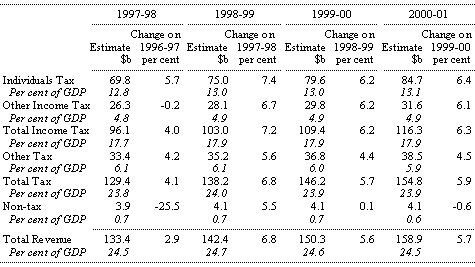
The revenue projections have been made on the conventional assumption of no change in current policy. The forward estimates of revenue are principally affected by projected growth in economic parameters and policy measures contained in this and previous Budgets.
Chart 1 shows actual taxation revenue and GDP(I) growth in nominal terms for the period from 1986-87 to 1995-96, and estimated growth for the years 1996-97 to 2000-01. Taxation revenue generally mirrors economic activity during periods of fairly steady economic growth (as depicted by the economic projections in this Budget), but tends to swing more sharply during periods of economic contraction and expansion and more sharply than nominal GDP(I) growth itself.
The forward revenue estimates are also particularly susceptible to tax minimisation and avoidance actions by taxpayers which over time erode the tax base. Measures taken in this Budget have an impact on revenue in 1997-98 and 1998-99 and serve to protect the tax base.
Longer term trends in major components of total tax revenue are shown in Chart 2. Total tax revenue as a share of GDP fell sharply in the early 1990s and is not expected to fully recover over the forward estimates period to its level of ten years ago.
CHART 1: GROWTH IN TAXATION REVENUE AND NOMINAL GDP
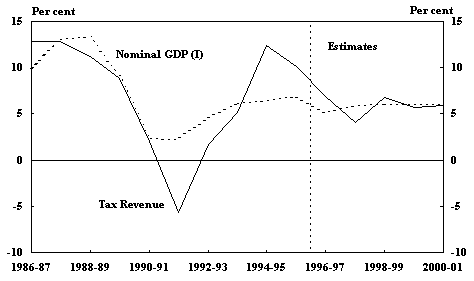
CHART 2: TAX REVENUE AS A SHARE OF GDP
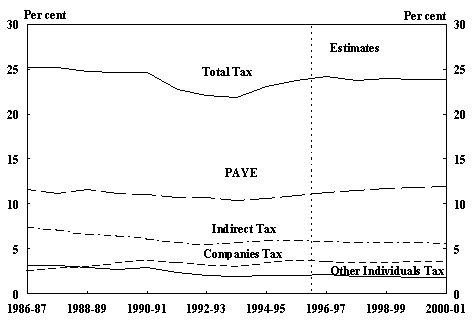
Within this overall trend, there have been some important compositional changes. Company tax as a proportion of GDP has increased since 1986-87, despite reductions in the company tax rate. The reasons for the trend rise in company tax may be traced back to influences such as the general improvement in corporate profitability and the tendency toward incorporation by small businesses. By the same token, the increasing incidence of incorporation is likely to be a factor explaining the trend decline in other individuals income tax as a share of GDP.
There has been a steady decline in the relative importance of indirect tax collections over the past ten years. Excise duties have declined significantly as a proportion of GDP owing to much lower collections of crude oil and LPG excise, following the extension of the PRRT to Bass Strait, and slower growth in consumption of alcohol and tobacco. Customs duty collections have also fallen significantly, largely due to tariff reductions announced in 1988 and 1991. Sales tax collections have increased slightly over the period, mainly because of increases in sales tax rates and some base broadening.
The past ten years has also seen the introduction of new taxes such as the FBT, tax on superannuation funds, PRRT, resident withholding tax, and royalties withholding tax.


