
STATEMENT 5 - REVENUE
PART I: BUDGET
ESTIMATES
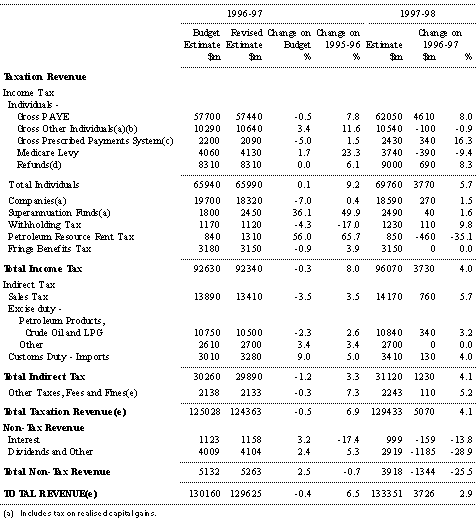
Table 1 compares the revised revenue estimates for
1996-97 with the 1996-97 Budget estimates and provides
estimates for 1997-98.
Table 1: Revenue
Estimates
- (a) Includes tax on realised capital gains.
(b) Includes Child Support Trust Account receipts ($426
million in 1996-97 and $454 million in 1997-98).
(c) Includes Reportable Payments System payments by
individuals ($1 million in 1996-97 and $1 million in
1997-98).
(d) Includes refunds of Child Support Trust Account
receipts ($10 million in 1996-97 and $10 million in
1997-98).
(e) Includes impact of classification changes except
for the 1996-97 Budget estimate.
Total revenue in 1996-97 is now estimated to be a little
lower than forecast in the 1996-97 Budget with a significant
downward movement in company tax partly offset by strength
in a number of other tax categories.
In 1997-98 total revenue is expected to increase by
2.9 per cent over estimated revenue in 1996-97, with
the ratio of revenue to GDP falling to 24.5 per cent.
Total tax revenue is expected to grow more slowly in
1997-98 at 4.1 per cent, compared with estimated growth
of 6.9 per cent in 1996-97. As a share of GDP, taxation
revenue is expected to fall to 23.8 per cent. Taxation
revenue is expected to increase by 2.0 per cent in
real terms.
The continued growth in taxation revenue in 1997-98
reflects ongoing expansion of economic activity as
well as the net contribution to revenue from measures
announced in this and previous Budgets. The decline
in non-tax revenue mainly reflects a lower dividend
from the Reserve Bank of Australia.
Revenue measures contained in this Budget add $71 million
in 1997-98; measures have substantially greater effects
in later years. A list of revenue measures is included
in Appendix
A and described in full in Budget
Paper No. 2.
The revenue estimates are influenced by the rate of
income growth (growth in nominal GDP(I) of around 6
per cent) and the following forecasts:
- average earnings (national accounts basis excluding
superannuation and redundancies) growth of around 4
per cent;
- growth in wage and salary employment of 2 per cent;
- a rise in 1996-97 company income of 3¼ per cent; and
- an increase in nominal private consumption of 5¼ per
cent.
Taxation Revenue
Individuals
Income Tax
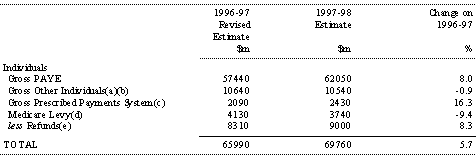
The revised estimates for 1996-97 and estimates for
1997-98 for the major categories of individuals income
tax are shown in Table 2.
Table
2: Individuals Income Tax
(a) Includes tax on realised capital gains.
(b) Includes Child Support Trust Account receipts ($426
million in 1996-97 and $454 million in 1997-98).
(c) Includes Reportable Payments System payments by
individuals ($1 million in 1996-97 and $1 million in
1997-98).
(d) The base Medicare levy reverts to 1.5 per cent
in 1997-98 with the cessation of the 0.2 per cent surcharge
imposed in 1996-97 for the purpose of buying back certain
firearms from the public.
(e) Includes refunds of Child Support Trust Account
receipts ($10 million in 1996-97 and $10 million in
1997-98).
Pay-As-You-Earn
(PAYE) Instalment Deductions
Wage and salary earners pay income tax on a pay as
you earn basis through tax instalment deductions made
by their employers.
Gross PAYE collections (net of the Medicare levy) are
expected to rise by 8.0 per cent in 1997-98 in response
to forecast growth in average earnings and in wage
and salary employment.
Other Individuals
The 'other individuals' category includes all collections
of income tax paid by individuals, other than those
made through the PAYE and Prescribed Payments System
(PPS) categories. Tax revenue comprises provisional
tax payments and debit assessments on income tax returns
(ie where tax credits are insufficient to meet the
tax assessed on income). Taxpayers in this category
derive their income from salary and wages, business
and property income and capital gains, and may also
make concurrent payments under the PAYE and PPS categories.
Provisional tax liability in a given year is generally
determined by increasing the previous year's assessed
income by a provisional tax uplift factor (currently
6 per cent). Taxpayers who expect their income to grow
by less than the uplift factor may elect to lodge a
provisional tax variation to reduce provisional tax
payments. Current year tax payments for other individuals
are made up of provisional tax payments together with
any balance on assessment from the previous year's
tax liability.
Revenue from this item is expected to fall by around
0.9 per cent in 1997-98 largely due to lower expected
collections from debits on assessments. Debits on assessments
in 1996-97 have been exceptionally strong because of
robust growth in incomes in 1995-96, which is expected
to moderate.
Prescribed
Payments System (PPS)
PPS collections represent the withholding, at source,
of taxation on payments for prescribed labour and services
in specific industries (eg building and construction
and road transport). PPS collections generally cover
industries where the PAYE form of collections is either
infeasible or costly to administer.
Revenue in 1997-98 is estimated to increase strongly
mainly reflecting strong growth in the construction
industries, viz:
- forecast growth of 22.5 per cent in the nominal value
of non-residential construction; and
- forecast growth of 12.5 per cent in the nominal value
of dwelling construction.
Medicare Levy
Collections in 1997-98 are expected to fall by 9.4
per cent owing to:
- reversion of the base levy to 1.5 per cent with the
cessation of the 0.2 per cent (of taxable income) surcharge
imposed in 1996-97 for the purpose of buying back certain
firearms from the public; partially offset by
- growth in wage and salary incomes.
Individuals
Income Tax Refunds
A final assessment of tax liability for individual
taxpayers is made on the basis of returns lodged after
the end of a financial year. Refunds are made where
tax payments exceed the final assessment. Where tax
credits are insufficient to meet the final tax liability,
taxpayers make an additional payment, which is collected
under the other individuals income tax category.
Refunds in 1997-98 are estimated to grow by 8.3 per
cent largely on account of:
- ongoing growth in income tax collected from individuals
during 1996-97; and
- the impact of the introduction of the Family Tax Initiative
from 1 January 1997, which allows taxpayers to claim
the tax relief through refunds (and through the year).
Company
and Other Income Tax
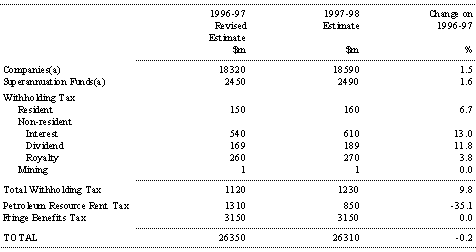
Table 3 contains revised estimates for 1996-97 and
estimates for 1997-98 for company and other income
tax items.
Table
3: Company and Other Income Tax
(a) Includes tax on realised capital gains.
Company Income
Tax
A company's tax liability is assessed as a flat percentage
of its taxable income. The general tax rate is 36 per
cent, with concessional rates applying to certain income
of life assurance companies, registered organisations,
pooled development funds and credit unions.
The significant reduction in estimated company tax
collections in 1996-97 relative to the 1996-97 Budget
estimate (see Table
1) is mainly due to some large companies using
stock valuation options to shift forward their income
to take advantage of the lower company tax rate applying
to the 1994-95 income year.
Estimated company tax collections in 1996-97 are higher
than estimated in the MYEFO partly reflecting more
information on the extent and implications of corporate
tax planning activities associated with the change
in the company tax rate.
Company income tax is forecast to grow by 1.5 per cent
in 1997-98 owing to:
- growth of 3¼ per cent in company taxable income in
1996-97;
- a recovery in company tax collections associated with
the end of tax planning which arose in response to
the increase in the company tax rate from the 1995-96
income year;
partly offset by:
- the end of the bring-forward of company tax revenue
associated with the move to quarterly tax payment arrangements
for companies.
Superannuation
Funds Tax and Surcharge
Superannuation funds are generally taxed at the concessional
rate of 15 per cent in relation to investment income
and certain contributions received. Payments are made
according to the same schedule as applies to company
income tax.
Tax collections under this category have generally
been volatile: the strong increase in collections in
1996-97 has followed negative growth in 1995-96. Although
the reasons for the large surge in superannuation funds
tax collections in 1996-97 are not fully clear, strong
growth in contributions, high realisations of capital
gains and strong growth in interest income have been
contributing factors.
The estimated increase in collections in 1997-98 of
1.6 per cent is attributable to:
- growth in contributions to superannuation funds; and
- the surcharge on employer and deductible member superannuation
contributions on behalf of or by high income earners;
partly offset by:
- the end of the bring-forward of superannuation funds
tax payments associated with the move to quarterly
tax payment arrangements; and
- an anticipated easing in capital gains tax payments
by superannuation funds from an unusually high level
in 1996-97.
Because the reasons behind the strong growth in 1996-97
collections are not fully known, the estimate for 1997-98
is subject to more than the usual degree of uncertainty.
Withholding Tax
Withholding tax is levied on:
- income payments to residents who, when making an investment,
do not supply the investment body with a tax file number;
- certain interest, dividend and royalty payments to
non-residents; and
- payments made to Aboriginal groups for the use of Aboriginal
land for mineral exploration and mining.
The estimated increase in withholding tax in 1997-98
of 9.8 per cent is attributable to strong growth in
expected collections of interest withholding tax and
continued growth in dividend withholding tax.
Petroleum
Resource Rent Tax (PRRT)
Under the Commonwealth's Petroleum (Submerged Lands)
Act 1967, PRRT applies to offshore areas other than
the North West Shelf production licence areas and associated
exploration permit areas, which are subject to excise
and royalty arrangements. PRRT is levied at the rate
of 40 per cent of taxable profit from a petroleum project.
The strong increase in PRRT collections in 1996-97
represents a large one-off payment related to the settlement
of the dispute between the Victorian gas utilities
and their gas suppliers. The gain in tax revenue is
largely offset by the payment of $556 million to the
Victorian Government under the Deed for the Return
of Tax Payments between Victoria and the Commonwealth.
In 1997-98, PRRT revenue is expected to return to more
normal levels.
Fringe Benefits
Tax (FBT)
FBT applies to a range of benefits provided by employers
to their employees or associates of their employees.
FBT collections are estimated to remain broadly unchanged
under the offsetting influences of remuneration growth
and a reduction in the statutory interest rate used
to determine the value of fringe benefits flowing from
low interest loans.
Indirect Tax
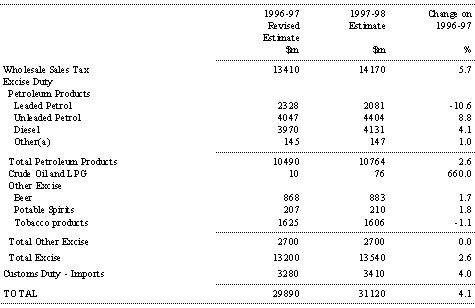
A summary of the revised 1996-97 estimates and estimated
revenue for 1997-98 for components of indirect tax
is contained in Table 4.
Table 4: Indirect
Tax
- (a) Includes aviation gasoline, aviation turbine fuel,
fuel oil, heating oil and kerosene and refunds/drawbacks
relating to petroleum products excise.
Wholesale
Sales Tax (WST)
WST is imposed on a range of goods destined for consumption
in Australia and is levied at the last wholesale or
import point on the wholesale sales value of taxable
goods. In 1997-98, taxable goods will continue to be
subject to tax rates of either 12, 22, 26, 32 or 45
per cent, depending on the classification of the goods
involved.
The estimated increase in WST revenue of 5.7 per cent
mainly reflects forecast growth in nominal demand for
taxable goods.
Excise Duty
Petroleum products excise includes excise on motor
spirit (petrol), diesel fuel, aviation gasoline, aviation
turbine fuel, fuel oil, heating oil and kerosene. It
is imposed at specific rates per litre of product.
Crude oil and LPG excise includes excise collected
from fields in the North West Shelf production license
areas not subject to PRRT.
Excise revenue from total petroleum products is expected
to increase by 2.6 per cent in 1997-98 reflecting an
expected increase in consumption of diesel fuel and
unleaded petrol and the indexation of excise rates.
The fall in excise collections from leaded petrol reflects
a continuing decline in the number of vehicles which
exclusively use leaded petrol. The increase in excise
collections from crude oil and LPG production reflects
the expectation that the Wanaea field will become excisable
in late 1997 (a delay of seven months on the forecast
in the 1996-97 Budget).
Other excise is derived from beer, potable spirits
and tobacco products. It is imposed at a specific rate
per kilogram on tobacco products, on the alcoholic
content of beer in excess of 1.15 per cent and on the
distilled alcohol in other products such as spirits
and mixed drinks. Beer with an alcoholic content below
1.15 per cent is subject to an excise rate of zero.
Wine, wine products and other fermented alcohol are
exempt from duty.
Excise revenue from these products is expected to remain
broadly unchanged in 1997-98 reflecting indexation
of excise rates offset by falling or static product
volumes. Tobacco product and brandy volumes are expected
to continue to decline, while other volumes are expected
to remain around 1996-97 levels.
Excise Indexation
The rates of duty for excisable commodities (with the
exception of crude oil and LPG) are adjusted each August
and February in line with half-yearly CPI movements.
If the change in the CPI is negative, the excise rate
is not reduced but instead the decline is carried forward
to be offset against the next positive CPI movement.
All revenue from the excise duty on aviation gasoline
and aviation turbine fuel is appropriated to the Civil
Aviation Safety Authority (CASA) and Airservices Australia
as a contribution to cost recovery. In addition to
the changes from indexation described above, the excise
rates applying to these fuels are adjusted as necessary
according to the funding requirements of those agencies.
Existing excise rates are shown in Table 5.
Table 5: Excise
Rates
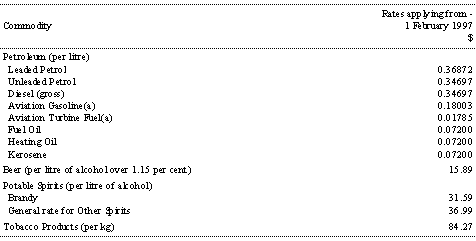
- (a) The excise rates applying to aviation gasoline
and aviation turbine fuel were reduced by $0.0075 per
litre on 1 September 1996 to $0.17931 per litre and
$0.01778 per litre respectively to reduce over-recovery
of revenue necessary to fund CASA and Airservices Australia.
Customs Duty
on Imports
Ad valorem tariffs are applied to many categories of
imports. Customs duty revenue is affected by the $A
value of imports, the level of the statutory tariff
rates applied to imports and the composition of imports
between high and low tariff rates. Around 70 per cent
of total imports by value enter duty free.
The expected increase in customs duty revenue of 4.0
per cent in 1997-98 reflects the rise in the total
value of imports, partly offset by continuing tariff
rate reductions.
Other Taxes,
Fees and Fines
The revised 1996-97 and 1997-98 estimates of other
taxes, fees and fines are shown in Table 6.
Table
6: Other Taxes, Fees and Fines
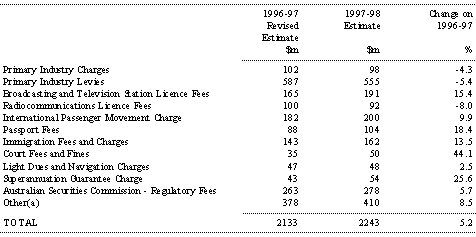
(a) Includes Telecommunications Act Carrier Licence
Fees, Coal Mining Industry Levy and the Interstate
Road Services Charge.
Primary
Industry Charges
The fall in industry charges reflects reforms to the
Australian Quarantine and Inspection Service's export
meat inspection programme and implementation of a company
based inspection system focussing on quality assurance.
Primary
Industry Levies
The reduction in Primary Industry levies is due mainly
to a reduction in the Wheat Industry Fund Levy. This
reflects an expectation of lower world prices and reduced
production levels in the 1997-98 financial year.
Broadcasting
and Television Station Licence Fees
The increase in broadcasting and television licence
fees reflects the expected growth of commercial broadcasters'
gross advertising revenue, on which the fees are based,
as well as a reduction in the equalisation rebates
due to commercial television broadcasters participating
in the equalisation scheme.
Radiocommunications
Licence Fees
Revenue from Radiocommunications Licence Fees has been
reduced primarily to reflect the Government's announcement
in October 1996 confirming its intention to proceed
with analogue mobile phone (AMPS) phase out by January
2000 and the detailed arrangements and time-table for
the phase out. The phase out will reduce the fees paid
by the telecommunications carriers for the use of AMPS
spectrum.
International
Passenger Movement Charge
The expected revenue increase reflects a forecast increase
in the number of international passengers of 10 per
cent with the charge remaining at $27. Revenue from
this item seeks to recover the costs of Customs, Immigration
and Quarantine processing of international travellers
at Australian airports and seaports as well as the
costs of processing short-term visitor visas.
Immigration
Fees and Charges
Revenue from immigration fees is expected to rise in
1997-98 largely as a result of the full year effect
of increases introduced in the 1996-97 Budget which
include:
- an increase in the Migrant Application fee on 1 May
1997;
- the change of status to permanent residency fee increasing
from 1 October 1996; and
- the application fee for a student visa increasing on
1 October 1996 with a further increase on 1 May 1997.
Measures announced in this Budget include the rationalisation
of temporary business entry visa sub-classes, cost
recovery for health assessments, health undertakings
and medical reviews, and increased cost recovery for
citizenship processing. A fall in the number of applications
for 1997-98 is expected to be offset by the higher
level of fees.
Non-Taxation
Revenue
The revised estimates of non-tax revenue for 1996-97
and estimates for 1997-98 are shown in Table 7.
Table
7: Non-Taxation Revenue
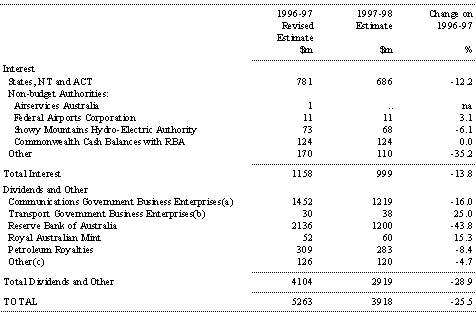
(a) Comprises Telstra Corporation and Australian Postal
Corporation.
(b) Comprises the Federal Airports Corporation and
Airservices Australia.
(c) Comprises the Export Finance and Insurance Corporation,
Commonwealth Funds Management Ltd, Housing Loans Insurance
Corporation, the Australian Industry Development Corporation,
Australian Defence Industries Ltd, Defence Housing
Authority, the Pipeline Authority and other non-tax
revenue.
Interest Revenue
Interest
Revenue from the States, NT and ACT
This item comprises interest revenue from the States
and Territories on General Purpose and Specific Purpose
Borrowings.
The Commonwealth receives interest payments from the
States in respect of borrowings made on behalf of the
States under the State Governments' Loan Council Programme
and from the Northern Territory in respect of advances
made under similar general purpose capital assistance
arrangements. Payments relating to these advances are
made in turn by the Commonwealth to bondholders.
Interest from the States on General Purpose Borrowings
is declining as a result of the June 1990 Loan Council
decision that the States make additional payments to
the Debt Retirement Reserve Trust Account (with analogous
payments from the Territories) each year, to facilitate
the redemption of all maturing Commonwealth securities
issued on their behalf. The reduction in interest received
from the States and Territories is matched by a reduction
in public debt interest outlays.
Interest will be lower in 1997-98 compared to 1996-97
reflecting repayments of outstanding debt to the Commonwealth
in 1996-97.
The Commonwealth receives interest on advances made
under Commonwealth-State Housing Agreements, States
(Works and Housing) Assistance Acts, Northern Territory
Housing Advances and from the Australian Capital Territory
on debts assumed upon self-government.
Interest from the States on Specific Purpose Borrowings
will be lower in 1997-98 compared to 1996-97 reflecting
repayments of advances to the Commonwealth in 1996-97.
Dividends and
Other
Communications
Government Business Enterprises (GBEs) Dividends
Total dividends from communications GBEs are expected
to fall by around 16 per cent as a result of a reduction
in the Commonwealth's entitlement to Telstra's dividend
following the sale of one-third of the Commonwealth's
equity in Telstra, partially offset by a special dividend
payment by Australia Post.
Transport
Government Business Enterprises (GBEs) Dividends
Total dividends from transport GBEs are estimated to
increase by around 25 per cent. This is principally
due to an expectation of an increased Federal Airports
Corporation dividend for 1997-98, as a result of higher
traffic growth leading to greater operating profits
for the 1996-97 financial year.
Reserve
Bank of Australia (RBA)
The Reserve Bank Act 1959 requires the RBA to pay its
net earnings to the Commonwealth after contingencies
and appropriations to reserves.
The lower dividend estimate in 1997-98 reflects the
effect on the RBA's 1996-97 earnings of expected asset
valuation adjustments arising mainly from changes in
exchange rates during 1996-97. The stronger the Australian
dollar, the lower is the value of the RBA's foreign
exchange assets in Australian dollar terms. Changes
in the structure of domestic and international interest
rates are also expected to reduce the RBA's underlying
earnings.
Royal Australian
Mint (RAM)
Revenue from the RAM includes seigniorage from circulating
coin production, royalties from numismatic coin sales
and annual dividends from the profits the Mint makes
as the manufacturer of these products. The estimated
increase in revenue in 1997-98 mainly reflects increases
in numismatic royalties and profits associated with
the Olympics coin numismatic programme.


