HORIZONTAL FISCAL EQUALISATION
The general revenue assistance provided to the States
by the Commonwealth is largely distributed on the basis
of the horizontal fiscal equalisation (HFE) principles
which are embodied in the per capita relativities recommended
by the Commonwealth Grants Commission (CGC) - see Box
1. The objective of HFE is to improve equity for
all Australian residents.
In its assessments, the CGC uses a complex methodology
that takes account of differences in the per capita
capacities of the States to raise revenues and differences
in the per capita amounts required to be spent by the
States in providing an average standard of government
services. A State's actual per capita expenditure or
revenue generally differs from the average of all States
for two reasons:
- influences that are beyond a State's control (referred
to as 'disabilities') affect the cost at which it can
provide services and its capacity for raising revenue;
and
- a State's policies, practices and operating efficiency
differ from those of other States. [1]
HFE requires that only those factors beyond a State's
control be taken into account in determining a State's
relative needs and hence the distribution of Commonwealth
general revenue grants. The CGC's recommendations seek
to ensure that each State has the capacity to provide
the average standard of State-type public services
if it makes the same effort to raise revenue as the
States on average and operates at an average level
of efficiency.
Since 1990-91, the CGC's assessments have been based
on data for the five financial years preceding the
year in which the assessment is made. Accordingly,
the review period for the per capita relativities to
be applied in 1997-98 spans the years 1991-92 to 1995-96.
The five year review period replaced a three year review
period and aims to provide greater year-to-year stability
in the distribution of FAGs among the States and hence
provide a greater degree of certainty for the States
in their forward planning. This was balanced against
the greater contemporaneity of assessments with current
circumstances that would be provided by a shorter review
period.
By international standards, the extent of HFE in Australia
is pronounced and the methodology is complex. The complexity
of the CGC's processes has arisen in response to the
requirements of the States and the Commonwealth over
time for a comprehensive and rigorous approach to HFE.
For its part, the CGC has sought to maximise the transparency
of its methodology and to provide the opportunity for
input and comment by the States and the Commonwealth.
Further information on HFE is provided in the CGC's
1997 Update report.
BOX 1: COMMONWEALTH GRANTS COMMISSION
- The Commonwealth Grants Commission (CGC) is an independent
statutory authority established by the Commonwealth
Grants Commission Act 1973.
- The CGC makes recommendations concerning the distribution
of general revenue assistance to the States in response
to terms of reference provided to it each year by the
Commonwealth Government.
- The Commonwealth's practice is to consult with the
States concerning the CGC's terms of reference with
a view to reinforcing the Commission's position as
an independent arbiter in relation to horizontal fiscal
equalisation.
- The terms of reference define the general approach
to be followed by the CGC as well as any specific conditions
or limitations on the extent to which fiscal equalisation
is to apply.
- The CGC produces both annual updates and five-yearly
reviews. Updates essentially revise the data upon which
the CGC's assessments are based. The longer term reviews
encompass changes to the Commission's methodology.
The next review is scheduled for implementation in
1999.
-
|
Effects
of Horizontal Fiscal Equalisation
The CGC first reported on relativities for the six
States simultaneously in 1981. Prior to that time,
the CGC's major task was to assess applications by
'claimant States' for special financial assistance
from the Commonwealth under section 96 of the Constitution.
The reviews of relativities were widened to include
the Northern Territory in 1985 and the Australian Capital
Territory in 1993.
The distribution of the pool of FAGs and HFGs in accordance
with the CGC's per capita relativities means that New
South Wales, Victoria, Western Australia and the Australian
Capital Territory receive less than an equal per capita
share, and the other States (particularly the Northern
Territory and Tasmania) receive more. This reflects
the CGC's assessment that the 'donor' States have greater
relative revenue capacities and/or less significant
expenditure disabilities than the other States.
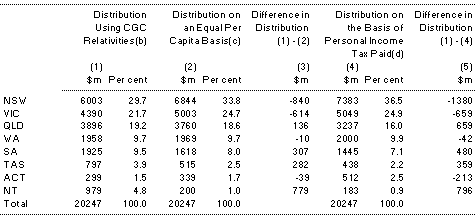
Table 3 shows the amount of FAGs and HFGs received
by each State under HFE relative to the amount that
they would receive on the basis of an equal per capita
distribution or a distribution based on personal income
tax collections. The table shows that, in 1997-98,
around $1,500 million (or 7.4 per cent) of the FAGs/HFGs
pool is to be redistributed among the States as a result
of the application of the CGC's relativities, compared
with an equal per capita distribution.
Table 3: Impact of Horizontal Fiscal Equalisation on
the Distribution of the Pool of Financial Assistance
Grants and Hospital Funding Grants in 1997-98 ($million)(a)
- (a) The pool consists of $16144.0 million in FAGs and
$4102.9 million in HFGs - see Table 11 in Chapter III.
(b) 1997 relativities as recommended by the CGC - see
Table 4 below.
(c) Based on ABS population projections - see Table
1.
(d) Based on each State's contribution to total net
tax paid by individuals for 1994-95, as shown in Table
P15 of Australian Taxation Office, Taxation Statistics
1994-95.
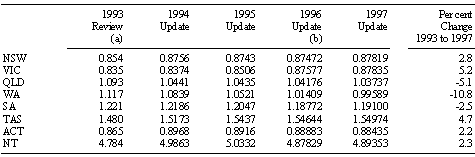
Table 4 shows the per capita relativities used to distribute
the combined pool of FAGs and HFGs since 1993.
- Western Australia and Queensland have experienced the
largest declines in per capita relativities, reflecting
relatively strong economic growth in those States which
has contributed to an increase in their assessed fiscal
capacities.
- In its 1997 Update report, the CGC for the first time
assessed Western Australia as having above average
fiscal capacity, reflected in a per capita relativity
of less than one.
- The per capita relativities of the remaining States
(except for South Australia) have increased, particularly
those of Victoria and Tasmania.
Table 4: Commonwealth Grants Commission Relativities,
1993 to 1997
- (a) Supplementary relativities calculated by the CGC
to take into account the Medicare Agreements and Commonwealth
policy in respect of State stamp duty exemptions for
corporate reconstructions.
(b) The 1996 Update relativities as amended by the
CGC's subsequent alternative calculation of 29 May
1996 relating to the treatment of Section 130 payments
to Western Australia by deduction.
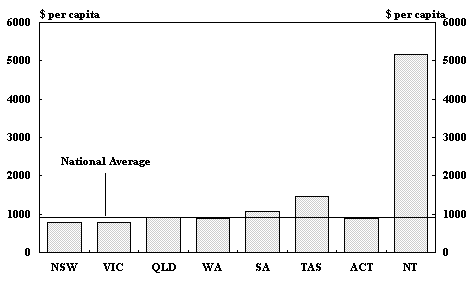
The estimated State distribution of general revenue
assistance on a per capita basis for 1997-98 is shown
in Chart 6. It indicates that New South Wales, Victoria
and Western Australia receive less than average per
capita payments while the Northern Territory receives
five times the national average and Tasmania and South
Australia also benefit from above average per capita
payments.
Chart 6: General Revenue Assistance, 1997-98
- Source: Table 6 of this Budget Paper.
Fiscal
Equalisation and Specific Purpose Payments
In determining per capita relativities for the distribution
of general revenue assistance, the CGC takes account
of the interstate distribution of most current SPPs.
Within the CGC's methodology there are four approaches
to dealing with SPPs.
- Inclusion is used for SPPs which are considered to
go towards meeting the CGC's assessment of State expenditure
needs (for example, SPPs for funding government schools).
In essence, this assumes that the provision of funding
through SPPs is no different in effect from the provision
of general revenue assistance.
- Absorption is a variant of the inclusion approach with
the main difference being that SPPs treated by this
method are added to the pool of FAGs and the CGC's
recommended per capita relativities are determined
with regard to the combined pool in that year. Unquarantined
HFGs are treated in this manner.
- Deduction is used where an SPP is considered to finance
expenditure in addition to that which the States would
otherwise have undertaken or where an SPP is distributed
in accordance with the CGC's assessment of State needs.
Under this approach, only the State-funded portion
of expenditure is included in the CGC's assessments.
A number of health SPPs - including the incentives
package and bonus pool payments in the Medicare Agreements
- are treated by deduction. The deduction approach
seeks to quarantine the distribution of FAGs from the
interstate distribution of SPPs.
- Exclusion is used for SPPs which are directed to areas
in which the Commonwealth has largely accepted financial
responsibility (for example, most SPPs 'through' the
States) or which are outside the scope of the CGC's
assessment. Under this method all expenditure in the
particular area is excluded from the assessments.
The distribution of SPPs treated by inclusion or absorption
(about three-quarters of current SPPs 'to' the States)
affects the distribution of FAGs. In general, while
the effect of the inclusion method on the overall distribution
of funding depends on a number of factors, a State
receiving a higher (lower) share of an 'included' SPP
than the CGC considers appropriate to satisfy its relative
'needs' in the area will be assessed as requiring a
commensurately lower (higher) share of the FAGs/HFGs
pool. Concerns have been expressed that this may in
some instances result in the Commonwealth's policy
objectives with respect to SPPs being overridden.
The Commonwealth attempts to balance the objectives
of SPPs with the objectives of fiscal equalisation.
Accordingly, the Commonwealth has sometimes instructed
the CGC to treat certain SPPs in a different way from
how the CGC may otherwise have treated them. For example,
the financial assistance provided under the South Australian
Assistance Package is excluded from the CGC's assessments
to ensure that the benefit of the assistance is not
redistributed to the other States by a change in the
distribution of FAGs.
In any event, it is not necessarily the case that the
Commonwealth's policy objectives will be forgone where
an SPP's distribution may be overridden over time in
a financial sense. The objective of an SPP may be achieved
by the fulfilment of the related conditions which the
Commonwealth has agreed with the State receiving the
payment.


