
Document
Index
Budget Paper 1
Budget Statement 3



|
Document
Index |
|
|
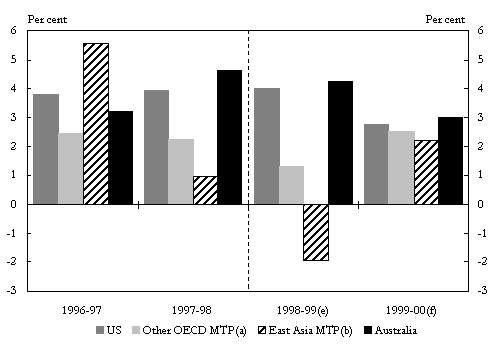
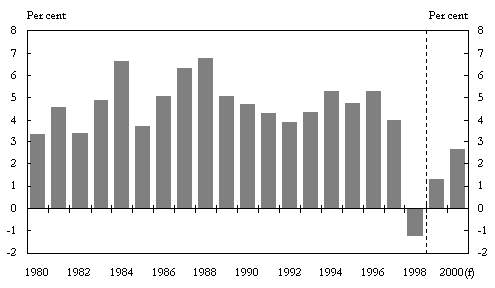
The current slowdown in world economic growth substantially reflects the deep recession in Japan and the crisis in a number of East Asian economies. Economic activity in Australia's MTPs fell in 1998, with only weak growth expected in 1999 and a modest strengthening in 2000 (Charts 1 and 2). This contrasts with previous slowdowns in world growth in the early 1980s and the early 1990s when East Asian economies, and to a lesser extent Japan, remained relatively buoyant.
Chart 1: Australian and MTP GDP Growth
The world economic downturn has contributed to a sharp 17 per cent fall in world prices of Australia's commodity exports. Moreover, export volume growth has been affected more on this occasion than in the past. This is particularly the case for ETMs and services, for which East Asian economies are major markets and diversion to other markets is relatively difficult.
In contrast, the decline in the exchange rate since late 1997 and the ability of commodity exporters, in particular, to divert sales to more buoyant markets in the United States and Europe have cushioned the effects of the downturn to some extent. Furthermore, Australia's terms of trade have been less affected than in the mid-1980s and early 1990s, with weakness in East Asia putting downward pressure on the world prices for some of Australia's major imports, helping to offset weakness in world commodity prices. World interest rates have also been lower on average than during the early 1990s, and that has cushioned the slowdown in world growth during the period and has helped Australia maintain a low interest rate environment.
Japan and the troubled East Asian economies (ie Korea, Indonesia, Malaysia and Thailand) are significant trading partners for Australia, accounting for around 39 per cent of total merchandise exports, including 44 per cent of commodity exports and 19 per cent of ETM exports, over the 1990s. As a result, the severe recessions in these economies contributed to negative MTP growth in 1998 and the prospect of growth well below trend in 1999 and 2000 (Chart 2).
Chart 2: MTP GDP Growth(a)
However, some of the effects of lower MTP growth have been avoided by commodity
exporters diverting export sales from East Asian MTPs to other, more strongly growing,
markets. For example, through the year to the September quarter 1998, the value of
commodity exports (excluding gold) to the troubled East Asian economies fell
by 11 per cent, while commodity exports to countries outside Asia rose by
18 per cent. While data are not readily available to calculate a price-volume
split by country of destination, for commodity exports much of the relative change in
values is likely to be attributable to changes in volumes.
Since late 1998 there has been some recovery in commodity exports to the troubled
East Asian economies as these economies have begun to recover slowly. Commodity exports
(excluding gold) to these economies rose by 18 per cent in the three months
to March 1999 compared with a year earlier, while commodity exports to countries
outside Asia fell by 1 per cent over this period as economic growth in other
regions has moderated. Commodity exports to Japan have continued to weaken, as the
Japanese economy remains recessed, falling by 8 per cent in the
three months to March 1999 compared with a year earlier.
Much less diversion of exports of ETMs away from troubled East Asian markets seems to have
occurred. For example, the value of ETM exports to these economies and Japan declined by
42 per cent in the first year of the crisis. The value of exports to countries
outside Asia increased by 5 per cent, with ETM export values declining
by 6 per cent in total.
The scope for Australian commodity exporters in particular to raise or lower sales in
various markets in response to changing economic conditions means there is merit in
considering a broader measure of international economic activity than MTP growth. One such
measure is overall world GDP growth. Most of the recent slowdown in world growth is
attributable to Japan, which accounts for around 15 per cent of world GDP. While
the contractions in other East Asian economies have been particularly severe, the
economies of Korea, Indonesia, Malaysia and Thailand constitute only around
3 per cent of world GDP. World growth has been buoyed by the strength in the
United States and, to a lesser extent, Europe, which together account for a little more
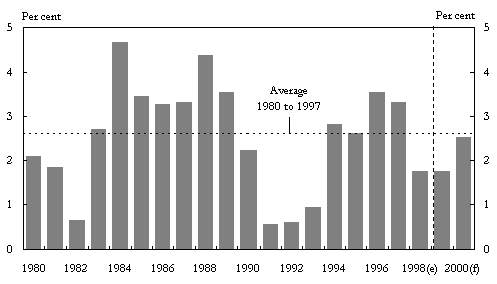
than half of world GDP. Hence, the slowdown in world growth has been less significant than
the sharp downturn in Australia's MTP growth (Chart 3).
Chart 3: World GDP Growth
Source: Various national statistical publications, the IMF and Treasury.
One reason economic growth has remained strong in the United States and relatively firm in Europe over this period is the macroeconomic policy environment in these countries. When the slowdown in East Asia emerged in late 1997, interest rates were already at low levels in the United States and Europe. The maintenance of this policy framework has meant that interest rates have remained at relatively low levels throughout the current period of below-trend world growth. This contrasts with the experience of the early 1990s when interest rates in the industrialised economies were generally at very high levels, as world growth initially fell below trend, and were reduced only gradually over the next three years of below-trend growth.
The concentration of slower growth in Australia's East Asian MTPs has resulted in a
sharp downturn in export volume growth. This has occurred despite the success of commodity
exporters in diverting their product away from the troubled East Asian economies. ETM and
service exports are more sensitive to changes in income in the importing country, with
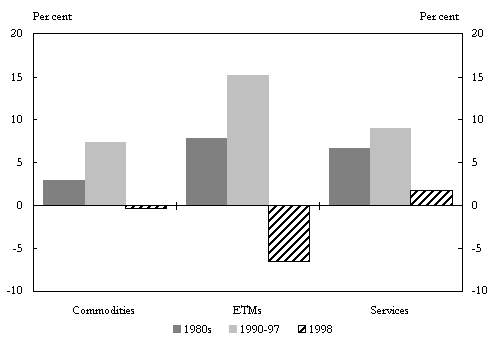
less scope for diversion to alternative markets than commodity exports.[1] As a result, exports of ETMs have been most affected by severe
recession in a number of East Asian economies. ETM exports fell
by 6.6 per cent in 1998, compared with an average growth rate of
10.3 per cent since the early 1980s (Chart 4). This is a much more
severe impact than was felt with the slowdown in world growth in the early 1980s or
the early 1990s.
Service export volumes have continued to grow over the past year and a half, but at rates
well below the longer-term trend. Volumes grew by 1.8 per cent in 1998,
down from an average growth rate of 7.4 per cent since the early 1980s.
Despite significant diversion of commodity exports to markets outside East Asia, there was
no growth in the volume of commodity exports in 1998. This compares with an average
annual growth rate of 4.6 per cent over the past two decades. However, the
relative weakness in commodity exports partly reflects the impact on farm production of
the return to normal seasonal conditions in 1997-98, following very strong farm product
growth in 1996-97, and so is not entirely attributable to the international downturn.
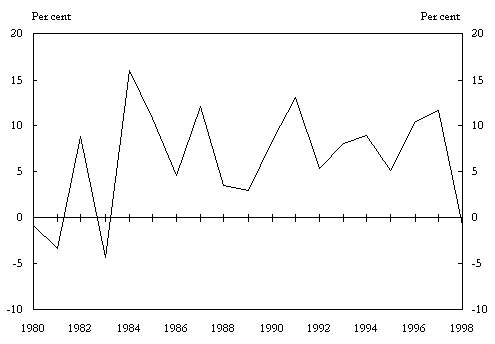
Overall, total export volumes fell by 0.5 per cent from the September
quarter 1997 to the December quarter 1998. This compares with average annual
export volume growth over the past two decades of 6 per cent and is a much
sharper slowdown than that experienced in the mid-1980s and early 1990s
(Chart 5). The very large fall in export volumes in the early 1980s was
exacerbated by the fall in rural production due to the drought that affected much of
Australia.
Chart 4: Annual Growth in Export Volumes -- Period Averages
Source: ABS Cat. No. 5302.0.
Chart 5: Annual Growth in the Total Export Volumes
Source: ABS Cat. No. 5302.0.
The weakness in export volumes contrasts with the relatively mild fall in Australia's
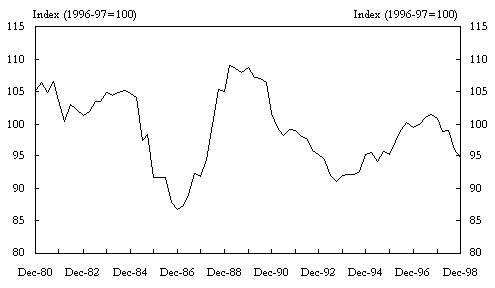
terms of trade. The terms of trade have fallen by 6.6 per cent since the
September quarter 1997. This has been a more modest fall than those which occurred in
the mid-1980s and early 1990s (Chart 6). While commodity prices on world markets
have fallen sharply, exerting a negative influence on the terms of trade, this has been
partly offset by falls in the prices of a range of other goods on world markets, including
the prices of many items that Australia imports. The relatively mild fall in the terms of
trade over this period is one factor helping to limit the impact of the international
downturn on Australia.
In United States dollar ($US) terms, import prices across the docks have declined by
nearly 10 per cent since mid-1997. For example, the prices of cars and computer
equipment across the docks have fallen in $US terms by 6 per cent and
24 per cent respectively since September 1997. These two items account for
around 20 per cent of Australia's goods imports. In contrast, during the
previous international downturn in the early 1990s, import prices in $US terms were
relatively stable.
The recent falls in world prices of Australia's imports reflect a combination of lower
global production costs, resulting from falling commodity prices, technological advances
and stronger productivity growth in a number of countries, a more competitive global
trading environment, and very low inflation and inflationary expectations in most
industrial economies. The downturn in East Asia is likely to have added considerably to
the strength of competition in world markets for manufactured items, with domestic demand
in East Asian economies very weak and Asian manufacturers benefiting from lower exchange
rates.
Chart 6: Terms of Trade
Source: ABS Cat. No. 5302.0.
The significant overall decline in the Australian dollar ($A) against major currencies
since the onset of the Asian crisis has partly cushioned Australia's commodity exporters
from the effects of the sharp fall in world commodity prices. Between the September
quarter 1997 and the March quarter 1999 commodity prices fell by
17 per cent in $US terms but fell only slightly in $A terms.[2]
While the $A and commodity prices tend to move broadly in the same direction, movements in
the $A generally only provide a partial offset to changes in world commodity prices,
particularly where changes in the overall terms of trade are relatively small.
On this occasion, the decline in the $A has probably reflected not only the decline in
commodity prices and the terms of trade, but also the difficulties faced by exporters of
ETMs and services in attempting to maintain export volumes in the face of the downturn in
East Asia. The decline in the $A has helped all parts of Australia's export sector to
adjust to the international downturn.
The fact that the overall decline in the $A over this period did not result in significant
inflationary pressures, and hence could be accommodated with both short and long-term
interest rates trending down, owes much to Australia's sound fiscal and monetary policy
framework. This issue is discussed further below.

