Document
Index
Budget Paper 1
Budget Statement 3



|
Document
Index |
|
|
Australia's economic performance in the period since the emergence of the East Asian financial crisis has benefited from a robust policy framework, reflecting both improvements in macroeconomic policy settings in recent years, and structural reforms that have been implemented progressively over a longer period of time.
Australia's economic performance in recent decades has been constrained by the tendency
for inflation and current account pressures to emerge following even relatively brief
periods of strong economic growth, and at a point where unemployment was still high.
Policy has periodically allowed, or even contributed to, the emergence of excess demand
pressures. Subsequent policy tightening to control rising inflation and current account
deficits (CADs) has then contributed to short-term economic downturns. Policy has too
often been reactive and short-term in its focus, and unclear in its objectives.
The forward-looking medium-term frameworks now in place for fiscal and monetary policy
mean that each arm of policy is anchored by a clear primary objective that it is best
suited to achieving: fiscal policy to ensuring adequate public saving; and monetary policy
to maintaining low inflation. This strategy has two key facets.
First, it is directed at keeping the economy growing at a strong but sustainable rate that
avoids excess demand pressures spilling over into inflation and the current account. This
is essential to sustain expansions for longer and avoid the 'boom-bust' syndrome that has
plagued the Australian economy, and contributed to a ratcheting up of unemployment over
the past quarter-century.
Fiscal and monetary policies are now more likely to operate in a complementary fashion to
limit, and not exacerbate, demand fluctuations. For example, the medium-term framework for
fiscal policy implies that a loosening can be used to support the economy in the event of
a downturn, but that the budget will need to be returned to surplus in the expansion phase
of the cycle. This should assist the operation of monetary policy, as it is less likely
that fiscal policy will contribute to excess demand pressures during the cyclical upswing.
A steadily growing economy that gradually approaches its capacity constraints can also
help to lower the threshold at which inflation pressures start to emerge. In a steadily
growing economy, firms are better placed to avoid short-run supply constraints because
they are able to anticipate developments and plan ahead to expand capacity through
investment and the hiring and training of new staff. This may make a modest contribution
to lowering structural unemployment, as those who are unemployed are given more
opportunity to gain skills and work experience that assist their future employability.
Second, policy is directed at raising the economy's growth capacity over time; by reducing
the rate of unemployment that can be sustained without increasing inflation, and by
raising the growth rate that is sustainable once the economy reaches that point. Over the
longer-term these are primarily the outcome of structural factors. Structural reform --
which encompasses a wide range of policy, including taxation and labour market reform,
competition policy, tariff reduction, and financial sector and corporate law
reform -- has been, and continues to be, the key to raising the economy's
productive potential. This is discussed below.
That said, macroeconomic policy can also play a role. Higher public saving should reduce
the average CAD over time and lead to a more soundly-based CAD. This should reduce the
risk that a cyclical increase in the CAD may trigger financial market concerns that limit
the scope for growth. A credible macroeconomic policy framework provides greater certainty
as to how policy will be conducted over time. Monetary policy credibility, through its
effects on inflationary expectations, may of itself help to lower the unemployment rate at
which inflationary pressures start to emerge.
Higher public saving and lower inflation can also contribute to raising potential economic
growth through positive effects on national saving and investment. Low and stable
inflation provides more certainty for long-term investment planning. High inflation tends
to mask relative price signals and distort saving and investment decisions.
Australia began the 1990s lacking a clearly articulated monetary policy framework
and, despite a decline in inflation, retained a reputation as an `inflation-prone'
economy. Critics of Australia's monetary policy approach saw the lack of a specific target
anchor for monetary policy decisions, and a perception of limited Reserve Bank
independence in setting monetary policy, as impediments to achieving sustained low
inflation.
The Reserve Bank first indicated an informal objective for inflation in 1993. In
August of 1996, a clear and transparent Statement on the Conduct of Monetary
Policy was agreed between the Treasurer and the Reserve Bank Governor. It formalised
the target of 'keeping underlying inflation between 2 and 3 per cent, on
average, over the cycle'.[3] Importantly, the Statement
formalised a clearer recognition of the independence of the Reserve Bank in conducting
monetary policy. The Statement was important in first setting policy, then explaining it,
and finally enhancing the credibility and responsibility for executing it.
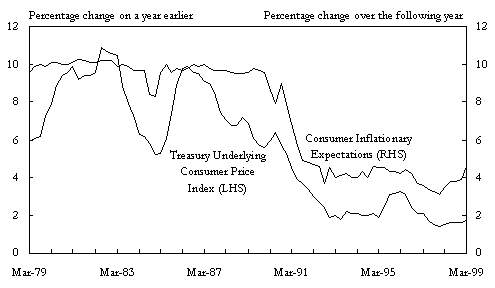
Both inflation and inflationary expectations have declined sharply over the 1990s
(Chart 7). Underlying inflation has averaged around 2 per cent
per annum in the second half of the 1990s, compared with over
8 per cent in the 1980s. This success has been supported by favourable
circumstances that have restrained global producer prices in recent years and the
heightened competitive pressures engendered by product and labour market reforms. But
clearly, the process has been anchored by wage and price-setters accepting the
authorities' commitment to the inflation target.
Chart 7: Australian Inflation and Inflationary Expectations
Source: ABS Cat. No. 6401.0 and Melbourne Institute of Applied Economic and Social Research, Survey of Consumer Inflationary Expectations.
Sustained low inflation allowed sharply lower nominal interest rates and has
contributed to lower real interest rates in recent years. In periods of high and variable
inflation, lenders tend to seek a premium to compensate them for uncertain future returns.
As the credibility of Australia's fiscal and monetary policy frameworks has been
established with financial markets, long-term interest rates have fallen, both absolutely
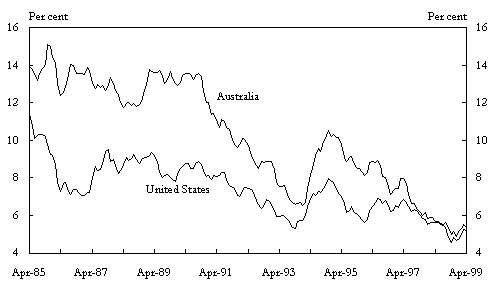
and relative to other economies (Chart 8). For example, the interest rate
differential between Australian and United States 10-year Treasury bonds has averaged
around 70 basis points over the past three years, compared with an average of
around 350 basis points over the 1980s.
Monetary policy credibility means that firms and individuals expect that the Reserve Bank
will act to maintain low and stable inflation, and are likely to factor this into their
decision-making. This change in behaviour should, of itself, reduce the extent of interest
rate increases needed over the course of the economic cycle to head off inflationary
pressures.
Low and stable inflationary expectations also reduce the likelihood that domestic
inflation will respond in a sustained way to transitory pressures. Consequently, there is
less need for monetary policy to respond to such developments. The onset of the East Asian
financial crisis in 1997 contributed to a significant depreciation of the Australian
dollar, particularly against the currencies of the major economies. In the past, falls in
the currency have flowed through into higher consumer price inflation. This time, a better
policy framework and a more competitive economy have helped minimise the flow-on of import
price rises into domestic prices and wages, as discussed in Statement 2. The recent
Australian experience, in which short-term interest rates were reduced, contrasts with
that of New Zealand and Canada, which had raised interest rates in the face of declining
exchange rates.
Chart 8: Yields on Australian and United States 10-year Treasury
Bonds(a)
In the mid-1990s, fiscal policy was at a critical juncture. In 1995-96, the fifth year
of recovery, the underlying Commonwealth budget deficit still stood at
2 per cent of GDP. This followed a long period in which fiscal policy had
generally been conducted without a clearly articulated and demonstrated medium-term
framework. Over the period from 1975-76 to 1995-96 inclusive, the Commonwealth's
underlying budget deficit had averaged 1.4 per cent of GDP. Commonwealth general
government net debt, which was non-existent in 1974-75, had increased to over
19 per cent of GDP in 1995-96.
The deterioration in the Commonwealth's fiscal position from the mid-1970s has been
associated with a structural increase in Australia's CAD. The CAD averaged around
2½ per cent of GDP over the 1960s and 1970s, but has averaged almost
4¾ per cent of GDP over the 1980s and 1990s. Against this background,
a perception that governments lacked commitment to sound fiscal policy principles
undoubtedly contributed to the interest rate differentials required to induce foreign
lenders to hold Australian debt.
The Government moved quickly after its election in 1996 to develop fiscal credibility
by adopting a medium-term objective of achieving underlying balance, on average, over the
economic cycle. Credibility was also enhanced through a legislated Charter of Budget
Honesty. The budget was returned to underlying surplus in 1997-98 and is projected to
remain in surplus over the forward estimates period.[4]
As the Commonwealth general government sector is not projected to be drawing on private
saving over the forward estimates period to fund its own activities, it is no longer
directly contributing to the national saving-investment imbalance reflected in the CAD.
This compares to an average Commonwealth saving-investment imbalance of
around 1½ per cent of GDP over the previous two decades. The general
government sector will contribute to raising national saving and lowering the structural
CAD over time, other factors equal.[5]
As discussed in Statement 1, sustained improvement in public saving can be expected
to improve national saving over time. This improvement may also encourage greater private
investment, through lower interest rates and confidence effects, but this is unlikely to
offset on an ongoing basis the effect on the CAD of higher national saving.
Notwithstanding this, increases in the CAD may occur during periods in which public saving
is improving, as a result of other factors. For instance, in the late 1980s a
cyclical boom boosted both investment (and, thereby, the CAD) and the budget surplus. In
the absence of higher public saving, the CAD would otherwise have been even larger.
An improvement in public saving is helping to limit the recent rise in the CAD in response
to the downturn in many of our East Asian export markets, and has been crucial to
retaining the confidence of the financial markets. Importantly, the increase in the CAD on
this occasion reflects private saving and investment decisions, rather than government
borrowing.
Sound macroeconomic policy settings have allowed Australian interest rates to remain low,
and this has contributed to subdued growth in the net income deficit. Australian financial
corporations have taken advantage of the low world interest rate environment and the
benefits of Australia's more open and efficient financial markets to access opportunities
in global markets to lower financing costs. Continued low world interest rates and an
increasingly open financial sector are expected to continue to support this over the
medium term.
In addition, compared to earlier periods, there has been a change in the make-up of
Australia's external assets and liabilities. Australian external liabilities denominated
in foreign currencies are now more than offset by external assets denominated in foreign
currencies. Thus the depreciation of the Australian dollar since the onset of the economic
downturn in East Asia has had a broadly neutral impact on the net income deficit. This
compares to previous periods when Australia's external liabilities denominated in foreign
currencies clearly exceeded assets and thus net payments in Australian dollar terms
escalated when the Australian dollar depreciated.
Structural reform is concerned with improving economic efficiency by making the economy
more competitive and more dynamic and by removing distortions that misallocate resources.[6] Effective competition in markets for goods and services
provides greater impetus for firms to seek productivity improvements and ensures that more
of these gains are distributed in the form of lower prices rather than higher profits.
Competition also provides a spur to innovation. By increasing the supply potential of the
economy, structural reform allows the economy to grow further before inflationary
pressures arise. Ultimately, this allows stronger sustainable growth in incomes and
employment.
Structural reform (including labour market reform) is likely to have contributed to the
economy's recent resilience in a number of ways.
Productivity is difficult to measure and is affected by a range of factors not directly
attributable to structural reforms. For instance, advances in information and other
technologies may be contributing to an upturn in productivity growth globally. However,
the extent of structural reforms that have been instituted over the past decade or so, and
the productivity gains that have occurred in sectors that have been a specific focus of
reform -- particularly sectors that were formerly dominated by publicly-owned
monopolies -- suggest that such reforms have been a significant factor.
Earlier reforms substantially reduced barriers to external trade, and more recent reforms
are increasing competitive disciplines in the non-tradables sector. An important element
of structural reform in recent years has been the National Competition Policy, which was
agreed to by all Australian Governments in April 1995. This includes a nationally
applied competition law and requirements to ensure that government businesses and
privatised public monopolies do not enjoy an unfair advantage over competitors.
Governments are also required to review anti-competitive legislation, which must be
reformed unless there are net benefits that can only be achieved by restricting
competition.
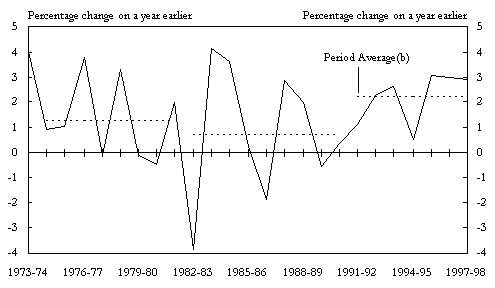
Chart 9: Multifactor Productivity Growth in the Market Sector(a)
A key objective has been to increase competition in sectors where it has been limited
by regulatory barriers, particularly in the communications, energy and transportation
sectors. A fully open market for telecommunications was introduced in 1997, a
National Electricity Market allowing electricity to be freely traded between the eastern
mainland States has recently commenced, and regimes are being developed to allow private
operators access to natural gas pipelines and rail infrastructure.
The full benefits from more recent reforms, including labour market reforms, are yet to be
seen, and this is likely to provide a continued boost to productivity growth over the next
few years. The potential for further productivity gains in sectors like telecommunications
and electricity is likely to be significant. Moreover, the dynamic effects of reform, in
terms of providing a continuing impetus to innovation and productivity improvement, should
have an ongoing positive effect on productivity growth.
Reforms to workplace relations arrangements and labour market regulation and assistance
have sought to increase the responsiveness of the labour market to changes in the economy,
and reduce impediments to job creation, participation in employment and improving
productivity.
Significant reforms to workplace relations have been implemented, including encouragement
for direct enterprise bargaining, freedom of association and tighter limits on industrial
action. The introduction of the Workplace Relations Act 1996 has accelerated
the move from centralised wage fixing to enterprise bargaining -- ensuring that
wages and workplace practices are consistent with the circumstances faced by individual
firms -- while providing a genuine safety net for low paid workers.
Policies have been implemented to assist and encourage job search by unemployed people,
including the new Job Network, changes to activity tests, and tighter eligibility
conditions for a range of benefits. Other initiatives are directed at improving workforce
skills and abilities in order to improve the employment prospects of unemployed people and
to enhance long-run productivity growth.
Labour market reform has contributed to the upturn in productivity growth discussed above.
Importantly, the recent period of strong economic growth has not been associated with the
emergence of unsustainable wage pressures that have contributed to increasing inflation in
past periods when the economy has grown strongly at an advanced stage of the expansion.
This is likely to be attributable in no small part to workplace relations reforms.
The crisis in East Asia emphasises the importance of sound corporate governance and
prudential supervision, and these issues are at the forefront of international efforts to
reduce the risk of similar crises occurring in the future. The soundness of Australia's
arrangements is a key ingredient in its ability to maintain a high level of business and
investor confidence.
The stability, integrity and efficiency of the financial sector are critical to the
performance of the economy and its ability to adapt to changing circumstances.
Deregulation in the 1980s substantially increased competition and innovation in the
financial sector, resulting in improved access to capital markets, a greater range of
financial products and better allocation of savings to investment. It also highlighted
weaknesses in the operations of markets and the need for comprehensive prudential
regulation. The major package of reforms implemented following the Wallis Inquiry build on
these foundations by reducing artificial barriers to competition between different types
of financial service provider.
The recent reforms also establish a more flexible regulatory system, with a functional
rather than institutional focus, that is better able to respond to a rapidly changing
environment without stifling innovation and competition. This will meet the need for
regulation to ensure stability and integrity, without endangering efficiency.
In addition, the Corporate Law Economic Reform Program is modernising and giving an
economic focus to regulatory requirements regarding fundraising, takeovers, corporate
governance, financial reporting and conduct and disclosure practices in financial markets.
Again, the focus is on providing the regulation necessary for well-functioning markets,
without compromising efficiency.