Document
Index
Budget Paper 1
Budget Statement 3



|
Document
Index |
|
|
Sound macroeconomic policy and sustained structural reform represent major steps toward
addressing inflation and current account problems. The full benefits of more recent
reforms have not yet been seen, which raises the question of how fast the economy can grow
sustainably over the medium term.
As noted in Statement 1, for the purposes of Budget figuring, real GDP growth
of 3½ per cent is assumed in the forward estimate years from 2000-01 to
2002-03. This is not a forecast, nor is it an estimate of 'potential' growth. Rather, it
is a projection based on historical averages and broad underlying trends.
The prospect of continuing strong productivity and employment growth, flowing from the
reform processes discussed above, suggests that real GDP has the potential to grow at a
rate above 3½ per cent on average over the medium term, provided the
macroeconomic policy framework is sustained.
As noted above, market sector multifactor productivity growth in the 1990s expansion
has so far averaged around 2¼ per cent per annum, well above the average
of the 1980s growth cycle of around ¾ per cent per annum. Similarly,
growth in average labour productivity (GDP per employee) has thus far averaged above
2¼ per cent per annum in the 1990s expansion, up from
around 1¼ per cent per annum in the 1980s growth cycle. Average
labour productivity growth was very rapid at around 3¼ per cent in 1997-98, but
is estimated to moderate to around 2 per cent in 1998-99. The forecasts for
1999-2000 incorporate a cyclical slowing in average labour productivity growth to around
1¼ per cent. On these estimates, the growth rate of average labour productivity
between 1997-98 and 1999-2000 would be around 2 per cent per annum, close
to the average for the 1990s as a whole, despite the recent international downturn.
The strong productivity performance during this recent period has helped the economy to
withstand the international downturn by supporting growth in real household incomes and
profits and by contributing to low inflation.
Looking ahead to the early years of the next decade, there are several factors likely to
influence the productivity outlook. A significant factor behind the rapid growth in
productivity in the 1990s has been the ongoing programme of microeconomic reforms,
including reforms to the labour market. It seems likely that some of the benefits of more
recent reforms, such as the Workplace Relations Act 1996 and the application
of the mutual obligation principle, have yet to be felt and will influence outcomes during
the early years of the next decade, although these effects are difficult to quantify.
Outcomes will also be influenced, of course, by future microeconomic reforms, further
reforms in the labour market, and the new taxation system.
It is also likely that part of the strong labour productivity growth in the 1990s
expansion reflects significant growth in the capital/labour ratio through the 1990s,
compared with a relatively constant ratio over the 1980s cycle. However, as outlined
in Statement 2, business investment growth is expected to moderate in 1998-99 and
1999-2000 after six years of very strong growth. If business investment were to be
around its long-term average share of GDP in the early years of the next decade (see
Chart 5 in Statement 2), then the capital/labour ratio would be likely to grow
at around its long-term trend. This, in turn, would point to some slight moderation in
average labour productivity growth, other factors unchanged.
On balance, given the microeconomic reforms already in place and current levels of
investment, average labour productivity growth of between 1½ and
2 per cent would seem to be sustainable over the early years of the next decade.
The other key element in sustaining a relatively high rate of economic growth over the
medium term is strong employment growth. The potential, or sustainable, rate of employment
growth depends upon labour force growth and also the structural rate of unemployment.
Neither of these factors is constraining present employment growth, but both could come
into play in the period ahead.
The current unemployment rate is above most estimates of the structural rate of
unemployment. For example, the OECD noted that most estimates of the structural rate of
unemployment in Australia are in the 6½ to 7½ per cent range for the
mid-1990s.[7] However, such estimates generally do not
include an allowance for the likely beneficial effects on structural unemployment of
recent reforms to product and labour markets. As noted above, these benefits are likely to
be still accruing. Nor do such estimates make any allowance for future reforms in the
labour market. More fundamentally, they do not acknowledge that structural unemployment
may have a dynamic element, such that the rate will fall as actual unemployment falls.
This appears to have been part of the recent United States experience.
In short, there is scope for the unemployment rate to fall significantly below its present
level of around 7½ per cent (and hence for employment growth to outstrip labour
force growth) over the medium term without igniting inflationary pressures. The extent of
these further falls in unemployment depend, in part, on the extent of further labour
market reform, taxation reform, social security reform, and microeconomic reform more
generally.
That said, a factor influencing likely employment growth over the medium term is lower
projected labour force growth than in recent decades, due to demographic effects (see
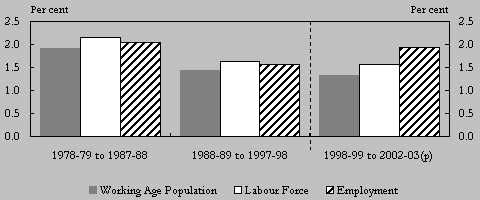
Box 1). Labour force growth could be around 1½ per cent per annum in
the medium term, lower than the average growth of recent decades. This reflects expected
lower growth in the working age population and only a relatively small net increase in the
participation rate in the medium term.
| BOX 1: DEMOGRAPHIC INFLUENCES ON MEDIUM-TERM LABOUR FORCE
GROWTH Labour force growth is expected to be lower over the medium term than the average of recent decades, as a result of lower projected growth in the working age population and relatively moderate growth in the total participation rate. While average working age population growth over recent decades was around 1¾ per cent per annum, it is expected to fall to around 1¼ per cent per annum in the medium term. The total participation rate has risen steadily in recent decades, but only a modest increase from its average level in 1998-99 is likely in the medium term. As participation rates vary markedly between different age groups, changes in the age-structure of the working age population can influence the total participation rate. The ageing of the population (in isolation) has placed downward pressure on the total participation rate in recent decades. This is expected to continue to be the case, possibly at an increased rate, over the medium term. This issue was discussed in more detail in the Summer 1999 Economic Roundup. Against this trend, increased employment opportunities over the medium term are expected to encourage some discouraged workers to re-join the labour force, resulting in continued increases in female participation rates (within age groups) and a flattening of the decline in male participation rates (within age groups). On balance, it is expected that, with slower working age population growth and a small net increase in the participation rate (relative to recent levels), labour force growth could be around 1½ per cent per annum in the early years of the next decade (Chart 10). This would be somewhat lower than the average labour force growth over the 1980s and marginally lower than in the 1990s to date. It would also mean, of course, that the rate of employment growth needed to reduce unemployment would be lower than has been the conventional wisdom over recent decades. Chart 10:
Employment, Labour Force and Working Age Source: ABS Cat. No. 6202.0 and Treasury forecasts and projections. |
On balance, given the demographic influences on medium-term labour force growth, employment growth of around 2 per cent per annum would seem to be achievable on average in the early years of the next decade, associated with further falls in the unemployment rate. Together with average labour productivity growth of 1½ to 2 per cent per annum, this implies that the Australian economy has the potential to sustain growth of 3½ to 4 per cent over that period.
Achieving sustained growth in output and employment in line with the economy's growth potential will require ongoing attention to the macroeconomic policy framework and continued microeconomic reform, including taxation reform and examination of the remaining rigidities that inhibit improved labour market outcomes.
It is important that macroeconomic policy maintain a consistent forward-looking focus
on medium-term objectives. Policy credibility is won by discipline over many years, but
the gains can be put at risk by relatively short periods of neglect. Policy should aim to
maximise growth, subject to maintaining the medium-term inflation and fiscal balance
objectives. This entails keeping the economy operating within sustainable bounds, so that
excess demand pressures that might spill over into inflation and the current account do
not emerge.
Fiscal policy will continue to focus on medium-term public saving objectives. The
medium-term fiscal strategy is essential if the private sector is to continue to be able
to tap into foreign saving to fund a substantial part of its investment without having to
pay significant risk premia.
The fiscal strategy will ensure that the CAD over time is essentially the outcome of
decisions by private sector borrowers and lenders, and not of government borrowing (one
role of structural policies is to ensure that these private sector decisions are soundly
based). The general government sector presently holds only 15 per cent of
Australia's net external debt. Private sector saving and investment decisions are now
better based than they have been in past cycles, as a result of microeconomic reform and
low inflation. In this environment the nation's ability to service external debt should
not be at issue.
The fiscal strategy must continue to take account of the economic cycle. Adequate
surpluses will be required while the economy is expanding to allow room for policy to
respond in the event of a downturn, at least to the extent of allowing automatic
reductions in the surplus, from lower tax receipts and higher unemployment assistance
payments, to support demand.
Monetary policy must continue to focus on the objective of achieving 2
to 3 per cent inflation on average over the medium term. Inflation has been
persistently below the bottom of the band over the past two years, and the outlook is for
continued low inflation in the period ahead.
The existing taxation system is a significant impediment to improving Australia's
economic potential.
The tax reform package currently before Parliament includes changes to personal income tax
rates and family and social security payments that will significantly lower effective
marginal income tax rates, and improve incentives to work and save. Introduction of a
broad-based Goods and Services Tax (GST), to replace the present Wholesale Sales Tax (WST)
and a range of inefficient State taxes, will result in an indirect tax system that has
lower costs, is less distorting to consumer decisions, and avoids taxing business inputs.
The new tax system will lift the tax burden imposed by the WST on Australian exports, and
reduce business costs, including costs of investment goods.
Similarly, the current Review of Business Taxation is directed at achieving a business tax system that minimises distortions to business decisions and reduces compliance costs, as well as providing a competitive regime for attracting international capital.
These reforms will contribute to raising the economy's growth potential through more
efficient resource allocation, as decisions throughout the economy better reflect
underlying costs and benefits, and better incentives.
Taxation reform will also contribute to maintaining sound public finances. The
narrowly-based WST is levied on a portion of economic activity that is declining over time
as the relative importance of services in the economy increases. Revenue from the GST,
which is to be allocated to the States, will grow in line with the economy. This will
provide a revenue base that is capable of meeting spending needs over the medium to long
term, without requiring periodic increases in taxation rates.
Reducing unemployment in a sustained way will require a continuing focus on integrating
sound macroeconomic policies and workplace relations reform with policies to ensure that
the welfare system, and its interaction with the tax system, does not discourage people
from seeking jobs.
Further reforms to the industrial relations system are being pursued to build upon those
already implemented. Amendments to the current unfair dismissal laws and the preservation
and extension of age-based junior wage rates are policies designed to overcome
restrictions on employment growth. Other policies being pursued to enhance productivity
and streamline enterprise bargaining include further award simplification, reducing the
role of third parties in the agreement-making process and ensuring that union membership
is voluntary.
Securing better labour market outcomes, particularly ongoing reductions in structural
unemployment, will require an ongoing focus on the link between productivity and wages.
One facet of this is ensuring that the award system fulfils its role of providing a
genuine safety net.
The Government's tax reform package will significantly reduce disincentives to work, which
particularly affect low and middle-income earners. The principle of mutual obligation for
unemployment beneficiary recipients is also important in ensuring that the welfare system
does not discourage job seeking. The Budget extends the scope of mutual obligation
arrangements and broadens the Work for the Dole scheme.
Attention to the education and training system is also important to ensure that the skills
of the workforce are appropriate for the future demands of the economy. The Budget
provides additional funding for education and training, including continued funding for
programmes to enhance the skills and experience of young people seeking work.
It is important that the various elements of the labour market strategy are not considered
in isolation. Recent international research demonstrates that labour market policies are
complementary, and that broad, integrated reforms are more effective in achieving lower
unemployment and sustainable improvements in productivity growth.