
Document
Index
Budget Paper 3



|
Document
Index |
|
|
This chapter provides an overview of:
On 13 August 1998, the Commonwealth Government announced its plan to reform
the Australian taxation system. A key element of the A New Tax System package is
the reform of Commonwealth-State financial relations. The principal objectives of these
reforms are to:
Implementation of the reforms requires the active involvement and support of both the
Commonwealth Government and the State Governments. At a Special Premiers' Conference
convened on 13 November 1998, Heads of Governments developed an Agreement on
Principles for the Reform of Commonwealth-State Financial Relations, which established
a set of guiding principles for progressing the reforms.
At the 9 April 1999 Premiers' Conference, Heads of Governments signed an Intergovernmental
Agreement on the Reform of Commonwealth-State Financial Relations (a copy of the
Intergovernmental Agreement is at Appendix B) which gives effect to the following reform
measures:
The States' receipt of the GST revenues is also subject to their meeting other
obligations.
As the GST revenues will not be sufficient initially to fund the States' current
expenditure and the new responsibilities they are assuming, the Commonwealth has
guaranteed that in each of the transitional years following the introduction of the GST,
each State's budgetary position will be no worse off under the new arrangements.
The Intergovernmental Agreement also provides for the establishment of a Ministerial
Council from 1 July 1999, comprising Commonwealth and State Treasurers, to
oversight the implementation and operation of the Intergovernmental Agreement and to
ensure compliance with its terms. The Ministerial Council will also provide a forum for
the discussion of the per capita relativities to apply to the distribution of the GST
revenues among the States and obviate the need for the annual Premiers' Conference
process.
The reforms to Commonwealth-State financial arrangements require the passage of
legislation by the Commonwealth and the States. The Intergovernmental Agreement will be
attached as a schedule to relevant Commonwealth and State legislation.
On 31 March 1999 the Commonwealth House of Representatives passed two Bills to
give effect to the Commonwealth's commitments: A New Tax System (Commonwealth-State
Financial Arrangements) Bill 1999; and A New Tax System
(Commonwealth-State Financial Arrangements -- Consequential Provisions) Bill 1999.
The A New Tax System (Commonwealth-State Financial Arrangements) Bill 1999 (the
Bill) fulfils the Government's commitment to appropriate all the GST revenues to the
States and includes provisions to ensure that the GST revenues are distributed across the
States on the basis of HFE principles after the second year following the introduction of
the GST.
The Bill also makes provision for the Commonwealth to provide State Governments with
transitional assistance to offset any revenue shortfalls in the initial years following
the introduction of the reforms. This transitional assistance will ensure that no State
budget will be worse off as a result of the reforms to Commonwealth-State
financial arrangements and will take the form of one-year interest-free loans to the
States in 2000-01 and grants to the States in subsequent years.
The Bill also establishes arrangements which `lock-in' the GST rate and base. Consistent
with the Intergovernmental Agreement, the Bill provides that the GST rate and, in most
cases, the GST base cannot be altered without the unanimous support of all State
Governments. However, in order to facilitate the administration of the GST in the initial
months of operation, the Commonwealth will reserve the right to make unilateral changes to
the GST base in the first 12 months of operation. These changes will have to be of an
administrative nature, necessary to facilitate minor adjustments to the GST and made
having regard to the need to protect the revenue of the States. From July 2001,
changes to the GST base of an administrative nature will require the majority support of
the Commonwealth and States.
Finally, the Bill maintains the States' entitlement to National Competition Payments and
the protection provided by the business franchise fees windfall tax from
1 July 2000 following the repeal of the existing States Grants (General
Purposes) Act 1994.
The States have agreed to enact legislation to fulfil their commitments including the
abolition of certain indirect taxes, the provision of funding to local government and the
introduction of a First Home Owners Scheme.
The Intergovernmental Agreement on the Reform of Commonwealth-State Financial Relations
will commence on 1 July 1999, with most reform measures taking effect from
1 July 2000.
At the 1999 Premiers' Conference, it was agreed that the level of Financial Assistance
Grants (FAGs) to the States will be maintained in real per capita terms in 1999-2000.
On the basis of current estimates, Commonwealth general revenue assistance to the
States is expected to be $17,719.6 million in 1999-2000, an increase of $706.2
million or 4.2 per cent on the previous year, as shown in Table 2.
Other key elements of the 1999 Premiers' Conference agreement on financial arrangements in
1999-2000 are as follows:
Estimates of general revenue assistance to be provided to the States in 1998-99 and
1999-2000 are shown in Table 2.
Further details of the Commonwealth's financial assistance to the States are contained in
Chapter III.
Table 2: General Revenue Assistance to the States, 1998-99 and 1999-2000 (estimated)
| Financial Assistance Grants
(a) |
Special Revenue Assistance
(b) |
National Competition Payments
(c) |
General Revenue Assistance | State Fiscal Contributions
(d) |
General Revenue Assistance Net of State Fiscal Contributions |
|||||
| $m | Change |
$m | Change |
|||||||
| $m | Per cent | $m | Per cent | |||||||
| 1998-99 | ||||||||||
| NSW | 4727.8 | 0.0 | 73.0 | 4800.8 | -7.3 | -0.2 | 101.5 | 4699.3 | 107.9 | 2.4 |
| VIC | 3528.8 | 0.0 | 53.6 | 3582.5 | -51.7 | -1.4 | 74.5 | 3507.9 | 32.7 | 0.9 |
| QLD | 3194.7 | 0.0 | 39.9 | 3234.5 | 96.0 | 3.1 | 55.4 | 3179.1 | 158.4 | 5.2 |
| WA | 1614.3 | 0.0 | 21.1 | 1635.5 | 46.7 | 2.9 | 29.4 | 1606.1 | 79.5 | 5.2 |
| SA | 1668.1 | 0.0 | 17.1 | 1685.2 | 117.2 | 7.5 | 23.7 | 1661.4 | 144.4 | 9.5 |
| TAS | 736.7 | 0.0 | 5.4 | 742.1 | 56.2 | 8.2 | 15.6 | 726.5 | 48.7 | 7.2 |
| ACT | 278.6 | 25.0 | 3.5 | 307.2 | 32.2 | 11.7 | 10.2 | 296.9 | 27.3 | 10.1 |
| NT | 1023.5 | 0.0 | 2.2 | 1025.7 | 53.3 | 5.5 | 3.0 | 1022.7 | 56.8 | 5.9 |
| Total | 16772.5 | 25.0 | 215.8 | 17013.3 | 342.7 | 2.1 | 313.4 | 16699.9 | 655.8 | 4.1 |
| 1999-2000 | ||||||||||
| NSW | 5031.1 | 0.0 | 148.4 | 5179.5 | 378.7 | 7.9 | 0.0 | 5179.5 | 480.2 | 10.2 |
| VIC | 3527.5 | 0.0 | 109.1 | 3636.5 | 54.1 | 1.5 | 0.0 | 3636.5 | 128.6 | 3.7 |
| QLD | 3237.4 | 0.0 | 81.4 | 3318.9 | 84.3 | 2.6 | 0.0 | 3318.9 | 139.7 | 4.4 |
| WA | 1594.1 | 0.0 | 43.3 | 1637.4 | 1.9 | 0.1 | 0.0 | 1637.4 | 31.3 | 1.9 |
| SA | 1681.4 | 0.0 | 34.5 | 1715.9 | 30.8 | 1.8 | 0.0 | 1715.9 | 54.5 | 3.3 |
| TAS | 782.6 | 0.0 | 10.8 | 793.5 | 51.4 | 6.9 | 0.0 | 793.5 | 67.0 | 9.2 |
| ACT | 341.8 | 13.2 | 7.2 | 362.1 | 55.0 | 17.9 | 0.0 | 362.1 | 65.2 | 22.0 |
| NT | 1071.3 | 0.0 | 4.5 | 1075.8 | 50.1 | 4.9 | 0.0 | 1075.8 | 53.2 | 5.2 |
| Total | 17267.2 | 13.2 | 439.1 | 17719.6 | 706.2 | 4.2 | 0.0 | 17719.6 | 1019.7 | 6.1 |
At its meeting on 9 April 1999, Loan Council endorsed the Loan Council Allocations
(LCAs) nominated by the Commonwealth and each State for 1999-2000.
Loan Council noted its decision (originally reached by correspondence) to discontinue the National
Fiscal Outlook (NFO) report. When the NFO was first published in 1993, it provided
fiscal forecasts for all States and for the total public sector. Since this information
was prepared on a consistent basis, the NFO promoted greater transparency in the fiscal
positions of all governments. However, in recent years there has been a significant
improvement in the standard and consistency of budget reporting. In particular, the
revised Uniform Presentation Framework, agreed by Loan Council in 1997, ensures
standardised budget reporting across States, including the release of mid-year budget
reports. These reports, which were first published in 1998-99, contain most of the
information previously included in the NFO. Statement 9 of Budget Paper No. 1 draws
on some of this data (updated with the Commonwealth Budget and available State budgets) to
present an overview of the national general government sector fiscal position. In these
circumstances, Loan Council agreed that the NFO was no longer required.
Loan Council issues -- including the Commonwealth's 1999-2000 budget time LCA
and the estimated 1998-99 LCA outcome -- are discussed further in Chapter IV.
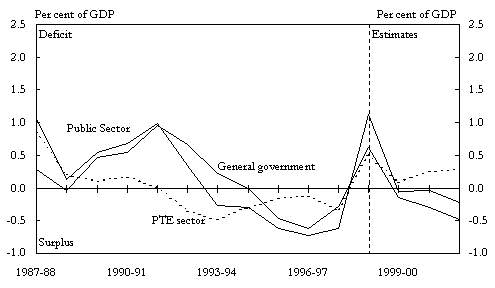
The underlying budget position, on a cash basis, of the State
non-financial public sector -- which comprises the general government and public
trading enterprise sectors of all States -- is shown in Chart 1[1]. In 1998-99, an underlying deficit of $6.7 billion is expected,
representing 1.1 per cent of GDP. This follows a surplus of $3.6 billion, or
0.6 per cent of GDP, in 1997-98.
However, the inclusion of certain `one-off' transactions in the 1998-99 deficit means that
this estimate is not directly comparable to the 1997-98 result. These transactions related
to the funding of superannuation liabilities in New South Wales and Victoria. This has
inflated total underlying outlays, making the underlying deficit larger than it would have
been in the absence of such transactions. Adjusting for the effects of these
superannuation payments yields a 1998-99 underlying surplus of around
0.4 per cent of GDP.
Abstracting from superannuation funding, the change in the State non-financial public
sector underlying balance has been precipitated by developments in the PTE sector. There
has been little change in the (adjusted) fiscal position of the aggregate State general
government sector. PTE sector underlying outlays have, however, increased substantially
while revenues have fallen. The PTE sector has accordingly shifted from a surplus of
0.3 per cent of GDP in 1997-98 to a deficit of 0.5 per cent in
1998-99, the first underlying deficit result since 1991-92.
The latest forecasts for the State non-financial public sector suggest a movement back to
a modest surplus position (cash basis) in 1999-2000. Subsequent years' projections show
the PTE sector remaining in an underlying deficit position. In contrast, the position of
the general government sector is expected to improve steadily over the medium term,
helping the non-financial sector to a further modest surplus in 2000-01 and larger
surpluses in the following two years.
Chart 1: State Underlying Deficit by Sector(a)
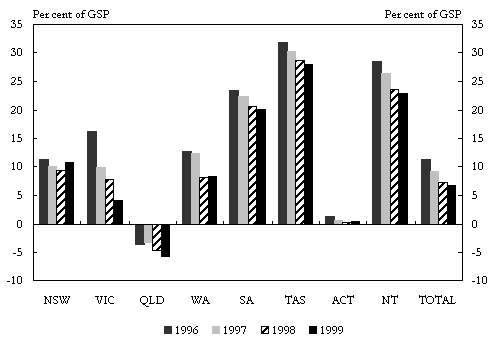
The ratio of aggregate State net debt to GDP has fallen steadily since 1992-93, with an
overall improvement in State underlying budget positions, and the application of these
funds -- plus the proceeds from equity and asset sales -- to debt
retirement. This trend is expected to continue. Chart 2 shows recent trends in the net
debt to Gross State Product (GSP) ratio of each State alongside the aggregate State net
debt to GDP ratio.
Chart 2: State Public Sector Net Debt
as at 30 June(a)
Fiscal developments and strategies in individual States are outlined below.
New South Wales' 1998-99 Half-Yearly Budget Review shows that a modest
general government underlying budget surplus (cash basis) is expected for 1998-99, after
allowing for the impact of the Government's superannuation conversion offer. This
represents a small improvement on the 1997-98 underlying deficit outcome.
New South Wales is expected to maintain a relatively sound fiscal position over the next
few years, with the underlying surplus growing steadily. It is anticipated that capital
outlays will peak in 1998-99, but current outlays restraint will also be required to
compensate for an expected easing in growth in own-source revenue during this period.
The State's non-financial public sector is expected to record an underlying deficit (cash
basis) in 1998-99, due to the PTE sector balance moving from surplus into deficit. The
non-financial public sector net debt to GSP ratio is expected to decline in the medium
term, reflecting a return to underlying surpluses, but is likely to remain above the
States' average in 1998-99 and 1999-2000.
New South Wales' General Government Debt Elimination Act 1995 includes a short-term
fiscal target that the general government sector be operating in a position of sustainable
underlying surplus by 1998-99. The State's long-term target is to eliminate general
government net debt by 2020, while fully funding accruing superannuation liabilities and
maintaining general government net worth.
Victoria's 1999-2000 Budget shows that the general government sector is set to
record an underlying deficit (cash basis) of 0.2 per cent of GSP in 1998-99, the
first deficit since 1994-95. However, this result is influenced by the application of
$2.5 billion in privatisation proceeds towards unfunded superannuation liabilities.
The underlying balance is projected to return to a surplus of 0.4 per cent of
GSP in 1999-2000 and to remain in surplus over the medium term.
Victoria's total non-financial public sector underlying surplus is expected to record a
large underlying deficit in 1998-99, largely as a result of the superannuation funding
transaction described above. A small underlying surplus is forecast for 1999-2000.
Victoria's energy privatisation programme, now nearing completion, has generated close to
$30 billion in proceeds for the State Government, most of which has been used to retire
State debt. Non-financial public sector net debt is estimated to fall to 4.0 per cent of
GSP by the end of 1999-2000, compared with 30.7 per cent of GSP at the end of 1991-92.
The Victorian Government has a number of long-term fiscal objectives including maintaining
public sector debt at a level consistent with a AAA credit rating, maintaining a
sustainable accrual based operating surplus, and bringing tax rates into line with
national averages.
Queensland continues to have the strongest financial position of all the States,
and remains the only jurisdiction in a positive net asset position (that is, where
financial assets exceed financial liabilities).
Queensland's 1998-99 Mid-Year Fiscal and Economic Review shows that the general
government sector is expected to record an underlying budget surplus (cash basis) of
0.8 per cent of GSP, lower than the surplus recorded in 1997-98 but higher than
forecast at budget time. The forecasts published in Queensland's mid-year review project
ongoing underlying surpluses over the forecast period to 2001-02.
The total non-financial public sector underlying surplus is expected to decline in 1998-99
and 1999-2000 to reach its lowest point since 1986-87. Declining general government
underlying surpluses drive this result.
Queensland has adopted a fiscal strategy of maintaining a public sector underlying surplus
and achieving full actuarial funding of all accruing employee entitlements, while
preserving Queensland's low tax status.
Western Australia's 1998-99 Mid-Year Review indicates a general government
underlying budget deficit (cash basis) of 0.7 per cent of GSP in 1998-99,
compared with 0.3 per cent of GSP in 1997-98. A further small deterioration is
expected in 1999-2000, prior to an improvement in later years.
Small expected deficits in Western Australia's PTE underlying balance imply that movements
in the non-financial public sector underlying deficit will broadly mirror those in the
general government sector.
Western Australia's combined PTE and general government net debt is currently marginally
above the States' average and is expected to remain stable for the medium term.
Western Australia's fiscal strategy is to achieve a whole of government accrual-based
operating surplus over the forward estimates period, while achieving Consolidated Fund and
general government underlying cash surpluses. The Government is aiming to maintain or
increase net assets and to reduce net interest costs as a proportion of gross own-source
revenue.
South Australia's Mid-Year Budget Review 1998-99 projections indicate that
the general government sector will remain in an underlying deficit position (cash
basis) for the foreseeable future. However, the deficit is projected to decline from
0.9 per cent of GSP in 1998-99 to 0.4 per cent in 1999-2000, largely
as a result of outlays restraint.
The total non-financial public sector in South Australia is expected to be in underlying
deficit in 1998-99 and beyond. This result is driven primarily by the fiscal position of
the general government sector.
South Australia's net debt position, which as a proportion of GSP currently ranks third
highest of the States, is expected to show modest improvement in the near future, as the
general government sector reduces the size of its underlying cash deficit.
The Government's fiscal objectives are to maintain the government sector in underlying
balance over the medium term, reduce government debt with the aim of achieving a AAA
credit rating and eliminate the State's unfunded superannuation liability over thirty
years.
The recent consolidation in Tasmania's government finances is continuing
notwithstanding budgetary pressures associated with slow economic growth. In 1997-98,
outlays restraint and increased public authority income occasioned Tasmania's first
general government underlying budget surplus (cash basis) in 22 years. Tasmania's Mid-Year
Report predicts increasing underlying surpluses in 1998-99 and beyond.
Reflecting continued, although declining, PTE sector underlying surpluses, the
non-financial public sector in 1998-99 is set to record an underlying surplus for the
fifth successive year.
Tasmania's non-financial public sector net debt to GSP ratio should fall over the medium
term but will remain substantially higher than the States' average.
Tasmania's fiscal objectives are to maintain a budget sector underlying surplus and to
reduce general government and total State government net debt, while not introducing new
taxes or raising existing tax rates.
The Australian Capital Territory's 1999-2000 Budget indicates the general
government sector moving from an underlying deficit (cash basis) of 0.6 per cent of GSP in
1998-99 to an underlying surplus of 0.4 per cent of GSP in 1999-2000. This improvement
reflects a combination of declining capital outlays and rising revenue (particularly
grants from the Commonwealth), which is expected to outweigh higher current outlays. The
Budget projects continued improvement in the underlying balance, based on outlays
restraint and further growth in revenues.
The Australian Capital Territory's fiscal objectives include achieving a zero
accruals-based operating loss by the 2004-05 budget and fully funding superannuation
liabilities by the 2001-02 budget.
The Northern Territory's general government underlying balance (cash basis) has
deteriorated over 1998-99, due to difficulties on both revenue and outlays. The
Territory's 1999-2000 Budget estimates suggest an underlying deficit of around
0.8 per cent of GSP in 1998-99, following four successive years of underlying
surpluses. An increase in the deficit to 1 per cent of GSP is forecast for
1999-2000, as growth in outlays outpaces an expected rise in revenues.
As a result of developments in the general government sector, and notwithstanding ongoing
surpluses in the PTE sector, the Northern Territory's total non-financial public sector is
also expected to record underlying deficits in 1998-99 and 1999-2000. However,
non-financial public sector net debt is expected to decline slightly as a proportion of
GSP by the end of 1998-99 to around 23 per cent.
The Northern Territory's fiscal strategy embodies a range of fiscal targets including not
increasing per capita current expenditure in real terms, maintaining an own-source revenue
effort broadly comparable to that of the States and reducing Territory debt as a
proportion of economic output.