Appendix B: Sensitivity
of Fiscal Aggregates
to Economic Developments
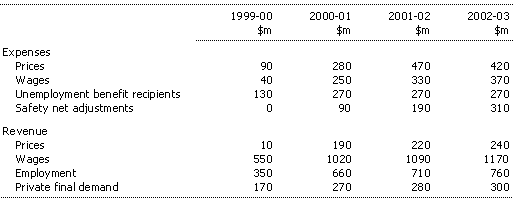
Table B1 provides a guide to the sensitivity of the forward estimates of expenses and revenues to variations in economic parameters in 1999-2000. It is important to recognise that such guides provide only a ‘rule of thumb’ indication of the impact on the budget of changes in economic and other parameters.
Table B1: Sensitivity of Financial Aggregates to Changes
in Economic Parameters
Expenses
On the expenses side, the sensitivity analysis of the estimates provides for the following assumptions about changes to four broad groups of parameters:
- prices — all price deflators are assumed to increase by one percentage point at the start of the March quarter 2000, with wage deflators left unchanged;
- wages — all wage and salary rates are assumed to increase by one percentage point from the beginning of the March quarter 2000, with price deflators left unchanged;
- unemployment benefit recipients (includes Newstart Allowance and unemployed Youth Allowance recipients) — the total number of recipients is assumed to increase by 5 per cent from the beginning of the March quarter 2000; and
- safety net adjustment — the safety net adjustment (SNA) determined by the Australian Industrial Relations Commission (AIRC) is assumed to increase by $2 per week at the start of the March quarter 2000.
Projected expenses respond to changes in economic parameters through a variety of mechanisms. For example, the Government’s decision to maintain pensions at 25 per cent of Male Total Average Weekly Earnings (MTAWE) means that projected spending on pensions will depend not just on changes to the CPI, by which pensions have been indexed for some time, but also on expected changes in the level of MTAWE.
In addition, about $30 billion of expenses, comprising agency departmental expenses, other Commonwealth Own Purpose expenses of a departmental expense nature and Specific Purpose Payments to the States of a departmental expense nature, are indexed to a weighted average of movements in inflation and the SNA.
The number of unemployment benefit recipients, and therefore the total spending on benefits, are affected by economic growth and employment growth. However, the relationship between GDP growth and unemployment benefit recipients is highly variable and difficult to quantify. For this reason, Table B1 only includes the impact of changes in the number of unemployment benefit recipients (that is, Newstart Allowance and unemployed Youth Allowance recipients) on the estimates.
The assumptions underlying the sensitivity of the revenue estimates to changes in prices and wages are identical to those used for expenses. In each case, the analysis presents the estimated effects of change in one economic variable only, and does not attempt to capture the linkages between economic variables that characterise changes in the economy more broadly.
The revenue effects of changes in employment and private final demand
show the effect of the following assumptions:- employment — if the level of employment is assumed to increase by one per cent from the beginning of the March quarter 2000, with no change in the composition of demand; and
- private final demand (consumption plus investment) — if the level of private final demand is assumed to increase by one per cent from the beginning of the March quarter 2000, with no change in the composition of demand.
Changes in prices affect revenue through changes in excise revenue.
Changes in wages and employment feed through quickly into tax revenue largely through increases in PAYE tax collections. The personal income tax cuts, which come into effect from 2000-01, cause some reduction in the sensitivity of revenue to changes in wages and employment.
Changes in private final demand affect revenue predominantly through changes in sales tax and excise collections. The abolition of Wholesale Sales Tax from 2000-01 means that changes in private final demand have a much lower impact on the revenue from that year.