Appendix C: Australian Accounting Standard Financial Reporting by Government Statements
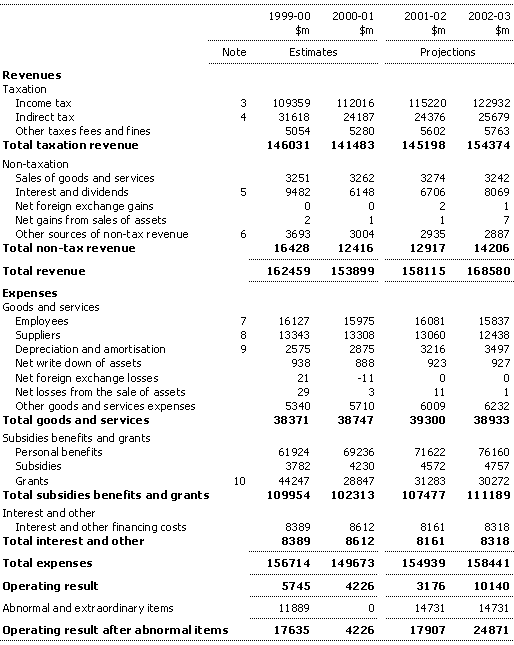
Table C2: Balance Sheet for the Commonwealth General Government Sector
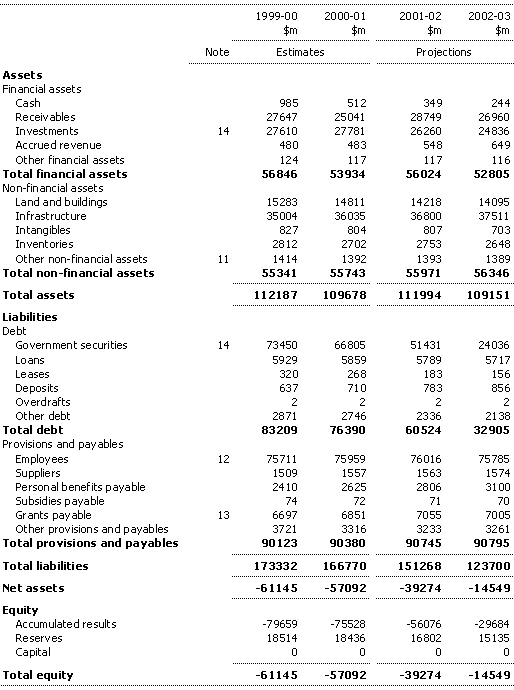
Table C3: Statement of Cash Flows for the Commonwealth General Government Sector
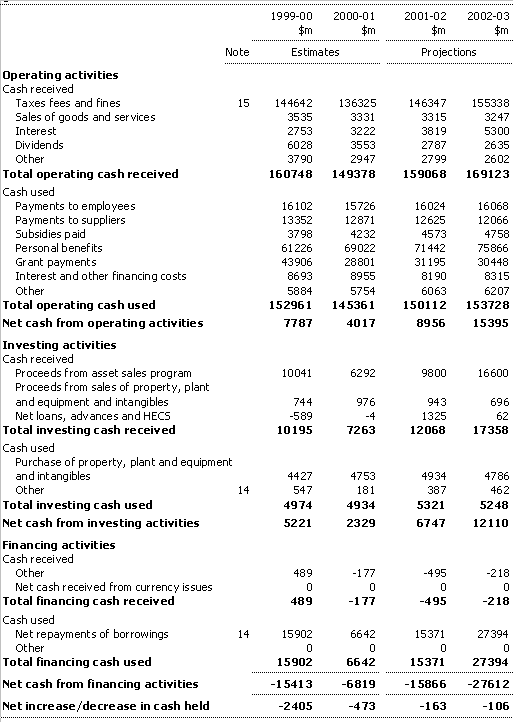
Statistics, Concepts and Notes to the Financial Statements
Note 1: External Reporting Standards
The Charter of Budget Honesty Act 1998 requires that the budget be based on external reporting standards and that departures from applicable external reporting standards be identified.
The 1999-2000 Budget financial statements have been prepared on an accrual basis in accordance with applicable Australian accounting standards, including Australian Accounting Standard No.31 Financial Reporting by Governments (AAS31). AAS31 is the relevant accounting standard for financial reporting by governments.
AAS31 requires the adoption of the full accrual basis of accounting. This means that assets, liabilities, revenues and expenses are recorded in financial statements when they have their economic impact, rather than when the cash flow associated with these transactions occur. Consistent with AAS31, an operating statement, a statement of financial position and a statement of cash flows have been prepared using estimates for the current year and the three forward years.
The accounting policies in this budget document are consistent with Australian accounting standards except for the following:
- While the scope for financial reporting required in AAS31 is the whole-of-government (that is, the Commonwealth public sector), the 1999-2000 MYEFO financial estimates cover the general government sector only. However, a whole-of-government approach for reporting financial outcomes is adopted in the Commonwealth’s Consolidated Financial Statements.
- In relation to revenue, AAS31 suggests revenue be recognised at the time the income (or economic activity) giving rise to a tax liability occurs, where this can be measured reliably. The Commonwealth does not consider its revenues can be reliably forecast on this basis. Revenue is therefore recognised at the time the relevant tax law indicates the existence of a requirement to pay an amount in tax or when a tax assessment is raised by the Australian Taxation Office (ATO) and the Australian Customs Service (ACS). That is, revenue is only recognised when the taxpayer makes a self-assessment or the ATO/ACS issues an assessment.
Note 2: Reconciliation of Cash
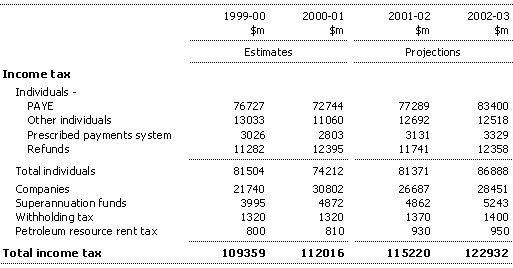
Note 3: Income Tax
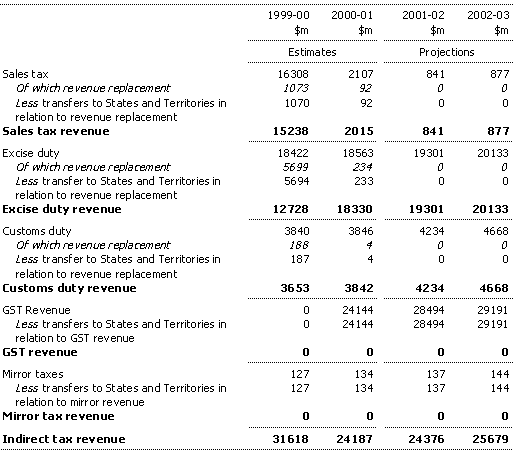
Note 4: Indirect Tax
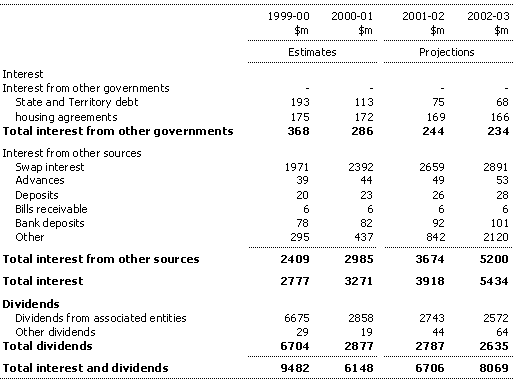
Note 5: Interest and Dividends
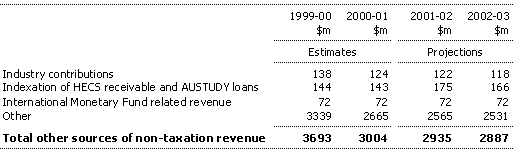
Note 6: Other Sources of Non-taxation Revenues
Note 7: Employee Expenses(a)
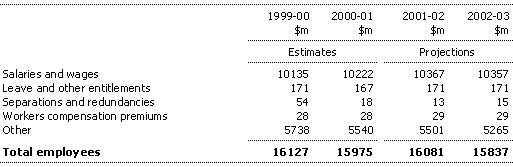
(a) Refer to Table D2 for components of general government superannuation expenses.
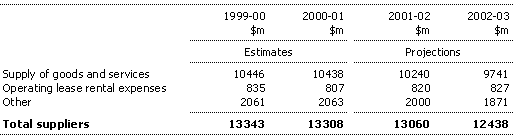
Note 8: Suppliers Expenses
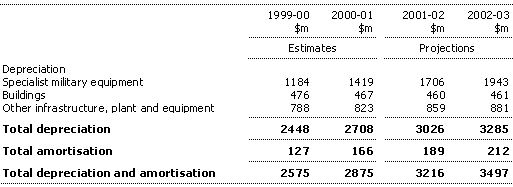
Note 9: Depreciation and Amortisation
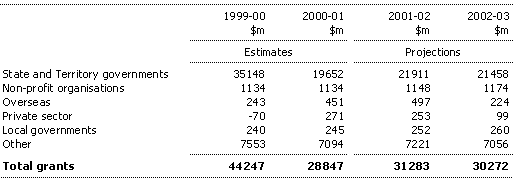
Note 10: Grants
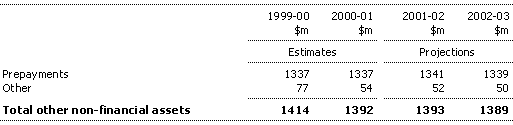
Note 11: Other Non-financial Assets
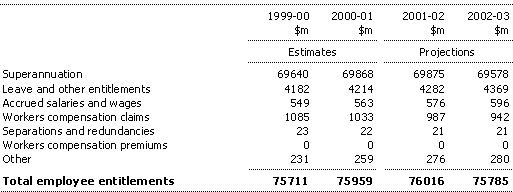
Note 12: Employee Liabilities
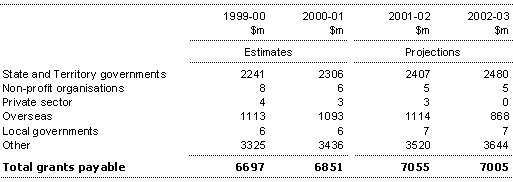
Note 13: Grants Payable
Note 14: Government Securities
Transactions relating to government securities and financial assets acquired for debt management purposes have been netted in the statements of financial position and cash flows. In the statement of financial position, the financial assets — investments category excludes financial assets acquired for debt management purposes, while the debt — government securities category is shown net of financial assets acquired for debt management purposes. Likewise, in the statement of cash flows, the investing activities — cash used — other category excludes cash used to acquire financial assets for debt management purposes while the financing activities — cash used — net repayment of borrowings category includes cash used to acquire financial assets for debt management purposes.
This netting treatment has been applied because of the considerable uncertainty associated with the split between government securities and financial assets acquired for debt management purposes. Debt management strategies in respect of government securities and financial assets are highly dependent on prevailing market conditions and other factors. The balance to be struck between gross debt retirement and financial asset acquisition can not be accurately estimated in advance.
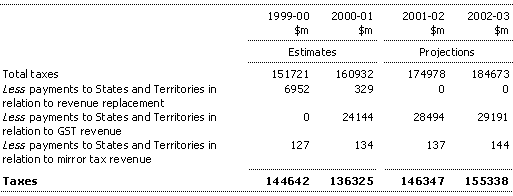
Note 15: Taxes
Statement of Risks
Overview
Full details of fiscal risks and contingent liabilities are provided in Statement 4 of Budget Paper No. 1 Budget Strategy and Outlook 1999-2000. The Statement of Risks presented in the MYEFO provides an update of that material, presenting changes to fiscal risks and quantifiable and unquantifiable contingent liabilities.
The forward estimates of revenues and expenses at the 1999-2000 MYEFO incorporate assumptions and judgements based on information at the time of publication. A range of factors may influence the actual budget outcome in future years. The Charter of Budget Honesty Act 1998 requires that these be disclosed in each Economic and Fiscal Outlook Report. This disclosure brings greater transparency to the fiscal projections.
Events that could affect fiscal outcomes include:
- changes in economic and other parameters;
- matters which have not been included in the fiscal forecasts because of uncertainty about their timing, magnitude or whether they will eventuate; and
- realisation of contingent liabilities.
Economic and Other Parameters
Some degree of uncertainty is attached to estimates of both revenues and expenses. While MYEFO estimates are prepared with the benefit of some revenue outcomes for the early months of the Budget year — which in general tend to reduce forecast errors — substantial uncertainties nevertheless remain. Moreover, the difficulties associated with such estimation will generally increase in accordance with extension of the forecast horizon over the forward estimates period. The sensitivity of the estimates to major economic parameters (but not other parameters) is discussed in Appendix B.
Fiscal Risks
Fiscal risks are general developments or specific events that may have an effect on the fiscal outlook. In some cases, the events will simply raise the possibility of some fiscal impact. In other cases, some fiscal impact will be reasonably certain, but it will not be included in the forward estimates because the timing or magnitude is not known. Fiscal risks may affect expenses and/or revenue and may be positive or negative.
Contingent Liabilities
Contingent liabilities differ from fiscal risks in that they are generally more readily quantifiable and clearly defined.
Contingent liabilities are defined as costs the Government will have to face if a particular event occurs. They include loan guarantees, non-loan guarantees, warranties, indemnities, uncalled capital and letters of comfort. The Commonwealth's major exposure to contingent liabilities arises out of legislation providing guarantees over certain liabilities of Commonwealth controlled financial institutions (ie the Reserve Bank of Australia (RBA) and the Export Finance and Insurance Corporation) and the now fully privatised Commonwealth Bank of Australia. Other substantial non-loan guarantees include guaranteed payments from Telstra Corporation Ltd to the Telstra Superannuation Scheme.
Details of Fiscal Risks and Contingent Liabilities
Fiscal Risks — Revenue
Tax Reform
Indirect Tax Changes
Legislation has been passed to introduce a GST from 1 July 2000 and thereby to abolish WST and a series of State and Territory taxes. Some fiscal risk may remain with regard to possible amendments to the tax reform legislation.
Review of Business Taxation
The Review of Business Taxation reported to the Government on 30 July 1999. On 21 September 1999, the Government announced that it would respond to the Review in two stages. The Government announced a package of measures on 21 September 1999 that will take effect from a range of dates. Rejection of, or significant amendments to, the legislation implementing these announced measures could significantly influence the fiscal impact of the announced package of reforms.
On 11 November 1999 the Government made a further response to the recommendations. In conjunction with its 21 September statement, measures announced by the Government will achieve overall revenue neutrality for business tax reform. See Appendix A, relating to revenue measures, for further details of measures announced in The New Business Tax System.
If the Government’s response is not adopted as set out in the two press releases, there could be a significant risk to revenue.
Specific Risks
There are also a number of specific risks to revenue that are currently the subject of ongoing analysis and evaluation by the Treasury and the ATO. Such risks include, for example, specific tax minimisation and avoidance schemes. Early detection and government response to such risks is desirable. It would be inappropriate to explicitly identify such current specific risks until the Government is in a position to respond to the risks. To do so may compromise the Government’s policy response and magnify the downside risks to the forward estimates of revenue.
The Government has announced a number of measures to date that have already been factored into the forward estimates of revenue but are yet to be passed by Parliament. Should the passage of legislation relating to these measures be delayed, amended or rejected, the forward estimates would need to be adjusted.
Sale of Telstra
Revenue from further sales of Telstra could be placed at risk if the necessary amendments to the Telstra Corporation Act 1991 are not enacted by Parliament.
Fiscal Risks — Expenses
The following items appeared in Budget Paper No. 1 1999-2000 Budget Strategy and Outlook. At MYEFO these items no longer represent risks to forward estimates of revenues and expenses.
- New South Wales University superannuation (Education, Training and Youth Affairs).
- Temporary safe haven for displaced Kosovars (Immigration and Multicultural Affairs).
The fiscal risks presented below are either reported for the first time at the 1999-2000 MYEFO, or have changed since their presentation at the Budget.
Communications, Information Technology and the Arts
Digitisation strategy of the Australian Broadcasting Corporation
The Government has agreed to cover, at the end of the five-year conversion period (ie until 2002-03), outstanding debt in relation to Phase 1 of the Australian Broadcasting Corporation’s plans for the conversion to digital broadcasting. That debt is currently estimated to be $32 million, increasing by $1 million since the 1999-2000 Budget.
Defence
Litigation cases in train — Department of Defence
The Department of Defence is involved in several cases covering a wide range of litigation where either the cases have not been heard, or damages and costs have yet to be awarded. The litigation involves Common Law liability and claims before the Human Rights and Equal Opportunity Commission, claims relating to HMAS Stalwart, HMAS Voyager, HMAS Melbourne, asbestos litigation, and alleged defective administration by the Department. In total there are now some 545 claims with a value of $104 million, increasing from 513 claims with a value of $92 million reported at the 1999-2000 Budget.
Peace operations in East Timor
The financial implications of this package will depend on a number of factors including: the unfolding security situation in East Timor; the timing of the transition from INTERFET to the UNTAET peacekeeping operation; the length of the UN peacekeeping operation and Government decisions in the context of the Defence White Paper regarding longer term force requirements.
Collins Class Submarines
Consequent to the Government’s acceptance of the McIntosh/Prescott Report, further remedial work to the Collins Class submarines is to be undertaken. The Government is considering options to achieve an agreed level of capability for the submarines.
Health and Aged Care
Australian Health Care Agreements
The Commonwealth and all the States and Territories have signed five-year Australian Health Care Agreements (AHCA) commencing 1 July 1998. The signed Agreements incorporate a risk sharing arrangement for changes in the private health insurance participation rate. Under this formula, a nationally consistent rise of one percentage point in the participation rate above a point midway between the March 1998 and June 1995 levels will reduce Commonwealth grants to the States and Territories by approximately $82 million a year from 1999-2000. Commonwealth grants will be increased by a similar amount from 1999-2000 if the participation rate falls by one percentage point below the December 1998 level (based on current estimates of movements in population, the hospital output cost index, and assuming that those leaving private health insurance have the same age/sex profile as those remaining).
In response to concerns relating to the impact of increased participation rates on the grants to the States and Territories, the Commonwealth has recently agreed to vary this risk sharing arrangement to guarantee that the States and Territories can not be worse off as a result of any increase in private health insurance participation rates. The details of this variation to the AHCAs are yet to be agreed.
The AHCA indexation arrangements also include provision for a default index of 0.5 per cent in the absence of agreement between the Commonwealth and the States and Territories on a suitable index for measuring changes in hospital output costs.
In accordance with the Agreements, this matter was referred to an independent arbiter. The final report from the arbiter was received on 28 October 1999 and recommended additional grant payments to the States and Territories. The Commonwealth is currently considering its response. For every one percentage point change (relative to the budget assumption of a 0.5 per cent increase), grants to the States and Territories will change in aggregate by approximately $60 million a year.
Major new listings—Pharmaceutical Benefits Scheme and Medicare Benefits Scheme
From time to time new items are added to the Medicare Benefits Scheme and Pharmaceutical Benefits Scheme schedules. Major new developments in medicines or medical procedures could result in increases in expenses that exceed the provision in the forward estimates.
Similarly, significant shifts in usage patterns, which may occur for particular drugs or groups of drugs from time to time, could result in increases in expenses that exceed the provision in the forward estimates. It is not possible to quantify the fiscal risk arising from such potential developments.
Immigration and Multicultural Affairs
Increased unauthorised arrivals
The recent surge in unauthorised arrivals by boat and the high risk of further arrivals in the short-term, presents a substantial resource risk arising from increased detention, processing and repatriation costs. The recent and prospective arrivals imply a detention requirement in excess of the current capacity of immigration detention infrastructure. This has necessitated the implementation of a range of temporary measures pending the development of plans for more permanent facilities to deal with ongoing requirements.
The Government has initiated a range of measures to limit its exposure to this risk, including a range of initiatives to combat people smuggling through greater cooperation with overseas Governments, increased penalties, deployment of additional compliance staff overseas, and increased coastal surveillance to detect unauthorised arrivals. More recently, the introduction of a Temporary Protection Visa for unauthorised arrivals found to have genuine protection needs, and legislative amendments to stop people who have effective protection overseas from gaining onshore protection in Australia, including through the development of proposals to enhance fingerprinting and other biometric identification tests, will also deter unauthorised entry to Australia. Given some of these initiatives are likely to take time to implement and be fully effective, the impact on unauthorised arrival numbers in the short-term is uncertain.
Transport and Regional Services
Maritime industry reform
On 18 August 1998 the Commonwealth provided a guarantee to cover borrowings made by the Maritime Industry Finance Company (MIFCo) to finance redundancy related payments in the stevedoring and maritime industries. MIFCo's borrowing facility, negotiated with its bankers, is presently $220 million (up from $155 million reported at the Budget). The Stevedoring Levy (Collection) Act 1998 has been amended to increase the expenditure cap in the legislation from $250 million to $300 million (reported as $350 million in the 1999-2000 Budget).
Treasury
Australia's involvement in the IMF assistance to Thailand, Indonesia and the Republic of Korea
In response to instability in regional financial markets and economies, Australia offered to provide bilateral financing in support of IMF programmes in Thailand, Indonesia and the Republic of Korea. In the case of Thailand, this has taken the form of a currency swap between the Reserve Bank of Australia (RBA) and the Bank of Thailand for up to $US1 billion available for draw down over a three-year period. In the event of default, the ability of the RBA to maintain the dividend stream projected in the forward estimates may be affected.
Australia also offered to provide supplementary financing or ‘second tier’ financing of up to $US1 billion for each of Indonesia and Korea. This financing would be provided via loans on a non-concessional basis. With the subsequent improvement in economic conditions in Korea, activation of its loan is not expected to be required. No money has been disbursed to Indonesia.
Financial Assistance to the Government of Papua New Guinea
The Commonwealth Government has offered financial assistance to Papua New Guinea (PNG) in support of its efforts to re-engage with the International Monetary Fund (IMF) and the World Bank. In the first instance, this assistance would take the form of a 90-day currency swap between the Reserve Bank of Australia (RBA) and the Bank of Papua New Guinea for the $A equivalent of $US80 million. This swap will provide short-term bridging finance until agreement can be reached between the PNG Government and the IMF on a Stand—by Programme (expected in early 2000). In the event of default, the ability of the RBA to maintain the dividend stream projected in the forward estimates may be affected.
The Government has indicated to PNG that it will consider providing a longer-term government-to-government loan (under the International Monetary Agreements Amendment Act — IMAA) once an IMF Stand-by Program is in place (expected in early 2000). This loan would help meet PNG’s external financing needs in 2000 and would be provided on a non-concessional basis, with a first call on the proceeds used to repay the short-term bridging facility.
Contingent Liabilities — Quantifiable
At the 1999-2000 MYEFO the following quantifiable contingent liabilities (reported at the 1999-2000 Budget) do not represent risks to the forward estimates:
- Commonwealth Loan Guarantees for the Abstudy financial supplement loan scheme (Education, Training and Youth Affairs); and
- Loans by the Australian Broadcasting Corporation and the Special Broadcasting Service, and indemnities relating to Art Indemnity Australia (Communications, Information Technology and the Arts).
The quantifiable contingent liabilities presented below are either reported for the first time at the 1999-2000 MYEFO, or have changed since their presentation at the Budget.
Agriculture, Fisheries and Forestry
Queensland Fisheries Management Authority
The Commonwealth guaranteed a loan of up to a maximum of $40.9 million to encourage the restructuring of the Northern Prawn Fishery. As at 29 July 1999, the amount outstanding on the loan was $1.6 million, which is to be finalised in January 2000. The loan was taken out by the Queensland Fisheries Management Authority on behalf of the Commonwealth to buy back surplus boat units from the fishery with repayment to be made by the industry through levies.
Communications, Information Technology and the Arts
Telstra Corporation Ltd — Superannuation Guarantee
Telstra Corporation Ltd has agreed to make additional employer contributions to the Telstra Superannuation Scheme. The Commonwealth has guaranteed that it will cover any outstanding additional employer contributions in the event that Telstra becomes insolvent. The net present value of the contingent liability in respect of the guaranteed stream of payments for the Telstra Superannuation Scheme as at 30 June 1999 was $1.0 billion.
Finance and Administration
ComLand Limited
Bank borrowings by ComLand Limited are explicitly guaranteed by the Commonwealth up to a limit of $60 million, comprising $50 million for principal and $10 million for accrued interest and other costs.
Foreign Affairs and Trade
Export Finance and Insurance Corporation (EFIC)
The Commonwealth guarantees the due payments by EFIC of money that is, or may at any time become, payable by EFIC to any person other than the Commonwealth. As at 30 September 1999, the Commonwealth’s total contingent liability was $7,612 million, comprising EFIC’s balance sheet liabilities ($1,183 million), contingent liabilities ($3,361 million) and national interest account liabilities ($3,068 million).
Industry, Science and Resources
Australian Industry Development Corporation (AIDC)
As at 30 June 1999, the Corporation’s contingent liabilities were $173.3 million in respect of guarantees and credit risk facilities. The Corporation’s other guaranteed borrowings totalled $1.6 billion as at 30 June 1999. These have been offset by holdings in Commonwealth Government securities and certain hedging instruments, all of which are fully guaranteed by Warburg Dillon Read (formerly known as UBS Australia Ltd.)
Australian Industry Development Corporation (AIDC) in relation to the Australian Submarine Corporation
The Commonwealth through the Australian Industry Development Corporation (AIDC) holds a 48.45 per cent interest in the Australia Submarine Corporation Pty Ltd (ASC). ASC is building 6 Collins Class Submarines for the Department of Defence (Defence). On 16 December 1998, at the request of the Corporation, the Commonwealth issued a guarantee for $26.6 million to back AIDC’s pro-rata shareholder obligations regarding the timely delivery of the Collins Class Submarines by ASC to Defence. A similar pro-rata guarantee was arranged by the other major shareholder, issued by its bank. The AIDC guarantee reduced to $13.3 million on 30 April 1999 and will terminate in full on 31 December 2001, subject to delivery of the final submarine.
Snowy Mountains Hydro-electric Authority (SMHEA)
The Snowy Mountains Hydro-electric Power Act 1949 provides that borrowings by SMHEA may be guaranteed by the Commonwealth. The Authority has issued inscribed stock at a discount to finance capital works of the Scheme. The borrowings are subject to explicit Commonwealth guarantees. As at 24 September 1999, the face value of guaranteed borrowings was $181.5 million with the net amount guaranteed (excluding the unamortised discount on the issue of inscribed stock) being $102.7 million.
Treasury
Guarantees under the Commonwealth Bank Sale Act 1995
Under the terms of the Commonwealth Bank Sale Act 1995, the Commonwealth has guaranteed various liabilities of the Commonwealth Bank of Australia, the Commonwealth Bank Officers’ Superannuation Corporation (CBOSC) and the Commonwealth Development Bank.
The guarantee for the Commonwealth Bank of Australia relates to both on and off-balance sheet liabilities. Of the existing contingent liability, 34 per cent involves off-balance sheet liabilities. As at 30 June 1999, the balance of the guarantee was $94,124.9 million, a reduction of $5,621 million on the previous year.
The guarantee for CBOSC covers the due payments of any amount that is payable to or from the Fund, by CBOSC or by the Bank, in respect of a person who was a member, retired member or beneficiary of the Fund immediately before 19 July 1996. Total accrued benefits at 30 June 1999 have been valued at $3,752.9 million following an actuarial review. The outstanding value subject to the guarantee is estimated to be $3,721.6 million.
As of 1 July 1996, the Commonwealth Development Bank ceased to write new business and no additional liabilities are being incurred. The existing contingent liability will gradually decline with the retirement of existing loans and exposures. The revised estimate for the balance of this guarantee was $272.6 million as at June 1999.
Reserve Bank of Australia (RBA) guarantee
This contingent liability relates to the Commonwealth’s guarantee of the liabilities of the RBA. The major component of RBA liabilities relates to Notes (ie currency) on Issue. This treatment of Notes largely relates to the historical convention of the convertibility of Notes to gold — coins are not treated as a liability in the Commonwealth's accounts. At 5 November 1999, Notes on Issue totalled $24,266 million.
In total, the guarantee for the Reserve Bank was $41,416 million as at 5 November 1999.
Uncalled Capital Subscriptions — international financial institutions
The liability relates to the value of the uncalled portion of the Commonwealth’s shares in the International Bank for Reconstruction and Development ($US2,769.5 million — estimated value $A4,198.7 million at 30 June 1999), the Asian Development Bank ($US2,413.5 million — estimated value $A3,656.82 million as at 30 June 1999), and the European Bank for Reconstruction and Development ($US81.7 million — estimated value $A123.8 million as at 30 June 1999).
Contingent Liabilities — Unquantifiable
Since the 1999-2000 Budget the Australian Federal Police (AFP) Adjustment Scheme (Attorney-General’s) has ceased to represent an unquantifiable contingent liability. The Government has decided to provide an equity injection to extinguish this liability. For further information refer to paragraph two of the expense measure in Appendix A (Revised Funding arrangements for the AFP Reform Programme and AFP Adjustments Scheme) in the Attorney-General’s portfolio.
Defence
HMAS Melbourne compensation
The decision in the Mewett v Commonwealth case may be used as a precedent by up to 954 crewmen of HMAS Melbourne, in relation to the Voyager incident, to lodge claims against the Commonwealth. Some 121 claims have been lodged to date, of which 107 are current claims. There are 6 identified dependant claims currently active and there is a possibility of further potential dependant claims, however there is no basis for quantifying further claims.
Finance and Administration
ComLand Limited — board members’ indemnity
Indemnities for directors of the ComLand group have been provided to protect against civil claims relating to employment and conduct as directors of ComLand Limited and its subsidiaries, St Marys Land Limited and Footscray Limited.
Transport and Regional Services
Tripartite Deed relating to the sale of Core Regulated Airports
Tripartite Deeds apply to the 12 Core Regulated Airports (Sydney, Melbourne, Brisbane, Perth, Canberra, Coolangatta, Townsville, Adelaide, Hobart, Launceston, Darwin and Alice Springs). The Tripartite Deeds between the Commonwealth of Australia, airport lessees and lessees' financiers provide for the Commonwealth to ‘step-in’ as airport operator in defined circumstances. The Deeds also provide protection to secured financiers where a lease termination event occurs. The potential liability of the Commonwealth would vary considerably with the specific factors leading to a lease termination. If the Commonwealth entered into possession of an airport site it could seek to recover its costs from a number of sources, including airport revenues, the Airport lessee company and potentially, from the financiers themselves.
Where the Commonwealth took action to terminate the Airport Lease, secured financiers can recover their loans from funds obtained by the Commonwealth from reselling the airport lease. If not resold, the Commonwealth and the financiers are to obtain a valuation of the airport lease that will set the basis for a repayment of financier’s loans by the Commonwealth.
Civil Aviation Safety Authority (CASA) — indemnity in relation to the Authority’s safety regulatory functions
Under a Deed of Agreement, CASA was indemnified against the claims incurred in carrying out its responsibilities for aviation safety regulation. This indemnity was subject to an annual renewal on payment of an annual premium by CASA to the Commonwealth. This indemnity expired on 5 July 1998 and CASA has replaced this arrangement with commercial insurance. The Commonwealth is obliged to continue to indemnify CASA in relation to liabilities associated with acts or omissions that occurred before the date of expiry of the Deed of Agreement.
Australian National Railways Commission (AN) — transfer of legal actions and contingent liabilities to the Commonwealth
As a result of the wind-up of the Australian National Railways Commission later this year, all associated contracts, assets and liabilities will become the responsibility of the Commonwealth. At this point, it is not possible to quantify liabilities as they involve uncertain legal processes and ex-employee claims.
Australian Maritime Safety Authority (AMSA) — insurance claims
AMSA is subject to a professional negligence claim seeking unspecified damages arising from a search and rescue incident involving the loss of one life. The flotation device manufacturer is a second defendant. The claim is being defended, however, it is not possible to estimate the amounts of any eventual payments that may result.
The insurer has indemnified AMSA although AMSA will be liable for any policy excess.
Australian Maritime Safety Authority (AMSA) — incident costs
In the normal course of operations, AMSA is responsible for the provision of funds necessary to meet the clean-up costs arising from ship-sourced marine pollution. The Commonwealth has agreed that AMSA’s responsibility should be limited to a maximum outlay of $10 million. AMSA has arranged a standby loan facility for this purpose.
In the event costs exceed that limit, funds will be provided by the Commonwealth. In all circumstances, the Authority is responsible for making appropriate efforts to recover the costs of any such incidents.
National Capital Authority (NCA)
The NCA is currently exposed to several claims, the financial risks of which are unquantifiable pending their resolution. There are three personal injury claims relating to its Land Management Function, two relating to contract disputes and a defamation action.
Treasury
Housing Loans Insurance Corporation (HLIC)
Indemnities were issued to certain directors of HLIC to indemnify them against all claims and losses, including legal costs incurred by the director in relation to his or her capacity as a member of HLIC. The indemnities are ongoing.
HLIC Limited
An adviser to the sale of HLIC Limited was appointed as an agent of the Commonwealth on 4 December 1996 and, as a result, was extended ongoing protection against all losses and liabilities sustained in lawfully carrying out the Commonwealth’s instructions.
On 14 December 1997, a number of indemnities were issued to GE Capital Australia indemnifying GE Capital from claims made in relation to and/or losses arising from: redundancy by terminated transferred employees; pre and post sale superannuation entitlements by transferred employees; breach of warranties, pre-closing liabilities and/or breach of Agreement; pre-transfer date insurance contracts; pre-transfer date tax liabilities; and audit costs regarding pre-closing financial affairs of HLIC Limited. Any claims are subject to a cap of the sale price.